
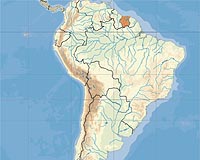
Suriname, which holds general elections Monday, is the smallest country in South America but has big problems related to drug trafficking, money laundering and illegal gold mining.
– Amazon blanket –
Nearly all of the country's 164,000 square kilometers (63,300 square miles) is covered by the Amazon rainforest, from its Atlantic coast to the southern border with Brazil.
– Ethnically diverse –
Roughly 90 percent of the population is concentrated along a coastal plain, mainly in the capital Paramaribo. People are mostly descendants from Hindustani Indians, Creoles, Javanese, "Maroons" who came from Africa as slaves, Amerindians, Chinese, and Dutch settlers. Almost half have Christian roots, but Hindus and Muslims constitute sizeable minorities.
– Dominant mining sector –
Per capita revenue stood at $9,270 in 2013 according to World Bank data, and the country's total output amounted to almost $5.3 billion, putting it in the bank's upper middle income range.
Mineral resources represent key sources of revenues, with bauxite, gold and oil accounting for 30 percent of the total.
A drop in bauxite prices in the 1990s led to a focus on the gold mining and timber sectors, and licenses granted to foreign companies resulted in widespread deforestation.
Gold deposits have attracted thousands of legal and illegal miners, and the country's waterways have been polluted by mercury used in the process.
In December 2014, the World Bank launched an economic partnership program designed to make growth less dependent on the mining sector.
– Government led by Desi Bouterse –
Five years after gaining independence in 1975, power in the former British and Dutch colony was seized by Desi Bouterse, an army sergeant who led military dictatorships from 1980-1987 and 1990-1991.
In 2010, Bouterse's election as president protected him from an Interpol arrest warrant issued after a Dutch court sentenced him to 11 years in prison for cocaine trafficking.
In 2012, an amnesty law granted him immunity from prosecution for the murder of 15 political opponents in 1982.
In March this year, his son Dino was sentenced to 16 years in prison by a New York court after he pleaded guilty to arms and cocaine trafficking and providing support for Hezbollah, a Shiite Muslim group designated by the United States as a foreign terrorist organization.
