
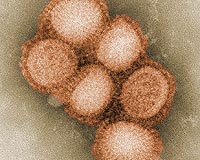
Argentina reported a sharp spike in deaths from swine flu as cases jumped across Latin America and more countries worldwide coped with their first fatalities.
In Geneva, the World Health Organization (WHO) on Thursday moved to assuage safety concerns over vaccines for pandemic influenza as nations geared up for massive campaigns to try and protect millions of people from the virus.
Argentinian officials said deaths from A(H1N1) had more than doubled to 337 from 165 two weeks ago, which puts the country second only to the United States with 353 confirmed deaths.
"We have confirmed 337 deaths by A(H1N1) flu," Argentina's deputy health minister Maximo Diosque said on Wednesday.
"We have a similar number, of around 400 cases, that are in the process of being confirmed," he said, adding that more than 700,000 of the 763,000 flu cases detected in the country were A(H1N1).
Mexico, the epicentre for swine flu, also reported a sharp increase in cases after an apparent easing in recent weeks had seemed an encouraging sign that the worst might be over for the moment.
Many experts fear that while swine flu causes relatively mild symptoms in most healthy adults, it could easily mutate into a much more severe strain, especially during the northern hemisphere winter when the flu usually takes its greatest toll.
Thus far, pregnant women and young adults are reported to suffer the most from swine flu, alongside people with serious underlying health problems.
While the death toll in Mexico remained unchanged at 146, the health ministry said almost 1,000 fresh cases had been confirmed in just five days, taking the total soaring above 17,000.
Since the virus first emerged in Mexico in April, it has spread globally, reaching pandemic level and affecting nearly every country in the world, according to the WHO.
The UN body said Wednesday that its tally of swine flu deaths had risen to 1,154 from the 816 announced on July 27, and the illness was now found in 168 countries and territories.
So far, the Americas have been hit hardest with nearly 90 percent of all reported swine flu deaths.
Some experts are describing the global effort to produce and distribute a new A(H1N1) vaccine before the northern fall-winter period as the largest of its kind in history.
On Thursday the WHO posted a statement on its website seeking to assure the public "that regulatory procedures in place for the licensing of pandemic vaccines, including procedures for expediting regulatory approval, are rigorous and do not compromise safety or quality controls.
"Vaccines are among the most important medical interventions for reducing illness and deaths during a pandemic," WHO said. "However, to have the greatest impact, pandemic vaccines need to be available quickly and in large quantities."
As of July 31, Azerbaijan, Gabon, Grenada, Kazakhstan, Moldova, Monaco, Nauru, Swaziland, and Suriname joined the list of infected.
The Netherlands and Vietnam joined the growing list of countries with fatalities from the pandemic, while three new deaths each, not yet confirmed by the WHO, were reported on Tuesday in Costa Rica and in El Salvador, and on Wednesday two more in Ecuador and one more in Israel.
Peru has reported five deaths since Tuesday, raising its total to 35, while Chile's death toll from the virus stood at 87.
Health authorities in three states in Brazil confirmed 40 new deaths from the virus, bringing the country's death toll to 131.
Greece reported Wednesday that A(H1N1) cases surged by 272 in the past week, bringing the total number of people infected to nearly 1,000 in the country.
There were two deaths in Saudi Arabia while in war-torn Iraq the authorities quarantined a hotel in the holy Shiite city of Karbala after a Saudi pilgrim staying there tested positive for swine flu.
Iran on Wednesday imposed a ban on all pilgrimages to the Muslim holy places in Saudi Arabia during the fasting month of Ramadan, the latest move by some Muslim countries retricting the pilgrimages amid fears about the risk of swine flu contagion if large numbers congregate there and then return home.
India and South Africa had both reported their first fatalities from the A(H1N1) virus late on Monday.
Panic-stricken Indians queued outside hospitals Thursday in the western city of Pune as residents rushed to be tested after the Monday report.
earlier related report
WHO emphasises safety of pandemic flu vaccines
The World Health Organisation moved to reassure the public about the safety of pandemic flu vaccines on Thursday, emphasising that rigorous precautions were taken despite the speed of their development.
"The public needs to be reassured that regulatory procedures in place for the licensing of pandemic vaccines, including procedures for expediting regulatory approval, are rigorous and do not compromise safety or quality controls," said the UN health agency on its website.
Although many national regulators had fast-tracked procedures for approval, the swine flu vaccine was built on the same technology used to produce vaccines for frequently changing strains of seasonal influenza, it said.
The streamlined process was established in the WHO's 2007 pandemic preparedness plan, agreed by health experts, regulators and vaccine makers to ensure that a flu vaccine for a pandemic strain was available quickly and in large quantities.
"During the 1957 and 1968 pandemics, vaccines arrived too late to be used as an effective mitigation tool during the more severe phases of the pandemics," the WHO said.
Influenza vaccines were not available in the deadliest flu pandemic on record in 1918, when Spanish flu killed an estimated 50 million people.
The WHO advised all countries to carry on intensive testing and monitoring of vaccines even after they start to be administered.
While some serious adverse effects had been reported over the 60 years that flu vaccines have been used "these have been rare", it said.
Nonetheless, the WHO said "special safety issues will inevitably arise during a pandemic" because of the massive scale on which a vaccine would be administered.
"For example, adverse events too rare to show up even in a large clinical trial may become apparent when very large numbers of people receive a pandemic vaccine," the WHO added.
Countries have been ordering tens of millions of doses of vaccine for the A(H1N1) virus for mass vaccination campaigns, while clinical trials are usually carried out on thousands of volunteers.
The trials have began in Australia, Britain, China, Germany and the United States, WHO's director of vaccine research Marie-Paule Kieny said.
Malaysia's swine flu-related deaths jump by 8 to 26: reports
Malaysian health authorities on Sunday announced a further eight swine flu-related fatalities, bringing the country's death toll in connection with the virus to 26, according to media reports. The latest deaths included a 20-year-old girl, a college student, who died in a hostel after being given outpatient treatment, the Star and New Straits Times websites quoted Health Minister Liow Tiong Lai as saying. "The latest eight deaths happened between August 3 and August 8 but we could only confirm that they died of influenza A after getting post-mortem results," Liow told New Straits Times. Malaysia has seen a surge in cases of influenza A(H1N1) over the past few weeks, and Prime Minister Najib Razak has urged the public to refrain from attending mass gatherings unless necessary. Health authorities said they are monitoring the situation to decide whether to proceed with National Day celebrations end of this month, which some 47,000 people are expected to attend, according to state news agency Bernama. On Thursday, the health minister warned that haze from forest fires that was shrouding parts of Malaysia would worsen the swine flu situation by causing more respiratory illnesses. The haze reached "unhealthy" levels in six locations in Malaysia on Wednesday but air quality had improved somewhat on Sunday.
"We expect more clinical trials to start in the days to come," she said, adding that first results of the trials should be collected in September.
Regulators will then have to approve the vaccine before it would be made available to the public.
If regulators were to approve the vaccine "in September, then it is possible that some countries (will) start vaccinating in September," said Kieny.
She said that manufacturers have reported that vaccine virus strains are currently generating "disappointing" yields.
Yields are now just between a third or half of what is usually obtained in a seasonal strain, meaning that this could result in a reduction in production capacity of the vaccine.
A recent batch of vaccine viruses produced appears to contain a strain which seems to be getting equivalent yields as the seasonal vaccine, said Kieny.
"I don't want to say too early that the question has been resolved but it really means that we have found a way to go around the problem," she said.
Share This Article With Planet Earth
