
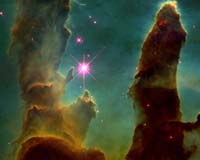
After 11 days, NASA engineers on Friday were able to activate the Hubble Space Telescope's Advanced Camera for Surveys, prompting huge sighs of relief among astronomers around the world.
The powerful camera – which comprises three electronic cameras, filters and dispersers that detect light from ultraviolet to near infrared wavelengths – had experienced an electronics problem on June 19 that caused the instrument to place itself automatically in a safe mode.
Engineers at NASA's Goddard Space Flight Center were able to activate a backup electronics system Friday that responded and returned the instrument to full operational status on Sunday.
"This is the best possible news," said Ed Ruitberg, deputy associate director for Goddard's Astrophysics Division, which manages the space telescope's operation. "We were confident we could work through the camera issue, and now we can get back to doing more incredible science with the camera."
Over the past four years, the ACS – which was installed aboard the Hubble by space shuttle astronauts in 2002 – has produced some of the most dramatic images of astronomy in history. Perhaps most famous was the camera's image of the Eagle nebula, now known as the "Pillars of Creation."
At a news briefing Friday, Ruitberg told reporters that despite the disruption in operations, there were no "irretrievable losses" of observational opportunities, and other Hubble activities continued on schedule using the Wide Field Planetary Camera 2 and the onboard spectrometer.
Engineers had begun uploading commands to the ACS on Thursday in an effort to restore operational status. The problem had begun on the 19th when they detected that the camera's power-supply voltages had exceeded acceptable limits.
