
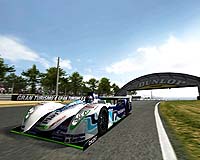
PlayStation users worldwide can now see for themselves what happens when Ariane launcher technology is applied to Le Mans racing. All they have to do is sit back and select which Pescarolo racing car they want to test-drive.
Gran Turismo 4, a new PlayStation 2 game, features the two custom-built top-performance Pescarolo racing cars that took part in the Le Mans endurance race in 2003 and 2004. Both were constructed using technologies developed for European space programmes.
"In 2003, our victories in Portugal and France, second place in Spa and our great performance at the 24-hours race of Le Mans proved that the technological contributions from ESA were effective," said Henri Pescarolo.
Andre de Cortanze, Technical Director of Pescarolo Sport team said, "having a lighter body made with material developed for space made it possible for us to optimise weight distribution, resulting in improved overall car performance".
To play the game you choose which Pescarolo racing car to drive:
the 2003 Pescarolo Sport Courage C 60/Peugeot Race Car with a 3.2 litre V6 twin turbo supercharged Peugeot engine designed for endurance racing
the 2004 Pescarolo Sport Courage C 60/Judd Race Car with a V105-litre Judd engine
Then select from the different options, such as choice of suspension, tyres and manual or automatic gearbox.
The 2003 version can deliver up to 519 hp at 6900 rpm. In the 2003 International Automobile Federation (FIA) Sportscar Championship the car won at Estoril in Portugal and at Nogaro in France, and came second at Spa in Belgium.
At Le Mans, in the June of 2003, the car came eighth out of 50 entries.
The 2004 version can deliver up to 591 hp at 7000 rpm. This car came fourth both at Monza in Italy and at the 2004 Le Mans. On both occasions it was only beaten by its Audi rivals.
Space technology helps
In December 2002 ESA's Technology Transfer Programme formed a partnership with Pescarolo Sport to identify and provide innovative technologies first developed for space for use in endurance racing cars. The priorities were security, reliability and performance.
Performance to weight ratio is vital in car racing and high-tech carbon composite materials – used by ESA to build satellites – were used for the 2003 Pescarolo sports car in preparation for that year¿s racing season. The use of this lightweight yet very strong material reduced the car¿s weight by almost 30 kg.
To improve safety, thermal shields similar to those used on Europe's Ariane launcher were placed between the engine and the fuel tank to protect it from fire hazards.
The 800¿ C hot exhaust system was insulated by quartz-felt, used on the Ariane launchers to increase both safety and turbo-compression performance.
Andre de Cortanze, Technical Director of Pescarolo Sport team, says: "The near 30 kg reduction in the car¿s weight enabled us to locate weight optimally for better overall handling. On a four km test circuit we gained one second with the 30 kg lighter car; as the Le Mans circuit is 13 km we gained 4.25 seconds per lap."
The drivers were also pleased with the improved car. "It was much better in 2003 than in 2002 as the car was much lighter," said Pescarolo driver Frank Lagorce, after the 2003 Le Mans race.
In 2004, an additional eight kg were saved by using the composite materials designed for space for more body parts. In total, an amazing 38 kg weight reduction has been achieved and the heat protection shield designed for the Ariane launcher has also helped to improve performance.
"Heat protection is essential," explained Andre de Cortanze, "it not only improves safety but it also helps the car to run. The engine produces a lot of heat and as this affects performance we need to add lots of insulation. This is much easier to do with products developed for space."
New technology originating from earlier space development was also used for the car¿s wheel bearings. A special hybrid construction of stainless steel rings and ceramic balls was made using spin-off technology from the gyroscopes developed for satellites.
Making cars safer
