
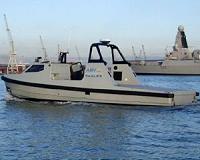
Thales and ASV have signed an agreement to cooperate on the development of unmanned surface vehicle technology.
The announcement by the two companies to collaborate on the development follows the completion of sea trials for ASV's Halcyon unmanned surface vehicle. The vehicle is designed for both civil and military purposes.
"Thales has already delivered world leading autonomous capability with the Halcyon USV," Thales UK Maritime Mission Systems managing director Phil Jones said in a statement.
"This agreement will allow us to build on this success to deliver the future autonomous requirements of our customers."
The Halcyon was designed and built by ASV to provide high-speed transit and maneuverability. The vehicle is fitted with a Thales-made mission system, enabling its autonomous capability. Company officials say the agreement will move the program forward.
"Pairing ASV control system technology with Thales sensor and software capabilities combines both specialist expertise and unrivaled experience in creating and using these systems," ASV managing director Dan Hook said.
The companies are collaborating on the French-U.K. Mine Countermeasures contract, which aims to improve mine countermeasure capabilities during naval operations.
Air Force orders more Predator/Reaper training simulators
Arlington, Texas (UPI) Jan 27, 2016 –
L-3 Link Simulation & Training reports it is building 34 new Predator Mission Aircrew Training System simulators for the U.S. Air Force.
The new Predator simulators come from the service's exercise of a contract option.
The new PMATS simulators — plus associated equipment and systems — will be delivered to 15 Air Force and Air National Guard installations to train Predator and Reaper pilot and sensor operator crews.
"The U.S. Air Force's and U.S. Air National Guard's requirements for MQ-1 Predator and MQ-9 Reaper pilots and sensor operators continue to grow, and the skills needed to complete an expanding set of missions are increasingly complex," said Frank Casano, L-3 Link's vice president of programs.
"These training devices will provide an unparalleled level of realism and immerse both new and experienced crews in challenging training scenarios based on today's mission requirements."
L-3 Link PMATS simulators were initially delivered in 2007.
