
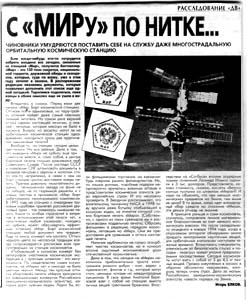
An article recently published in a popular Russian Daily, The Trud (the Labour), quotes unnamed Russian cosmonauts, all, at one time, having lived on the station, as saying that there is at least one counterfeit copy of the official Mir Station's on-board seal.
In the pictures provided, some discrepancies are evident between the matched pair of seals, one authentic and another forged having never been to space.
There is no particular legislation on the use of the seals on the station, and any cosmonaut, while onboard, could stamp just about anything he wished – envelopes, books, tapes – turning the ordinaryinto meaningful and valuable auction items. The signatures of the Mir's crew members traditionally follow a black-coloured imprint.
"Any item "from Mir", stamped by a red-coloured seal and not being signed by the crew is a fake" warn the cosmonauts. "There just has never been other ink on Mir but black."
Nevertheless, a red-coloured seal embellishes official Russian Aviation and Space Agency's (RAKA) envelopes having been given to prominent guests ranked from a military attach¿ to a foreign space agency's representative.
In 1998 even a high-ranking NASA official was allegedly awarded with the bottle of "just returned from space" Russian vodka tattooed with the false Mir Station seal.
"Neither cosmonauts, nor the cash-strapped Russian space industry can benefit from this situation," says The Trud. The recent bidding at Christie's has proved that space memorabilia is establishing a strong collecting category. Obviously, the fewer space items there are, the higher prices are garnered at the auctions.
More than 300 kg of the miscellaneous potential space memorabilia, presently on Mir, might well contribute to keeping some Russian space programs afloat, if not being contested by fakes.
Apparently, there has been a sort of smuggling with the cosmonauts allowed to take to/from orbit 3 to 4.5 kg of personal belongings. The cosmonauts alledgedly tried to make a bit of money by bringing space memorabilia back to earth. But since January 1994, when more than 30 kg of unauthorized extra payload was detected in the returning capsule, the regulation has been substantially tightened.
"There is strict control by the RAKA over operations in space. It just should maintain the same level of strictness on earth" urges The Trud.
