
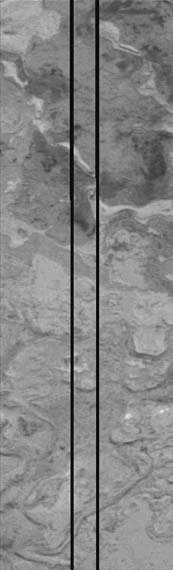
Lava flows similar to those found in Hawaii are seen in the black and white image at top, taken by NASA's Galileo spacecraft. It is one of the highest resolution images (7 meters or 23 feet per picture element) ever obtained of Jupiter's volcanic moon Io. The two horizontal black stripes are places where data were lost during transmission to Earth.
The image shows the textures of lava flows on the floor of the caldera Chaac, which is shown in false color at lower resolution (185 meters or 607 feet per pixel element) in the bottom image.
Calderas are depressions caused by collapse during volcanic eruptions. The one shown here is approximately 100 kilometers (63 miles) long and 30 kilometers (19 miles) across.
Using shadow lengths from the new high-resolution observations, the northeastern (upper right) scarp, or line of cliffs, has been estimated to be 2.8 kilometers (9200 feet) high.
The lava flows are similar in texture to lava flows within the caldera at Hawaii's Kilauea volcano. This suggests that the floor of Chaac has been covered by a combination of lava flows and lava lakes.
The light-colored material surrounding the caldera may be composed of sulfur-dioxide frost or some other sulfur-rich material on the surface of Io.
Galileo scientists believe that the greenish color on the caldera floor is a form of contaminated sulfur created when sulfur-rich material escaping from volcanic vents reacts chemically with warm lava flows. The high-resolution view shows numerous lava flows.
