
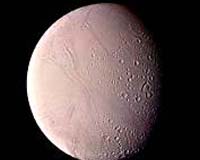
Many of Saturn's more interesting moons are crusted with ice. The moons are often too small for a radioactive core and internal heating. The bizarre wrinkled surface on one of the moons, Enceladus, may reveal a geologically young age.
Enceladus is covered with bright water ice. The part of its surface visible here appears to be largely free of craters – indicating that it is geologically young.
The first close imaging of this moon will be done by Cassini in February 2005 and should reveal many surprises. Enceladus has a diameter of 499 kilometers (310 miles).
This view shows primarily the leading hemisphere of Enceladus. The image has been rotated so that north on Enceladus is up.
The image was acquired with the Cassini spacecraft narrow angle camera on Jan. 15, 2005, at a distance of approximately 367,000 kilometers (228,000 miles) from Enceladus and at a Sun-Enceladus-spacecraft, or phase, angle of 74 degrees.
According to the standard view of Enceladus: 'At least five different types of terrain have been identified on Enceladus. In addition to craters there are smooth plains and extensive linear cracks and ridges. At least some of the surface is relatively young, probably less than 100 million years. This means that Enceladus must have been active until very recently (and perhaps is still active today). Perhaps some sort of "water volcanism" is at work. '
'Enceladus is much too small to be heated by the decay of radioactive material in its interior at present (the heat would have all dissipated long ago). Enceladus is locked in a 1:2 resonance with Dione (similar to the situation between Io and Europa). This may provide a heating mechanism but it is probably insufficient to melt water ice. Enceladus may therefore be composed of some low-melting point material rather than pure water.'
Condensed ices give many of Saturn's moons very high albedo (reflection coefficients) but some are mottled with darker regions that may be rich in organic chemicals like methane or ammonia. These building blocks for primitive biochemistry may offer insight into how a similar, but much warmer environment on Earth, might have given rise to primordial life.
Cassini will make close
