
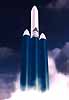
Thiokol Propulsion and Howmet International, operating units of Cordant Technologies Inc., are providing their own boost to Boeing's Delta IV launch vehicle family for the next generation Expendable Launch Vehicles (ELVs).
Thiokol Propulsion and Howmet are supplying a significant portion of the low-cost RS-68 engine components, which will be the most powerful oxygen/hydrogen engine in the world — 50 percent more powerful than the Space Shuttle's Main Engine (SSME). Thiokol Propulsion is supplying the exit cone with an ablative design, while Howmet is supplying castings for several key fuel and liquid oxygen (LOX) turbopump components.
Thiokol Propulsion has applied its experience as the world's largest solid
rocket motor company to the design of the RS-68 exit cone. The exit cone is comprised of phenolic materials. This design substantially reduces
manufacturing time and cost. Thiokol's simple four piece ablative design
replaces the previous complex, multi-piece exit cone design.
Howmet has worked extensively with Boeing over the last four years to
concurrently engineer rocket hardware for the RS-68 program at Howmet's
facilities in Hampton, Virginia and LaPorte, Indiana. Early supplier
involvement and teamwork culminated in the delivery of complex, large
structural castings for the RS-68 engine.
Howmet is producing eight large structural castings, such as those for the
LOX and fuel turbopumps, gas generator and blisks; and four smaller, yet
complex castings, such as those for fuel and LOX stators and blisks. The fuel pump volute is the largest RS-68 casting. At over 650 pounds, this casting replaces more than a dozen subassemblies and has features that could not have been incorporated in the previous assembly design.
Combined, Thiokol Propulsion and Howmet International have reduced the
number of parts and processing steps substantially. Fewer parts and
simplified designs yield lower life cycle costs, and better performance and reliability for the RS-68 engine.
