
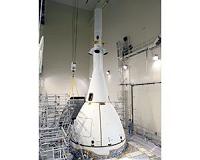
After plans to move Orion were nixed on Monday as a result of strong winds and lightning storms, the future of NASA's manned missions was relocated to its new home atop a Delta IV Heavy rocket at Space Launch Complex 37.
The spacecraft's journey began at 8:30 Tuesday night, as engineers wheeled the 46,848-pound vehicle out of the Launch Abort System Facility at NASA's Kennedy Space Center. Roughly six hours later the craft NASA hopes will one day take astronauts to Mars arrived at launch pad 37B.
#Orion has arrived at the launch pad. Getting ready for lift operations. pic.twitter.com/Lckx3IYnXG— Orion Spacecraft (@NASA_Orion) November 12, 2014
For space fans who don't have six hours to watch a spacecraft (however historic it may be) move slowly from point A to point B, NASA has condensed Orion's travels into a roughly minute-long time-lapse video.
Now, Orion will rest for three weeks at its new launch pad home, as it is fine-tuned and prepared for its first test flight, an unmanned mission to low Earth orbit.
Scheduled for December 4 takeoff, Orion will launch through the atmosphere to an altitude of roughly 3,600 miles. After circling the globe twice the capsule will fall back to Earth and splash into the Pacific Ocean. Upon re-entry, Orion will zip through the upper atmosphere at a speed of 20,000 miles per hour. An elaborate parachute system will ensure that number is considerably lower when the craft hits the water.
The brief 60,000-mile journey will allow scientists to take a number of readings and measurements — ensuring Orion will hold up under the stresses of longer, more demanding missions.
