
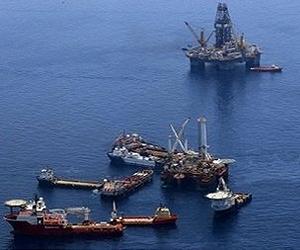
BP offered little insight Saturday as to whether its latest effort to plug a disastrous Gulf of Mexico leak would work, as local officials sought million of dollars from the oil giant.
BP Chief Operating Officer Doug Suttles said engineers were still feeding heavy drilling fluid into the leaking well head, hoping to overcome it and ultimately seal it with cement, but that the results would not be clear for at least another day.
"To date it hasn't yet stopped the flow. That's what I do know," he said at a press conference Saturday.
"What I don't know is if it ultimately will or not. We're going to keep at this until we either believe we see it work or we believe it won't work and then move to the next option."
The efforts continued a day after President Barack Obama visited the region for the second time since the oil spill began in April, in an attempt to bring new urgency to the response.
Obama toured some of the affected areas in Louisiana on Friday and pledged "to continue to do whatever it takes to help Americans whose livelihoods have been upended by the spill."
Obama said he would triple the number of workers clearing up soiled beaches, after he saw the effects of the spill up close, picking up and examining tar balls that washed ashore in Louisiana.
"I'm here to tell you that you're not alone. You will not be abandoned. You will not be left behind," he promised to local residents.
"We are on your side and we will see this through."
Since the oil spill began, after an April 20 explosion tore through the Deepwater Horizon rig killing 11 workers, an estimated 12,000 to 19,000 barrels of crude a day have been gushing into the Gulf.
BP has sought to assure locals and the government it is doing all it can to stop the spill, but the depth of the leak — some 5,000 feet (1,500 meters) below the surface — and the environmental damage already apparent has left many furious at the firm.
On Friday, Admiral Thad Allen, the former Coast Guard commandant charged with overseeing the spill response, said initial signs suggested the "top kill" was working.
"They have been able to push the hydrocarbons down with the mud. The real challenge is to put enough into the well to keep the pressure where they can put a cement plug over the top," he said on ABC's "Good Morning America."
But The New York Times said Saturday that the bid was marked by "an apparent lack of progress," and suggested that officials might soon move to their next available option: a containment dome that could capture the leaking oil.
The disaster has already closed stretches of coastal fishing waters, endangering the seafood industry and tourism businesses, and threatening a catastrophe for Louisiana marshes, home to many rare species.
Government data released Thursday suggested between 18.6 million gallons and 29.5 million gallons of oil have poured into the Gulf — far more than the roughly 11 million gallons of crude spilled in the 1989 Exxon Valdez disaster.
Amid the environmental catastrophe, there were also growing fears for the health of cleanup workers exposed to the oil and chemical dispersants.
Four more crewmen aboard ships helping burn off surface oil were evacuated to hospital late Friday after falling ill, a day after the US Coast Guard announced that seven workers were evacuated for medical emergencies.
On Saturday, Louisiana state officials called on BP to create a 300-million-dollar fund to mitigate the immediate and long-term impact of the spill on businesses and local residents.
State agencies also sent a letter to the British oil giant seeking another 457 million dollars to fund a 20-year seafood safety plan, warning that "the future of this industry is in peril."
Obama said Friday that 910,000 meters (three million feet) of hard boom had already been deployed in an effort to stop the oil spill reaching wetlands and beaches. But he admitted "there's a limited amount" available and it "may take some time" to manufacture more.
The commander of a federal research ship who spent five days out at sea on the edges of the slick said a heavy smell of oil hung over the area.
"It's a strong smell out there," said commander Shepard Smith of the Thomas Jefferson, a 204-foot survey vessel.
BP said Friday the oil spill had cost the firm about 930 million dollars, while the company's market value has also dropped by billions.
burs-sah/mlm
Share This Article With Planet Earth
