
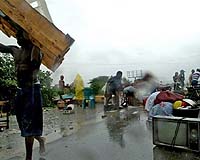
Tropical Storm Noel lashed Hispaniola and Cuba with heavy rainfall, and on the morning of Halloween, Oct. 31, Noel exited Cuba and is headed to the Bahamas. At 11:00 a.m. EDT on Halloween, Tropical Storm Noel re-strengthened after moving off the northern coast of Cuba and into open waters. The Bahamas are now expecting the ghoulish storm to hit on Thursday, Nov. 1. Noel is already responsible for at least 30 deaths, according to reports.
Halloween morning has brought tropical storm warnings in effect for the central and northwestern Bahamas. Southern Florida is also keeping an eye on Noel as the storm's wind field approaches, and the current wind advisory may be replaced with a tropical storm warning. Either way, forecasters are expecting gale force and tropical storm force winds in south Florida's coastal areas until 11:00 a.m. EDT, Nov. 1.
NASA's Aqua satellite is eyeing the storm carefully. Aqua carries the Atmospheric Infrared Sounder (AIRS) instrument, which captured Noel's clouds on Oct. 31 at 1:30 a.m. EDT. The AIRS images show the temperature of the cloud tops or the surface of the Earth in cloud-free regions. The lowest temperatures (in purple) are associated with high, cold cloud tops associated with showers and thunderstorms. The infrared signal does not penetrate through clouds. Where there are no clouds the AIRS instrument reads the infrared signal from the surface of the Earth, revealing warmer temperatures (red).
Where is Noel?
At 11:00 a.m. EDT, the center of Tropical Storm Noel was located near latitude 22.7 north and longitude 78.5 west or about 175 miles south-southwest of Nassau. Noel is moving toward the north-northwest near 8 mph and a turn to the north is expected later today. Maximum sustained winds have increased and now are near 50 mph with higher gusts. Some additional strengthening is forecast during the next 24 hours. Estimated minimum central pressure is 994 millibars.
What Will Noel Do to the Bahamas?
According to the National Hurricane Center, "Above normal tides are likely within the warning areas. Noel is expected to produce total rainfall accumulations of 5 to 10 inches, with possible maximum amounts of 15 inches over the Bahamas and eastern Cuba. Additional rainfall accumulations of 2 to 4 inches are expected over Hispaniola."
Tropical Storm Noel Delivers Heavy Rains, Flooding To Hispaniola
After forming just south of Hispaniola on Oct. 28, Tropical Storm Noel made landfall on the Haitian side of the island on the morning of the 29th with sustained winds reported at 45 knots (52 mph).
Even before making landfall, Noel began to soak the island with heavy downpours. Despite the center of circulation passing over Haiti on the western side of Hispaniola, the Dominican Republic located on the eastern side of the island felt the brunt of the rain. The storm's asymmetric structure with most of the rain occurring east of the center as well as southerly winds wrapping around that same right side of the storm combined to bring numerous showers and abundant moisture to the Dominican Republic.
The Tropical Rainfall Measuring Mission or TRMM satellite came into service in November of 1997 with the primary mission of measuring rainfall in the Tropics using a combination of passive microwave and active radar sensors. The TRMM- based, near-real time Multi-satellite Precipitation Analysis (MPA) at the NASA Goddard Space Flight Center monitors rainfall over the global Tropics.
MPA rainfall totals are shown here for the period 26 to 30 October 2007 for Hispaniola and the surrounding region. The highest rainfall totals (shown in the darkest red) are over the south-central Dominican Republic and are on the order of 400 mm (~16 inches). Most of that side of Hispaniola received at least 150 mm (~6 inches) of rain (shown in yellow). Rainfall totals over Haiti were much less but still significant, ranging from about 1 to 6 inches (shown by the blue and green areas). So far at 20 people are reported to have died with several still missing. After passing Haiti, Noel curved westward over Cuba. The storm is expected to turn northeastward and parallel the Eastern Seaboard.
