
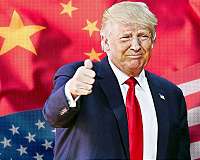
President Donald Trump said Tuesday he was growing "more and more angry at China" over the spread of the coronavirus, as American health officials warned they were not in "total" control of the pandemic.
"As I watch the Pandemic spread its ugly face all across the world, including the tremendous damage it has done to the USA, I become more and more angry at China," Trump tweeted.
The global pandemic, which Trump blames on Beijing, has intensified already strong tensions between the two countries over an ongoing trade war.
Amid a surge in US cases, particularly in the south and west, infectious disease expert Anthony Fauci told Congress earlier Tuesday that things were "going in the wrong direction," and that "clearly we are not in total control right now."
He also warned that cases could more than double to 100,000 per day if authorities and the public fail to take steps to suppress the pandemic.
China has accused Trump's administration of politicizing the pandemic to deflect from its own handling of the illness, with the United States suffering by far the highest death toll of any country.
US officials, meanwhile, have urged greater transparency from China.
UN rights chief slams virus response in China, Russia, US
Geneva (AFP) June 30, 2020 –
The UN rights chief on Tuesday said COVID-19 was being instrumentalised to silence free speech, citing China and Russia, while voicing alarm at statements in the US that "deny the reality" of the virus.
UN High Commissioner for Human Rights Michelle Bachelet pointed to Russia, China, Kosovo, Nicaragua among others where "threats and intimidation against journalists, bloggers and civic activists, particularly at the local level, (were being used) with the apparent aim of discouraging criticism of the authorities' responses to COVID-19".
Bachelet also voiced concern about "severe restrictions on freedoms of expression" in Egypt and "excessive and arbitrary enforcement" of pandemic response measures in El Salvador.
"Censorship and criminalisation of speech are likely to suppress crucial information needed to address the pandemic," she told the 44th session of the United Nations Human Rights Council.
The former Chilean president said it was vital for leaders to maintain "consistent, credible and fact-based communication" with citizens, praising South Korea's "open" approach to its pandemic response.
"In contrast, in Belarus, Brazil, Burundi, Nicaragua, Tanzania and the United States — among others — I am concerned that statements that deny the reality of viral contagion, and increasing polarisation on key issues, may intensify the severity of the pandemic by undermining efforts to curb its spread," she said.
– Threat to peace –
Opening the session in Geneva, Bachelet gave a global update on the COVID-19 pandemic's impact on human rights.
"Six months after the first cases were detected, it is clear that this epidemic threatens both peace and development — and that it calls for more civil, political, economic, social and cultural rights, not less," she said.
Bachelet said the pandemic was deepening local and regional threats to peace, with essential services, already devastated by conflict, left "acutely vulnerable" to the crisis.
Bachelet reiterated her call for the easing or suspension of sanctions "to ensure that medical care and aid is accessible to all".
She said racial and ethnic minorities and indigenous peoples are both more likely to die of COVID-19 and were hit the hardest by its socio-economic consequences.
"This is particularly true of people of African descent," she said.
"Too often, unjust and violent actions by law enforcement personnel reflects systemic racial discrimination that is deeply embedded in institutions across society," she added.
In combating the virus, "discrimination kills. Depriving people of their social and economic rights, kills," she said.
"COVID-19 is like a heat-seeking device that exposes, and is fuelled by, systemic failures to uphold human rights."
