
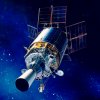
The next Defense Support Program (DSP) satellite scheduled for duty, Flight 19, has been shipped to Cape Canaveral where launch preparations have begun. The TRW Inc.-built satellite is scheduled for launch this winter.
Key launch preparations include an integrated system test to ensure the satellite's flight worthiness after travel to the Cape. Following this
month-long test, the satellite is fueled and moved to the launch pad where
it will be mated to an Inertial Upper Stage rocket and the Titan 4B launch
vehicle. A mission dress rehearsal, including a simulated count-down
exercise, is held a few weeks prior to launch.
"The upcoming launch continues DSP's three-decade-long history of
service to the country," said Martin Melnick, TRW's DSP program manager.
"DSP can be counted on to continue providing early warning of missile
launches and nuclear events well into the next century."
TRW builds the 5,200-pound DSP spacecraft under contract to the U.S. Air
Force Space and Missile Systems Center and integrates the sensor payload
provided by associate contractors, Aerojet, of Azusa, Calif., and Sandia
Laboratories of Albuquerque, N.M. Eighteen DSP satellites have been launched
since 1970, and TRW is under contract to deliver a total of 23 satellites.
DSP serves the nation as an orbiting sentry 22,300 miles above the
Earth, using infrared sensors to detect and provide early warning of
strategic and tactical ballistic missile launches and nuclear explosions.
DSP has been the spaceborne segment of NORAD's Tactical Warning and Attack
Assessment System since 1970.
DSP satellites have exceeded their specified design lives by 125 percent
through five upgrade programs. The upgrades have improved satellite
capability, survivability and life expectancy, allowing DSP to provide
accurate, reliable data in the face of constantly changing requirements.
Today's DSP satellites are far more sensitive than the original
satellites, with three times the number of infrared detectors. DSP
satellites detected SCUD launches during the 1991 Gulf War, and post-event
data reduction shows they have detected forest fires, detonations,
explosions and other natural events.
