
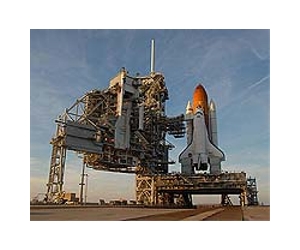
A University of Central Florida study aims to reduce the time it takes to prepare the space shuttle for a launch after an attempt has been scrubbed.
United Space Alliance, NASA's prime space shuttle contractor, awarded UCF a contract to optimize the assembly steps necessary for the integration of the space shuttle to the launch structure. To accomplish that goal, the UCF team built replicas of the sealing interface in the shuttle's external fuel tank's gaseous hydrogen vent line and is studying how the materials behave in different assembly scenarios.
Several UCF graduate students and undergraduates are working with Ali P. Gordon, an assistant professor of Mechanical, Materials and Aerospace Engineering, and Kent Williams, an associate professor of Industrial Engineering and Management Systems. The team began testing the devices in January and expects to share results in the spring.
"This research is providing students with an excellent opportunity to transfer their knowledge of experimental design to a significant real-world problem," Williams said.
Inside a College of Engineering and Computer Science laboratory, the UCF team built three replicas of the gaseous hydrogen vent line interface. Each replica, small enough to fit on a laboratory table, includes several sensors that measure how the gasket materials within the connection behave over short and long periods of time.
A better understanding of the mechanical behavior of the materials would help NASA and United Space Alliance minimize the changes and the leaks that can result from them.
The results could benefit more than the space program, Gordon said. Facilities such as power plants or water reclamation facilities that deal with gasketed connections, extreme temperature variations, connected pipes and storage tanks in high-pressure conditions also could apply the results of the research.
"We are eager to provide our expertise to help NASA enhance our nation's vital space program," Gordon said. "This will also be a unique opportunity for our students to see real-world applications to what they study in class. As part of our research, we visit Kennedy Space Center and meet with top-notch engineers."
Gordon, who began teaching at UCF in 2006, has worked on several other research projects related to how materials perform when they're exposed to extreme temperature. Williams began teaching at UCF in 1998. His specialties include the design and development of simulation and training systems, management systems engineering and advanced statistical techniques.
Share This Article With Planet Earth
