
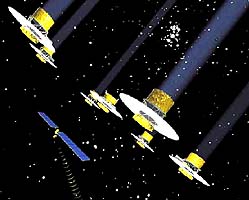
A ¿15M investment in the UK small satellite sector was announced today by Science Minister Lord Sainsbury. The funding is intended to help transfer the UK's world-leading capability in small satellites from the academic into the scientific and commercial markets.
Lord Sainsbury said: "I hope this initiative will stimulate industry to invest in small satellite missions, particularly for satellite communications, the largest and most rapidly expanding market for space products.
He also announced that: Research into microgravity and astrobiology is to get a ¿1.4M boost from UK Government.
Welcoming a report from a panel of experts, seeking to establish astrobiology as a new science for the millennium, Lord Sainsbury announced that the UK is to invest in the research opportunities offered by the European Space Agency's EMIR-2 programme.
He said: "EMIR-2 will offer our scientists experimental and research opportunities in astrobiology and microgravity"
"UK teams will be able to lead challenging research designed to improve our development and preparation of important new drugs, smart fluids and high performance sensors". Their initial results will allow us to evaluate the relevance of the International Space Station to achieving UK priorities"
"We will accelerate our involvement in a new science that will exploit our lead role in the Mars Lander, Beagle 2".
Lord Sainsbury went on to say that the UK would not enter ESA's Future Launch Technology Programme (FLTP), preferring instead to press ahead with more immediate national measures in partnership with UK firms that are already having success exporting to European and International builders of launch vehicles.
He confirmed that the National Space Technology programme would be extended to provide specific opportunities to support innovative ideas at the equipment and component level, rather than at the vehicle level.
"My decision supports the priorities set out in the UK Space Strategy published in August", the Minister said. "The Strategy confirmed major investments in space science, remote sensing, satellite communications, technology and navigation."
"We gave relatively low priority to launch vehicles. After careful consideration, I have decided that the high costs of FLTP in the longer term would have an unacceptable effect on other, higher priorities. To enter Phase 1 and then to withdraw later on would have confused our partners in ESA and those firms seeking a consistent approach from Government in the high priority sectors".
