
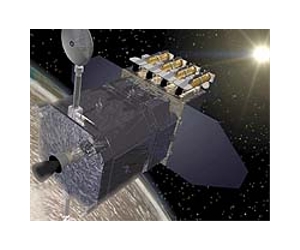
UK scientists are gearing up for the launch of NASA's latest space mission, set to launch from Cape Canaveral at 15:30 GMT on Tuesday, 9 February 2010. The Solar Dynamics Observatory (SDO) will deliver high resolution images of the Sun ten times better than the average High-Definition television to help scientists understand more about the Sun and its disruptive influence on services like communications systems on Earth.
The UK, including scientists and engineers from the Science and Technology Facility Council's (STFC's) Rutherford Appleton Laboratory (RAL), has provided essential expertise and technology to the mission.
SDO is the first mission in NASA's Living with a Star (LWS) program. Its unique orbit will allow high resolution images to be recorded every three quarters of a second, providing in-depth information about the Sun's complex magnetic fields and space weather generated by solar flares and violent eruptions from the Sun's atmosphere known as Coronal Mass Ejections (CMEs).
"A CME can carry a billion tons of solar material into space at over a million kilometers per hour. Such events can expose astronauts to deadly particle doses, can disable satellites, cause power grid failures on Earth and disrupt communications," said STFC Rutherford Appleton Laboratory scientist, Prof. Richard Harrison.
"The Sun's activity has a strong influence on the Earth. By studying solar activity, we hope to improve the prediction of solar storms and find new ways to protect technological systems here on Earth".
The UK's principal contribution is provision of the cameras for SDO and the data they produce. The high resolution cameras are at the heart of a set of US-led telescope systems which allow scientists to see features in the Sun's atmosphere on very small scales in time and space, and in many wavelengths simultaneously. The telescopes also allow detailed studies of solar magnetic fields and even of the nature of the solar interior.
"The cameras will give us new views of the Sun at a faster rate than ever before, and in exquisite detail, enabling us to find out what makes the Sun so hot and what causes the explosions in the Sun's atmosphere. This will produce more science data than any mission in NASA history," said Mullard Space Science Laboratory (MSSL) scientist, Prof. Len Culhane.
RAL engineers designed and built the electronics systems for the six cameras on two of SDO's instruments. Under contract from, Lockheed Martin, they developed the electronics boxes which control and read out the data from SDO's cameras.
"Space missions require extremely light and compact, power-saving equipment which has to be built to stringent design and manufacturing requirements," said RAL's SDO Project Manager, Sarah Beardsley.
"Inside each electronics box are four small, custom made video processing chips called ASICs (Application Specific Integrated Circuit). Each ASIC replaces a complete board of electronics which saves both space and power, and enables complex high speed parallel processing of data. The design of the electronics boxes has been so successful that we are now under contract to design, build and test the camera electronics for the SUVI instrument on NASA's forthcoming GOES-R weather satellite."
RAL's engineers also worked closely together with e2v Ltd, the UK company tasked with developing the unique Charged Couple Devices for SDO's cameras.
Share This Article With Planet Earth
