
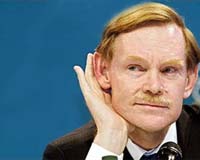
U.S. President George W. Bush's pick for the next World Bank president may be a surprisingly good one, but regardless of his abilities, Robert Zoellick is likely to face considerable opposition from some quarters. The president announced Wednesday that the former U.S. deputy secretary of state was his choice to replace Paul Wolfowitz, who is set to leave the bank June 30 amid a cloud of controversy.
Unlike Wolfowitz, who will forever be known as a neoconservative and key architect in the U.S. decision to attack Iraq in 2003, Zoellick has no significant political baggage.
In addition, Zoellick apparently has no girlfriend at the World Bank. The girlfriend issue ultimately led to Wolfowitz's downfall, who was found to have given an a much higher than customary pay raise to fellow bank employee Shaha Riza when he assumed power in June 2005.
What's more, given his background as the former U.S. trade representative under the current administration and his experience at the U.S. Treasury during the presidency of George H. W. Bush, there is no doubt that Zoellick has considerable experience in international affairs and finance, in addition to having strong ties with the Republican Party.
Qualifications aside, however, many advocacy groups focusing on foreign aid and the World Bank and the International Monetary Fund in particular are likely to oppose his nomination in principle as they continue to question the U.S. prerogative to name the bank's head. While there is no written rule per se, the current practice is for the United States to have first choice in naming the bank's leader, while Europeans get to pick the head of the IMF. But that tradition itself is being criticized from a larger number of people, particularly after the Wolfowitz fiasco.
"This is a multilateral institution, and there should be a multilateral process for choosing its head," said Oxfam International's advocacy director, Bernice Romero. The British non-profit group's director added that "other countries must step forward and name candidates" to replace Wolfowitz too.
A survey conducted by Washington-based think tank Center for Global Development agreed with Oxfam's assessment. The CGD found that 85 percent of its 700 respondents disagreed with continuing the current practice of the United States nominating a single American candidate after informal consultations with bank members.
According to the survey conducted May 22, British Prime Minister Tony Blair was the best choice among 38 percent of those polled in terms of having the necessary banking and finance experience. But surprisingly enough, Zoellick garnered a quarter of the total votes too, only just behind the president of Yale University, Richard Levin, with 32 percent, and scoring as much as U.S. Deputy Treasury Secretary Robert Kimmitt. Others who were suggested as potential candidates included Turkey's Kemal Dervis, who now heads the U.N. Development Program, and South African Finance Minister Trevor Manuel.
For its part, the World Bank's board, which is made up of 25 executive directors each representing the 185 member countries of the organization, released a statement about what it was looking for in its president shortly after media reports that Zoellick was the White House's choice as the bank's leader. The board said it wanted someone with "a proven track record of leadership, experience managing large, international organizations" as well as "political objectivity and independence," among other qualifications.
Clearly, Zoellick has the right experience to lead the world's biggest development lender. But questions remain about his political independence, as well as his ties to corporate America. After all, the former trade representative is currently an executive at Wall Street giant Goldman Sachs, and he also served on the board of the now-defunct controversial energy giant Enron.
For now, though, the odds are in favor of Zoellick gaining the top stop at the bank. The World Bank stated that its board "expects to receive nominations by no later than June 15, 2007, and to complete the process for the selection of the president of the bank by June 30, 2007."
