
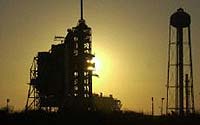
Barring last minute hitches, the space shuttle Atlantis will blast off at 6:11 pm (2311 GMT) Wednesday from the Kennedy Space Center here carrying an extraordinary payload — a full-blown science laboratory destined for the International Space Center (ISS).
National Aeronautics and Space Administration (NASA) officials are expecting good weather and have reported no technical problems ahead of the launch of the shuttle, carrying Destiny, the laboratory they describe as "the centerpiece of the ISS."
In addition to offering astronauts the opportunity to conduct research in biology and physics, the US-built Destiny module will serve as the command and control center for the space station, NASA said.
When Destiny, a 9.2 meters (30.2 feet) long cylinder with a 4.3 meter (14 feet) diameter, is attached to the ISS, the 112-tonne space station will be roughly the size of a three-bedroom house.
"The foundation has been laid, the electrical lines and plumbing have been extended," said Michael Hawes, NASA Associate Administrator for Space Development. "We're ready to get the lab in place and go to work."
During the 11-day mission, Atlantis' five-member crew of Commander Ken Cockrell, Pilot Mark Polansky, and Mission Specialists Tom Jones, Marsha Ivins and Bob Curbeam, will use the shuttle's robotic arm to attach Destiny to the space station.
Jones and Curbeam will make three space walks to complete the new laboratory's installation, connecting power cables and other hardware, according to space officials.
The 1.4 billion dollar laboratory, manufactured by Boeing Corporation, will allow station crew members to conduct science experiments in near-zero gravity.
Designed to accommodate pressurized payloads, it has 24 rack locations where various experiments will take place.
Jon Cowart, the laboratory payload manager, said Destiny would prove to be an important scientific center.
"You cannot even begin to fathom the discoveries that are going to be made in a hundred years from now," he stressed. "And Destiny is the key in ushering us in that future."
Destiny is the first of six space science laboratories that will be attached to the International Space Station before 2006, when it will be complete.
The station, meanwhile, is no longer uninhabited.
US astronaut Bill Shepherd and Russian crewmates Sergei Krikalev and Yuri Gidzenko have been in orbit for 11 weeks, doing assembly work, performing maintenance and preparing for the arrival of Destiny.
