
More than $200 million in grants will support safety improvements for rail transport of hazardous materials, the U.S. Federal Railroad Administration announced.
"These $200 million in grants will help the railroads continue to implement positive train control, a technology that could help reduce accidents and save lives," U.S. Transportation Secretary Elaine L. Chao said in an emailed statement.
Positive train control, or PTC, is technology that can take over when an operator fails to respond to adverse conditions like a pending overspeed derailment or possible collision. With some minor exceptions, the requirements cover rail lines carrying any poisonous or hazardous materials or an any line that regularly transports commuters.
The U.S. Congress in 2008 mandated PTC systems, but has responded to railroad requests for an extended schedule on implementation.
The increase in crude oil production in North America had been more than the existing network of pipelines can handle, which left many in the industry to turn to rail as an alternate transit method in the peak era of shale.
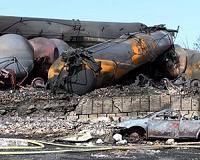
Four years ago, about a dozen empty crude oil tankers derailed in Casselton, N.D., from a BNSF-operated train. About 950 barrels of oil spilled when two trains operated by BNSF collided and derailed near Casselton in late 2013.
U.S. safety regulators said older DOT-111 cars, some of which derailed in the 2013 accident, may be more vulnerable to leaks or explosions than other types of rail cars.
North Dakota officials at the time said specific action would target route safety, speed limits and other guidelines.
In July 2015, the federal Transport Canada filed charges against Montreal, Maine and Atlantic Railway for a 2013 derailment of a train carrying crude oil through Lac-Megantic, Quebec. The incident left more than 40 people dead.
U.S. federal data show about 197,000 barrels of oil per day moves on the U.S. rail system, a fraction of the total U.S. production. Data from Canada, the largest exporter of oil to the United States, show crude oil transport by rail has nearly doubled, however, from last year.
