
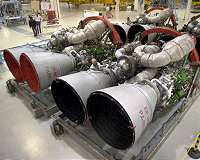
The United Launch Alliance (ULA) will receive 11 RD-180 rocket engines in 2017 through US-Russian venture RD Amross, with the latter hoping to sell more in the future, RD Amross CEO Michael Baker told Sputnik on the sidelines of the Space Symposium in Colorado.
The ULA acquires the engines through RD Amross, which is a joint venture, involving RD-180 manufacturer, Russian company Energomash.
"Right now we have 28 more engines to deliver, 11 this year, 11 next year and 6 in 2019," Baker said.
"We are really hoping that ULA is going to purchase some more engines. Right now they are going through the internal process, trying to determine if they need to buy any and if so, how many," Baker said. "I am pretty confident that they are going to buy some. We just don't know how many and we're not sure when they're going to let us know. Hopefully before June."
When asked for what year, he noted, "2019 I think and into 2020 maybe."
Baker added that he did not foresee any difficulties on the part of the Congress.
The US' plan to replace Russian RD-180 rocket engines with US-made ones is more about politics, Baker told Sputnik.
"I think it's more politics because it is a very successful partnership that has been very good for both countries," Baker said. "Everybody wants to have their own organic capabilities. I understand that. But we had this joint partnership 20 years for the purpose to help bring us together, to help bring two countries together and I think it has done that very well."
In 2014, the US Congress strictly limited future purchases of Russian RD-180 engines at a time when it imposed economic sanctions on Russia.
Moreover, legislators passed a law requiring the United States to develop a domestically produced next-generation rocket propulsion system by 2019 in order to eliminate reliance on the Russian RD-180.
However, in December 2015, Congress passed a budget that includes a provision allowing the United States to continue purchasing the RD-180 rocket engines.
The US space program currently relies on Russian-made RD-180 rocket engines to power the booster rockets that carry its astronauts up to the International Space Station (ISS).
Private companies, including SpaceX and Blue Origin, are developing rocket engines that could be used by the Pentagon in the future.
Blue Origin has been developing BE-4 engines working on liquid oxygen and liquid methane since 2011. The flight tests are expected to take place in 2019.
How Russian RD-180 Engines Could Be Used After US Halts Purchases
Russian RD-180 engines can be installed on new domestic carrier rockets after the United States stops procuring these engines for its Atlas space launch vehicles, Boris Katorgin, a former general director and general designer of NPO Energomash corporation in 1991-2005, told Sputnik.
According to Katorgin, the United States will eventually swap out Russian engines for domestically produced versions, however, the current US space industry "rush" is best explained on political grounds, and in the case of normalization of bilateral relations, US purchases of the Russian engines could continue for years.
"I think that, of course, these engines will be used at the new [Russian] heavy and even super heavy rockets. Now we are talking about the creation of a carrier that would immediately give us an advantage in terms of time, all technical solutions and finances, because today we have already gained the most important competitive advantage – ready, functioning, successfully operating engines… which will remain the best in the world for a long time," Katorgin said.
In March, the head of Russia's space corporation Roscosmos, Igor Komarov, told Sputnik that BE-4 rocket engines developed by the Blue Origin company would eventually replace Russia's RD-180 used on US Atlas space launch vehicles. Blue Origin has been developing BE-4 engines using liquid oxygen and liquid methane since 2011. The flight tests are expected to take place in 2019.
US Atlas launch vehicles have been using RD-180 engines since 2000.
In 2014, the US Congress strictly limited future purchases of Russian RD-180 engines at a time when it imposed economic sanctions on Russia. Legislators passed a law requiring the United States to develop a domestically produced next-generation rocket propulsion system by 2019 so as not to rely on the RD-180s.
US Hardware Production Begins for Money-Saving Next-Generation Rockets
Orbital ATK's proposed launch system will reduce the cost of US government rocket and missile programs, saving taxpayers up to $600 million on these programs over a ten-year period, according to official statement.
Progress in developing advanced solid rocket propulsion and other technologies has allowed early production to begin on next generation hardware for intermediate- and heavy-lift … read more
