
The United States will commit more troops and a massive surge in new aid to Afghanistan as part of a revamped war strategy aimed at defeating resurgent Islamist fighters, US officials said Thursday. US Secretary of State Condoleezza Rice said she would present a plan to fellow NATO foreign ministers here Friday to provide Afghanistan with 10.6 billion dollars in new aid over the next two years.
She said 8.6 billion dollars of the aid would go to expanding, training and equipping security forces loyal to President Hamid Karzai, and two billion for reconstruction and anti-narcotics.
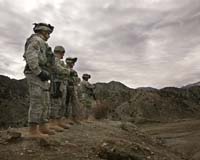
The Pentagon meanwhile announced that about 3,200 US soldiers currently operating in Afghanistan would remain in the war-torn country for an extra four months, effectively increasing overall troop numbers.
"The challenges of the last several months have demonstrated that we want to and we should redouble our efforts" in Afghanistain, Rice told reporters flying with her to Brussels for the NATO meeting.
The alliance has some 33,000 troops in Afghanistan, where attacks by the formerly ruling Taliban militia have surged in recent months and a new offensive is feared when winter ends.
The US plan, described by a senior official as a "comprehensive strategy" shift, comes shortly after Washington overhauled its war effort in Iraq and will be followed by US pressure on NATO allies to increase their engagement in support of President Hamid Karzai's government.
"We're looking for others to step up their effort with us, step it up across the board," US Assistant Secretary of State Richard Boucher said here.
Around 4,000 people were killed in the insurgency last year — many of them rebels — and US officials say there were nearly 140 suicide attacks, up from 27 in 2005.
Rice acknowledged that the strength of the Taliban attacks five years after the movement and its Al-Qaeda allies were ousted from Afghanistan had been "a bit more organised than people expected".
But she insisted US and NATO forces had achieved success against the rebels.
"This (new aid) is really to reinforce that success," she said, adding that the reconstruction aid would target some of Afghanistan's poorest southern areas where the Taliban have had their greatest successes.
The new aid represents a huge increase over past US assistance to the country, which totalled 14.2 billion dollars between 2001 and now.
A senior US official said US President George W. Bush would ask Congress to commit the new funds as part of a fiscal 2007 supplemental budget due to be presented to the Democratic-controlled legislature in the coming weeks.
While the Democrats won control of both houses of Congress largely on the back of their opposition to the unpopular war in Iraq, they have generally not opposed the US and NATO involvement backing Karzai's government in Afghanistan.
The senior official, who accompanied Rice and spoke on condition he not be named, said the administration began discussing the "comprehensive strategy" shift for Afghanistan with NATO allies at a summit in Riga in November.
Rice will begin the "roll out" of the new plan Friday to NATO's 26 members, Afghan leaders and officials from non-NATO countries involved in Afghanistan, including Australia.
Alliance defence ministers will continue the talks next month in Spain.
The official said the security package would involve increasing the size of the Afghan army by 70,000 and police forces by 82,000.
The reconstruction aid will go to roads, electrical power supplies, rural development and counter-narcotics operations, he said.
The official said the unveiling of the new strategy should help ease concerns in Europe that Washington's focus on the war in Iraq, where Bush recently announced an increase in troop numbers to curb rampant violence, would lead to a scaling back of US efforts in Afghanistan, leaving the European allies to shoulder the burden there.
"We're not asking Congress for this money because its necessary for Afghanistan, but it is also true that our efforts now also have the benefit of showing the Europeans that it's not all Iraq, all of the time," he said.
