
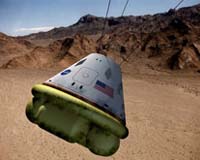
United Space Alliance and Pioneer Aerospace announced Wednesday they have joined forces to develop a parachute landing system for NASA's new Crew Exploration Vehicle. The CEV is the crew vehicle of the space agency's next phase of exploration called the Constellation Program. This program aims to take astronauts to the Moon, Mars and beyond, beginning in the next decade.
The new vehicle, which will resemble the space capsule of the Apollo era, will use parachutes for Earth landings. Unlike the Apollo capsules, however, which landed in the ocean, the CEV will be designed to touch down softly on land, using the ocean only in an emergency. The CEV will include many modern systems to make space flight safer for future astronaut crews.
Jacobs Sverdrup plans to award the Crew Exploration Vehicle Parachute Assembly System contract in August of 2006.
USA is currently responsible for the parachute systems on the space shuttle's solid rocket boosters. In addition, USA is responsible for the shuttle's drag-chute system, used to slow the vehicle as it lands on the runway.
Both systems are recovered then processed for re-use in the USA Parachute Refurbishment Facility at Kennedy Space Center.
Pioneer Aerospace developed the original SRB main parachute design and worked with NASA in developing the world's largest parafoil for the X-38 flight vehicle. The vehicle was to become the Crew Return Vehicle for the International Space Station astronauts.
In addition, NASA's Mars Exploration Rovers, Spirit and Opportunity, both landed safely on the surface of the red planet using Pioneer parachutes. In January 2006, a Pioneer parachute system was used to recover the Stardust sample-return capsule following a seven-year mission in space.
