
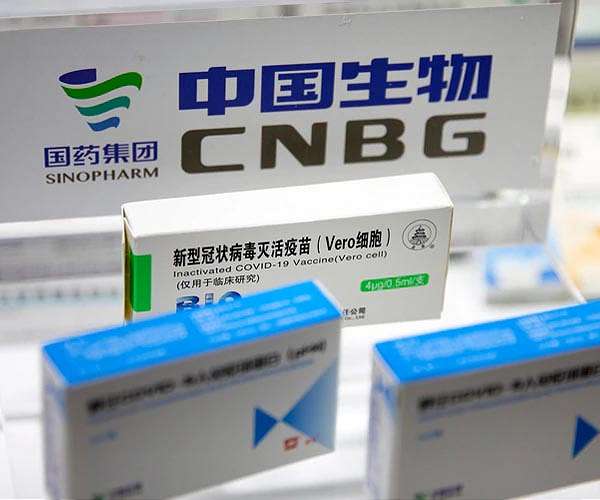
Uzbekistan on Thursday began coronavirus vaccinations, offering citizens a choice between AstraZeneca and a Chinese-made vaccine that the Central Asian country plans to start producing soon.
Russian, Western and Chinese vaccines are all in play in ex-Soviet Central Asia, with Uzbekistan's neighbour Kazakhstan producing and distributing Russia's Sputnik V jab and another neighbour Kyrgyzstan starting vaccinations with China's Sinopharm last week.
But as in other parts of the world, rollout delays and vaccine scepticism have raised fears of an extended pandemic, which proved particularly brutal for the region's countries last summer.
Uzbeks vaccinated on Thursday and interviewed by AFP had mostly opted for AstraZeneca instead of the vaccine developed by China's Anhui Zhifei Longcom Biopharmaceutical Co.
"Now I will have to hope that everything goes well," said Makhfuza Tuichibayeva, a retired doctor, who did not explain her choice of AstraZeneca, which Uzbekistan received over 600,000 doses of through the Covax programme.
Pavel Prosvirin, another pensioner, also picked AstraZeneca.
"So far I am feeling fine," he told AFP.
The republic of 34 million people is targeting medics and citizens over 65 in its first wave of inoculations.
Retired university professor Malika Khadjayeva told AFP that she had opted to get a shot of the Chinese ZF-UZ-VAC 2001 vaccine that Uzbekistan expects to start producing in the coming months.
"I am up to date with what is happening," she said, noting "very good results" the vaccine had produced in third stage trials carried out in Uzbekistan and other countries.
Khadjayeva said that she hoped Uzbekistan would avoid another summer like last year, when the coronavirus overwhelmed both its own health system and those of its neighbours.
"(Our) people have learned how to protect themselves and their close ones," Khadjayeva said.
Uzbekistan's health minister Abdukhakim Khadjibayev said authorities planned to vaccinate around four million people by the end of June.
An online poll by a state-endorsed non-profit organisation called Yuksalish showed this month that 44 percent of more than 19,000 respondents did not intend to get vaccinated and showed Sputnik — also registered in Uzbekistan — as the preferred vaccine choice.
Next door, Kazakhstan's president Kassym-Jomart Tokayev said Thursday that his country of 19 million people was "falling behind", with only 47,000 people fully vaccinated against coronavirus since the rollout began at the start of last month.
"The reason for this situation is simple — lack of vaccines," Tokayev said
China vaccine maker Sinovac says doubles production capacity
Beijing (AFP) April 2, 2021 –
Chinese biopharmaceutical firm Sinovac said Friday a third production line for its Covid-19 vaccine has been put into use, doubling its annual capacity of the jabs to two billion doses.
Its CoronaVac is one of four domestic vaccines given conditional approval by Chinese authorities, which helps rush emergency drugs to market.
On Wednesday, experts from the World Health Organization said an interim analysis of clinical trial data from two Chinese vaccines, including Sinovac's product, showed they demonstrated "safety and good efficacy", although more data is still needed.
"Over 200 million doses of CoronaVac have been delivered to over 20 countries, including China," said Sinovac in its latest statement.
Although Sinovac's jab has been approved by domestic regulators, it has yet to receive authorisation by what the WHO considers "a stringent regulatory authority", noted the UN health agency's Strategic Advisory Group of Experts on Immunization (SAGE).
Sinovac is among Chinese firms to have submitted data in applications for the WHO's emergency use listing, which opens the door for the jabs to join the global Covax programme, which aims to ensure equitable access to Covid-19 vaccinations.
Hong Kong to resume Pfizer/BioNTech vaccine roll-out on Monday
Hong Kong (AFP) April 1, 2021 –
Hong Kong will resume administering the Pfizer/BioNTech coronavirus jab on Monday after the pharma giant said a packaging flaw that temporarily halted its use did not affect its safety, officials said.
The financial hub suspended use of the German-made vaccine last month when Fosun, its China distributor, informed authorities that some vial caps were defective.
It was a blow to the roll-out of mass vaccination programmes against a deadly virus that has killed more than 2.7 million people around the world and hammered the global economy.
"BioNTech told us that the batch of vaccines concerned did not have quality and safety problem," Hong Kong's civil service chief Patrick Nip, who has been leading the government's cross-department anti-virus initiative, said Thursday.
"Administration of the BioNTech vaccines will resume on Monday," he said, adding that a new batch of 300,000 doses would arrive in the city on Friday.
Health authorities in Hong Kong had previously stressed that any defective bottles were discarded before being given out, and that they paused the programme temporarily out of an abundance of caution.
More than 180,000 residents who reserved Pfizer/BioNTech vaccinations were affected by the 12-day suspension, including some 30,000 people who were due to receive their second jab within the recommended 21-day window.
Citing BioNTech's own analysis, Hong Kong's health director Constance Chan said the problem in some vials had been traced to how caps reacted to the minus 70 degrees Celsius temperatures the vaccine must be kept in for storage.
When the vials were defrosted to be prepared for administering, she said, air sometimes leaked in.
Officials said the new batch of vaccines arriving in Hong Kong on Friday had been manufactured in another factory in Germany where over 15,000 vials were tested and no defects were found.
More than 460,000 residents of Hong Kong have received their first jab of coronavirus vaccines since the campaign kicked off over one month ago, accounting for about seven percent of the city's population aged 16 and above.
"It's still far from our immunity target," Nip said. "We appeal to all eligible members of the public to get vaccinated."
Authorities currently offer China's Sinovac and the Pfizer/BioNTech vaccine.
Sinovac received fast-track approval despite not publishing peer-reviewed clinical data.
The data available points to an efficacy rate of between 50-80 percent, depending on the studies.
Pfizer says its efficacy rate is 94-95 percent.
