
Our Curious robotic explorer is spending another Valentine's Day in faraway Gale crater, Mars. For the first time since 2019, Curiosity has a NASA-built MRV (Martian Rover Valentine)! Although Perseverance and Curiosity won't be able to visit each other, they will certainly be sending love over the red horizons.
On this Valentine's Day, Curiosity is planning a full workload with ChemCam LIBS and APXS of 'Loch Garten' followed by MAHLI images of this target before and after dust removal. In addition, ChemCam and Mastcam will image 'Stivva Head' and Mastcam will image 'Blackcraig.'
Navcam will be looking for dust devils and taking other images, while DAN, RAD, and REMS will be taking standard measurements.
Sols 3385-3386: Up We Go!
by Vivian Sun | Planetary Geologist – NASA/JPL
In this weekend two-sol plan (Sunday is a soliday!), we continue making progress towards the "Greenheugh Pediment" and will hopefully be almost on top of the pediment after the weekend drive. As we climb onto the pediment via its steep slopes, Curiosity will drive as far as we have available navigation mesh, so this drive will be similar to the last plan's drive in terms of distance.
But before we continue driving towards the pediment, we planned plenty of contact science and remote sensing at our current location. We will be obtaining APXS and MAHLI measurements of "Kintradwell," a smooth bedrock surface, that will provide us with more data about changes in bedrock composition as we approach the contact with the pediment capping unit.
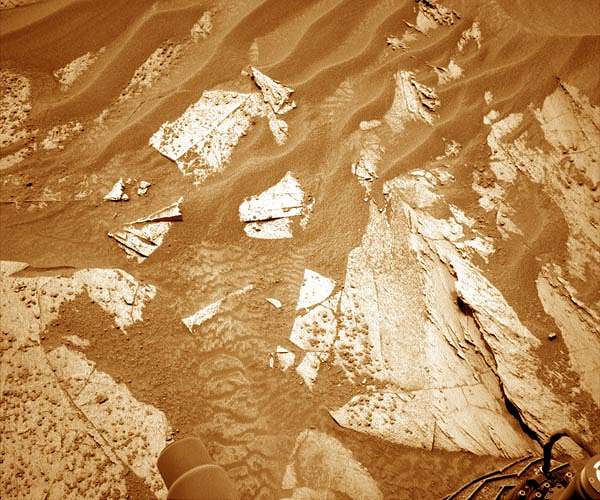
ChemCam observations of "Apardion" and "Copp Crag," two nodular targets, will give compositional data on these diagenetic textures, similar to what we've observed in our past workspaces (see above image). We'll also be thoroughly documenting the fantastic landscape around us, with more Mastcam and ChemCam imaging of "Maringma Butte," focusing in particular on a protruding lens of rocks, and Mastcam imaging of "Blackcraig Butte."
Although we have imaged these buttes before from previous locations, these additional images are useful not only because they will be higher resolution (since we are closer now), but also because imaging the same feature from different angles is how we build up our three-dimensional understanding of the layering and sedimentology in these buttes.
