
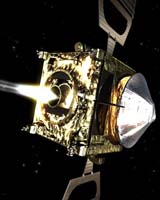
ESA's Venus Express spacecraft is closing in on Earth's veiled neighbor after a five-month, 400-million-kilometer (250-million-mile) journey, which began last Nov. 9. The spacecraft is expected to enter orbit on April 11.
Controllers at ESA's Space Operations Centre are preparing for orbital insertion – which comprises a series of telecommands, engine burns and maneuvers designed to slow the spacecraft from a velocity of 29,000 kilometers (18,000 miles) per hour relative to Venus, just before the first burn, to an entry velocity some 15 percent slower, allowing the spacecraft to be captured by the planet's gravity.
Controllers will order Venus Express to ignite its main engine for roughly 50 minutes in order to achieve deceleration and create a highly elliptical orbit. The maneuver will require most of VEX's 570 kilograms (1,255 pounds) of onboard propellant. The team also will position the spacecraft's solar arrays to reduce the possibility of excessive mechanical load during engine ignition.
Over the subsequent days, controllers will order a series of additional burns to adjust the orbit's apocenter (highest altitude) and pericenter (lowest altitude) with the goal of producing a 24-hour orbit around Venus by early May.
ESA will provide live coverage of the event on its TV network and on its Web site, including the news conference and podcast from the control room at ESOC.
