
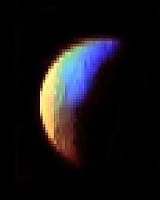
This color composite image of Saturn's moon Iapetus from Cassini's visual and infrared mapping spectrometer was obtained on Dec. 31, 2004, an hour and a half before the New Year, at a distance of 121,000 kilometers (75,186 miles), with a spatial resolution of about 60 kilometers (37 miles).
The three colors used in the mosaic correspond to 1.01, 3.21, and 3.80 microns. The different colors represent vastly different surface compositions. The upper bright blue region is rich in water ice, while the lower, dark brown region is composed mainly of a substance rich in organic material.
The yellow region consists of a mixture of ice and organics, suggesting a gradual change in composition on the surface. This pattern suggests Iapetus swept up the dark material, which may have come from debris created from meteoritic impacts onto the small, outer satellites of Saturn.
