
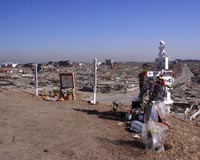
Japan on Wednesday marked the ninth anniversary of the killer tsunami that triggered the Fukushima nuclear meltdown, but fears about the new coronavirus forced a scaling back of public commemorations.
The government of Prime Minister Shinzo Abe cancelled the annual public ceremony at National Theatre, attended by members of the royal family and people from the northeastern region hit hardest by the 2011 tsunami, earthquake and nuclear accident.
Instead, Abe will hold a small wreath-laying ceremony at his office in Tokyo, and he has asked the nation to observe a moment of silence at 2:46 pm (0546 GMT), when a 9.0-magnitude earthquake struck a seabed off Miyagi prefecture on March 11, 2011.
The decision came as the government asks the public to cancel or postpone major gatherings or unnecessary outings in a drive to contain the spread of the coronavirus, which has infected 568 people and been linked to 12 deaths in Japan.
The call has resulted in the shutdown of schools and the cancellation or rescheduling of everything from music concerts to football games, while graduation ceremonies, fashion shows and a sumo tournament have taken place behind closed doors.
"In light of the current situation, as it is now time for us to take all available measures to prevent further domestic spread of the virus, we have reached the conclusion that we could not avoid the cancellation of the ceremony," Abe said in a statement issued last week.
He offered condolences to those who lost loved ones and renewed his pledge to rebuild the disaster-hit region.
– Decades to decommission –
In 2011, the powerful quake triggered violent shaking followed by a towering tsunami, estimated at as high as 17 metres (56 feet) in some areas.
The wave swept Japan's vast northeastern shoreline, killing nearly 16,000 people with more than 2,500 still missing, and overwhelming the emergency power supplies that cooled reactors at the Fukushima Daiichi nuclear plant.
The disaster sent the reactors into meltdown, producing the world's worst nuclear accident since Chernobyl.
The enormous steel-and-concrete buildings that housed the reactors exploded after hydrogen became trapped inside, spreading radioactive material across the region, though no deaths were attributed to the accident directly.
The accident prompted 160,000 to evacuate, many of whom have never returned.
Since then, the government and the plant's operator Tokyo Electric (TEPCO) have managed to bring the reactors to relative stability by pumping water inside to cool them.
But that has led to the accumulation of contaminated water, creating another problem to be solved, potentially by releasing it — after filtration — into the sea.
The final decommissioning of the crippled plant is expected to take four decades, but Abe's government hopes to showcase reconstruction so far in the region at this year's Olympics, with the torch relay starting from Fukushima and travelling across affected areas.
The coronavirus outbreak has raised concerns however that the Tokyo Games might be postponed, cancelled or take place behind closed doors. Organisers say preparations are on track, but they have already had to scale back test events and the Olympic flame arrival.
Tokyo Disney parks extend closure until early April over virus
Tokyo (AFP) March 11, 2020 –
The operator of Tokyo Disneyland and DisneySea said Wednesday the parks will remain closed through early April over fears of the coronavirus outbreak.
Oriental Land also said the openings of new zones and attractions, scheduled for April 15, will also be pushed back to mid-May, as the government calls on the public to avoid unnecessary outings and crowded places.
The announcement came a day after Prime Minister Shinzo Abe called for a 10-day extension of measures intended to halt the spread of the new coronavirus, including cancelling, delaying or scaling back major events.
The virus has so far infected 568 people and been linked with 12 deaths in Japan.
Oriental Land originally closed the parks from February 29 with a plan to reopen from March 16.
"We are planning our resumption time for early April, but we will make an announcement at a later time," the company said in a brief statement.
"The opening of Tokyo Disneyland's major development area, which was scheduled for April 15, has been rescheduled to mid-May or later," the company said.
More than 30 million visitors flood into the two parks each year, including school children during spring break, and they are among the most popular destinations for tourists coming to Tokyo.
Abe has made a nationwide plea for the public to help halt the spread of the coronavirus, urging schools to close through early April and telling businesses to encourage commuters to work from home or avoid rush hour trains.
A panel of experts is expected to meet next week to assess the effectiveness of those measures.
