
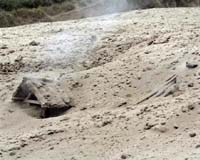
A volcano in southern Ecuador erupted Thursday, killing at least five people, injuring 13 and burying five villages in lava and hot ash, local authorities said. President Alfredo Palacio declared a state of emergency in the four affected provinces before heading to Penipe, at the foot of the active Tunguraua volcano, accompanied by several ministers.
The sky around Tunguraua, located 135 kilometers (83 miles) south of Quito, was thick with ash, blocking access by helicopter or plane. Geophysicists said it was the volcano's biggest eruption in seven years.
About 3,200 people living at the foot of the volcano were evacuated and more than 20,000 hectares (50,000 acres) of farmland were destroyed, said Penipe Mayor Juan Salazar, whose town was among the worst hit.
"Red-hot lava and ash buried five villages, killing five persons," Salazar told AFP by telephone. Four bodies could not be recovered as they were buried under debris, he said.
"Everything was knocked down. In one of the settlements, lava set fire to 12 houses that are still burning," Salazar said.
About 60 people who had been missing were found alive by a military rescue team, he said.
Authorities said five of the 13 injured people suffered first or second degree burns.
Thousands of cattle were killed, according to reports.
About 60 percent of the 15,000 people living in the tourist town of Banos took refuge in nearby hotels, said Civil Defense deputy director Mauro Rodriguez.
"Mama" Tunguraua, as locals call it, erupted violently before dawn, following a 4.4-magnitude earthquake that struck Wednesday southeast of the volcano.
Rocks up to 10 centimeters (four inches) large rained down on homes, piercing roofs and windows, witnesses said.
"The noise they made as they fell was thunderous," said Wilson Perez, the leader of the Cusua community at the foot of the volcano. "Several people were hit in the head, leaving them dazed."
Airports announced closures in nearby Riobamba, Latatunga and Guayaquil, Ecuador's most-populous city, due to airborne ash.
Unable to fly due to the smoke, the president traveled to Penipe by land, Palacio's office said.
The 5,029-meter (16,500-foot) volcano disgorged lava and flames, and an eight-kilometer (five-mile) high plume of smoke, local officials and volcanologists said.
A powerful explosion produced "glowing rocks, ash and lava that devastated several areas," said Penipe mayor Salazar. "We suffered 18 continuous hours of fire."
One resident said the area around the volcanic cone was covered with a dense layer of ash, about five centimeters (two inches) thick.
"Penipe is in the dark, as if it were night. There is a lot of ash. Rocks drove holes in the houses. I saw a lot of injured people," the resident told a radio station.
The eruption is the strongest since 1999, and larger than a July 14 eruption that destroyed 20,000 hectares (50,000 acres) of farmland and left 10,000 people homeless, Quito University's Geophysical Institute said.
"We can't say whether this is the last eruption," said institute director Hugo Yepez, who called the event a "national disaster."
The volcano's behavior appears more and more like that of a huge eruption in 1918, which was the biggest of the 20th century, Yepez said.
Institute vulcanologists pinpointed the strongest eruption near midnight Wednesday and said it lasted until 3:00 am (0800 GMT) Thursday.
The quake struck Wednesday at 12:16 am (0516 GMT), according to the US Geological Survey, which described the magnitude 4.4 quake as "light," 180 kilometers (110 miles) southeast of Quito at a depth of 32.6 kilometers (20.3 miles).
