
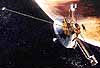
In a dark, cold, vacant neighborhood near the very edge of our solar system, the Voyager 1 spacecraft is set to break another record and become the explorer that has traveled farthest from home.
At approximately 2:10 p.m. Pacific time on February 17,
1998, Voyager 1, launched more than two decades ago, will cruise
beyond the Pioneer 10 spacecraft and become the most distant
human-created object in space at 10.4 billion kilometers (6.5
billion miles.) The two are headed in almost opposite directions
away from the Sun.
As with other spacecraft traveling past the orbit of Mars, both
Voyager and Pioneer derive their electrical power from onboard
nuclear batteries.
"For 25 years, the Pioneer 10 spacecraft led the way,
pressing the frontiers of exploration, and now the baton is being
passed from Pioneer 10 to Voyager 1 to continue exploring where
no one has gone before," said Dr. Edward C. Stone, Voyager
project scientist and director of NASA's Jet Propulsion
Laboratory.
"At almost 70 times farther from the Sun than the Earth,
Voyager 1 is at the very edge of the Solar System. The Sun there
is only 1/5,000th as bright as here on Earth — so it is
extremely cold and there is very little solar energy to keep the
spacecraft warm or to provide electrical power. The reason we
can continue to operate at such great distances from the Sun is
because we have radioisotope thermal electric generators (RTGs)
on the spacecraft that create electricity and keep the spacecraft
operating," Stone said. "The fact that the spacecraft is still
returning data is a remarkable technical achievement."
Voyager 1 was launched from Cape Canaveral on September 5,
1977. The spacecraft encountered Jupiter on March 5, 1979, and
Saturn on November 12, 1980.
Then, because its trajectory was designed to fly close to
Saturn's large moon Titan, Voyager 1's path was bent northward by
Saturn's gravity, sending the spacecraft out of the ecliptic
plane – the plane in which all the planets except Pluto orbit the
Sun.
Launched on March 2, 1972, the Pioneer 10 mission officially
ended on March 31, 1997. However NASA's Ames Research Center,
Moffet Field, CA, intermittently receives science data from
Pioneer as part of a training program for flight controllers of
the Lunar Prospector spacecraft now orbiting the Moon.
"The Voyager mission today presents an unequaled technical
challenge. The spacecraft are now so far from home that it takes
nine hours and 36 minutes for a radio signal traveling at the
speed of light to reach Earth,"said Ed B. Massey, project manager
for the Voyager Interstellar Mission. "That signal, produced by
a 20 watt radio transmitter, is so faint that the amount of power
reaching our antennas is 20 billion times smaller than the power
of a digital watch battery,"
Having completed their planetary explorations, Voyager 1 and
its twin, Voyager 2, are studying the environment of space in the
outer solar system. Although beyond the orbits of all the
planets, the spacecraft still are well within the boundary of the
Sun's magnetic field, called the heliosphere. Science
instruments on both spacecraft sense signals that scientists
believe are coming from the outermost edge of the heliosphere,
known as the heliopause.
The heliosphere results from the Sun emitting a steady flow
of electrically charged particles called the solar wind. As the
solar wind expands supersonically into space in all directions,
it creates a magnetized bubble — the heliosphere — around the
Sun. Eventually, the solar wind encounters the electrically
charged particles and magnetic field in the interstellar gas. In
this zone the solar wind abruptly slows down from supersonic to
subsonic speed, creating a termination shock. Before the
spacecraft travel beyond the heliopause into interstellar space,
they will pass through this termination shock.
"The data coming back from Voyager now suggest that we may
pass through the termination shock in the next three to five
years," Stone said. "If that's the case, then one would expect
that within 10 years or so we would actually be very close to
penetrating the heliopause itself and entering into interstellar
space for the first time."
Reaching the termination shock and heliopause will be major
milestones for the mission because no spacecraft have been there
before and the Voyagers will gather the first direct evidence of
their structure. Encountering the termination shock and
heliopause has been a long-sought goal for many space physicists,
and exactly where these two boundaries are located and what they
are like still remains a mystery.
Science data are returned to Earth in real-time to the 34-
meter Deep Space Network (DSN) antennas located in California,
Australia and Spain. Both spacecraft have enough electricity and
attitude control propellant to continue operating until about
2020, when electrical power produced by the RTGs will no longer
support science instrument operation. At that time, Voyager 1
will be almost 150 times farther from the Sun than the Earth —
more than 20 billion kilometers (almost 14 billion miles) away.
On Feb. 17, Voyager 1 will be 10.4 billion kilometers (6.5
billion miles) from Earth and is departing the Solar System at a
speed of 17.4 kilometers per second (39,000 miles per hour). At
the same time, Voyager 2 will be 8.1 billion kilometers (5.1
billion miles) from Earth and is departing the solar system at a
speed of 15.9 kilometers per second (35,000 miles per hour).
