
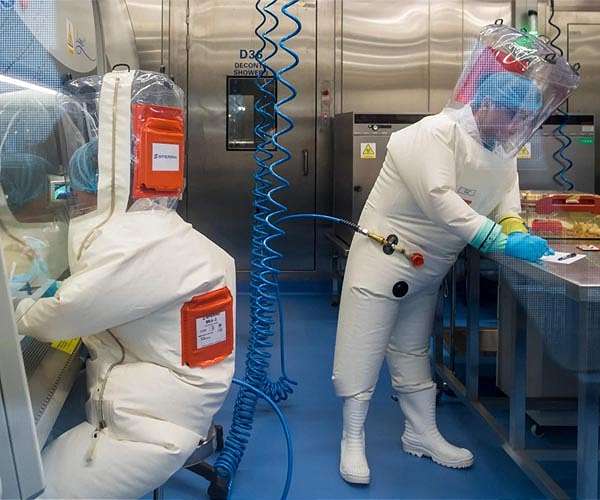
The WHO's chief, long accused of complacency towards Beijing, hardened his tone Tuesday, urging further investigation into a theory Covid-19 sprang from a laboratory leak.
The director-general of the World Health Organization Tedros Adhanom Ghebreyesus also rebuked China for sitting on key data.
The theory that the new coronavirus may have escaped from a lab in Wuhan, the Chinese city where it was first detected in humans in December 2019, was a US favourite under former president Donald Trump.
China has always flatly rejected the hypothesis.
And the team of international experts sent to Wuhan by the World Health Organization earlier this year to probe the pandemic's origins have also all but ruled it out.
Their long-delayed report, written alongside the team's Chinese counterparts and published Tuesday, ranked four hypotheses in order of probability.
They said the SARS-CoV-2 virus that causes Covid-19 disease most probably jumped from bats to humans via an intermediary animal, judging a lab leak to be an "extremely unlikely" source.
But Tedros said Tuesday the probe into Wuhan's virology labs had not gone far enough, adding that he was prepared to launch a fresh investigation.
"I do not believe that this assessment was extensive enough," he told the UN health agency's 194 member states, in a briefing on the Covid origins report.
"Further data and studies will be needed to reach more robust conclusions," he said.
"Although the team has concluded that a laboratory leak is the least likely hypothesis, this requires further investigation, potentially with additional missions involving specialist experts, which I am ready to deploy."
– More data call –
Tedros also urged China to be more forthcoming with data — a call echoed by several countries led by the United States, Britain and Japan.
Tedros said the Wuhan mission found that the first detected case had symptom onset on December 8, 2019 — but to understand the earliest cases, scientists would benefit from full access to data stretching back to at least September 2019.
The team "expressed the difficulties they encountered in accessing raw data. I expect future collaborative studies to include more timely and comprehensive data sharing," said Tedros.
Hitherto, the WHO chief has faced allegations throughout the pandemic of being too close to China — notably from the former Trump administration, which zeroed in on the lab leak theory.
Peter Ben Embarek, who led the international mission to Wuhan, said the report had "only scratched the surface" in the quest to find the origins of the pandemic, which has killed nearly 2.8 million people and battered the global economy.
The WHO food safety expert said he was "optimistic" the team would discover more "and get closer to the final answer".
– Lab leak 'first reaction'
On the laboratory accident hypothesis, the Danish scientist said the natural initial reaction to the outbreak of the virus, in a city housing virology labs, was to make the connection between the two.
"Even the staff in these labs told us that was their first reaction," Ben Embarek told journalists Tuesday.
"They all went back to their records… but nobody could find any trace of something similar to this virus in their records or their samples.
"Nobody has been able to pick up any firm arguments or proof or evidence that any of these labs would have been involved in a lab leak accident."
That said, Ben Embarek added: "we haven't done a full investigation or audit of any of the labs."
He said there had been hours of discussions with laboratory staff and management. The documentation seen by the team had not led them to believe there was anything further left to explore.
But the balance of the hypotheses could be reassessed as further leads come in, he added.
The United States, Japan, Canada, South Korea, Australia, Israel, Britain and seven other European countries issued a joint statement voicing concerns that the investigation "was significantly delayed and lacked access to complete, original data and samples".
Independent experts needed "full access to all pertinent human, animal, and environmental data, research, and personnel", they said.
China's foreign ministry said in a statement: "Actions politicising this search for the origins will only seriously hinder global cooperation in this regard, undermine the global anti-epidemic efforts and cause more loss of life."
Nepal to restart Covid-19 vaccinations after China donates shots
Kathmandu (AFP) March 30, 2021 –
Nepal was set to restart Covid-19 inoculations after receiving a donation of doses from China, resuming a campaign that was put on hold because India slowed vaccine exports.
India and China have sought to use vaccine diplomacy to extend influence around the world during the coronavirus pandemic, particularly among poorer countries seeking cheaper shots.
Nepal began vaccinations in January after receiving one million doses of the AstraZeneca/Oxford vaccine from neighbouring India. Another 348,000 from the World Health Organization-backed Covax scheme arrived in March.
But only half of a follow-up order of two million shots from India has been delivered so far, and none have been administered since mid-March.
The health ministry said Tuesday that the drive would resume after 800,000 doses of China's Sinopharm vaccine arrived on Monday.
"It will be given after a decision is made on which population bracket we will target," health ministry spokesman Jageshwor Gautam told AFP.
Beijing "provided vaccine assistance to Nepal as a priority", Chinese ambassador Hou Yanqi wrote in local English daily Republica on Tuesday.
The donation "demonstrates the great importance the Chinese side attaches to China-Nepal friendship", she said.
India is home to the world's biggest vaccine maker, while China also has a large production capacity.
In Sri Lanka, India has supplied half a million vaccines as a donation, another half a million as a commercial purchase, with a further 264,000 delivered via Covax.
Beijing was also due to deliver 600,000 vaccines on Wednesday to administer to Chinese nationals living in the country.
In the Maldives, India has gifted 100,000 doses, while another 100,000 was purchased by Indian manufacturer the Serum Institute with 12,000 more shots via Covax.
Beijing was due to deliver 100,000 doses on Tuesday after donating an earlier 100,000.
"China is… gifting double the amount of vaccine doses India had given the Maldives," Sri Lanka's former high commissioner to Delhi, Austin Fernando, told AFP.
"China is trying to show that… they are more generous and Beijing is making a political statement with the vaccine diplomacy."
More than 1.7 million Nepalis have received their first AstraZeneca jabs so far. Authorities were forced to save doses for the second round after deliveries slowed from India.
Nepal, home to 28 million people, has recorded more than 275,000 coronavirus infections and over 3,000 deaths so far.
New infections have slowed in recent months in the Himalayan nation, with just over 100 cases on average a day and 11 deaths in the last 10 days.
