
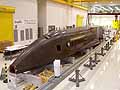
A critical series of tests on a rocket engine that could power the
next generation of space launch vehicles has been successfully
completed at the Marshall Space Flight Center in Huntsville,
AL.
The Fastrac engine — only the second American made engine
developed in the last 25 years — will be the primary
propulsion system for the X-34 technology demonstration vehicle
scheduled to begin flight tests in late 1998.
X-34 is next in NASA's series of Reusable Launch Vehicle
(RLV) technology demonstrators set for up to 25 flights
beginning late next year. X-34, an air-launched vehicle being
developed under contract to Orbital Sciences Corporation,
Dulles, VA, is intended to demonstrate technologies ranging
from composite structures and reusable propellant tanks and
insulation to advanced thermal protection systems and low-cost
avionics.
The Mach-8 (eight times the speed of sound) craft
will begin flights at the White Sands Missile Range, NM, and
could include missions through inclement weather conditions in
Florida, as well. X-34 demonstrations will precede the more
advanced X-33 technology demonstrator scheduled to begin
flights up to Mach 15 in mid-1999. A major goal of NASA's RLV
efforts is to reduce dramatically the cost of putting payloads
into space.
Recently completed Fastrac engine component tests evaluated
the engine's thrust chamber assembly at high pressure almost
identical to flight conditions. The primary combustion of
propellants — a mixture of liquid oxygen and kerosene —
occurs in the thrust chamber assembly. As the engine heats,
the chamber is cooled by charring or scorching a liner inside
the chamber that decomposes to prevent excessive heat buildup.
"The thrust chamber assembly performed as designed, which
is another indication that the Fastrac is an engineering
breakthrough," said George Young, Fastrac engine chief
engineer. "Marshall engineers developed this engine in a much
shorter-than-usual design cycle at significantly lower costs
than a typical rocket engine."
"These tests demonstrate that a key component of our
simple, low-cost engine performs in flight-like conditions,"
said Danny Davis, manager of the Low Cost Technologies project,
which oversees the Fastrac engine. "These successful test
firings of the thrust chamber mark a major milestone in the
progression to low-cost space propulsion."
Each Fastrac engine initially will cost approximately $1
million — about one-fourth of the cost of similar engines.
The Fastrac provides 60,000 pounds of thrust and, in addition
to the X-34 vehicle, is targeted for launch systems designed
to boost payloads weighing up to 500 pounds at a dramatically
lower cost.
Individual components, such as the thrust chamber assembly,
gas generator and fuel tanks, are undergoing testing at
Marshall. Other first-stage booster components such as tanks,
propellant supply and electronic control systems and the
complete engine assembly will be tested at Stennis Space
Center in Mississippi beginning in early 1998.
The Fastrac engine is one element of NASA's Advanced Space
Transportation Program, managed at Marshall. The program is an
initiative to reduce the cost of space launch and develop
technologies for space transportation needs for the next 25
years.
Reuseable Launch Vehicle Archive at Spacer.Com
Rotary
