
Banned by the United States but feted in Pakistan, Islamic militants who once fought in Kashmir have spent the last year battling to help earthquake victims. There is nothing but praise from patients at a tin-roofed hospital in Muzaffarabad, the capital of Pakistani Kashmir, which was built by the hardline Jamaat-ud-Dawa organisation after October 8, 2005 disaster.
"We are very grateful to Jamaat-ud-Dawa for their hospitality and their help," said Zulakhian Bibi, 55, as she recuperated in the women's ward after breaking her leg in two places in a fall at home.
A massive signboard headed "Dawa Field Surgical Hospital" says it has the city's only orthopaedic surgeon, two operating theatres, a blood bank, free medicine and, of course, a mosque.
"We are not afraid of the US ban," said hospital administrator Basharat, who goes by one name. "They have got the wrong perception about Jamaat-ud-Dawa."
Jamaat-ud-Dawa is the political wing of the outlawed group Laskhar-e-Taiba, which fights Indian rule in the other sector of disputed Kashmir, and was founded by the former head of the militant outfit.
The United States blacklisted Dawa as a "terrorist organisation" in April. In August the group denied reports that it had provided money to some of the suspects arrested in Britain over an alleged plot to blow up airliners.
But key US ally President Pervez Musharraf has refused to take any action against the group, while authorities here have showered praise on militant groups involved in quake relief.
Islamist organisations were the first on the scene after the quake which killed 74,000 people, arriving hours before the army and days before the United Nations despite losing dozens of their own fighters.
Their members could be seen wearing commando jackets and sometimes carrying Kalashnikovs. They rode in the back of pick-up trucks to hand out supplies, help dig up survivors and collect bodies for burial.
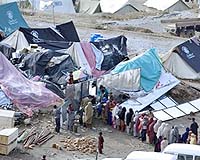
In the past 12 months — now in civilian clothes and with no sign of any weapons — they have set up clinics, tent camps and schools.
"Our rehabilitation work is in full swing in the quake-affected areas," Khaled Imran, a spokesman for the Karachi-based Al-Rashid Trust, told AFP.
The Pakistani government has frozen the Al-Rashid Trust's accounts since the United Nations added it to a list of terrorist organisations in the wake of the September 11, 2001 attacks on the United States.
"We did face problems from the authorities in the relief work soon after earthquake as there were a lot of suspicions about us. But that phase is over and I don't want to go into details," Imran said.
"When the American doctor teams came over after the earthquake they were reluctant to work with Dawa people," Ghulamullah Azad, Jamaat-ud-Dawa's Kashmir spokesman, said with a smile at his office in Muzaffarabad.
"But after some days they were very friendly. They appreciated the level of our work."
He said the prime minister of Pakistani-administered Kashmir showed his appreciation by officially opening the Dawa hospital earlier this year, while quake survivors protested when they heard about the US ban.
Asked about the US blacklisting, Azad replied: "We don't bother about it because we are doing something for the cause of humanity. We fail to understand why America considers us its enemy."
It is not just America. India has also expressed misgivings about the open presence in the quake zone of groups linked to the insurgency that has wracked New Delhi's part of Kashmir since 1989.
Pakistan says they are only charities and insists that since 2001 it has banned the main insurgent groups — once backed by its intelligence services — and closed their camps.
However other outside observers have also criticised the role of "jihadi groups".
The International Crisis group said earlier this year that as many as 17 groups that were either banned by Pakistan or on its terror watchlist were involved in the initial relief effort.
The Brussels-based think tank warned that "threats to domestic and regional security will increase" if these organisations remained involved in the reconstruction process.
