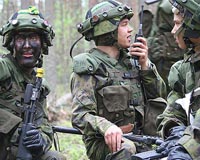
Finland's government announced plans Thursday to strengthen the country's military capacity due to concerns over assertive behaviour from its powerful eastern neighbour Russia.
Finland, which is not a NATO member, will increase the number of its wartime troops from the current 230,000 to 280,000 to "improve the capability to defend the entire territory of the country", which shares a 1,340-kilometre (830-mile) border with Russia, the government wrote in a defence report.
"Russia aims to strengthen its great-power status, and it has expressed the goal of a sphere-of-influence based security regime," the report said, noting the security situation in the Baltic Sea region surrounding Finland had deteriorated.
The increase in wartime troops entails a modest addition of 55 million euros ($58.6 million) to Finland's annual military spending of 2.4 billion euros ($2.56 billion), but the government said expenditure was to increase more significantly after 2020.
The Nordic country plans to replace its ageing maritime fleet as well as its Hornet fighter jets during the next decade.
Finnish Finance Minister Petteri Orpo said the investments would raise Finland's defence expenditure by 0.3-0.4 percentage points to 1.5-1.6 percentage points of the country's gross domestic product in the 2020s.
"Which would put it on a good, or very good European level," Orpo said.
In October 2016, Finland and the US signed a bilateral defence cooperation deal, after a similar agreement between Sweden and the US was signed in June.
After Russia's annexation of Crimea and the conflict in eastern Ukraine, Finland has also stepped up its bilateral military cooperation with its western neighbour Sweden.
NATO to boost naval presence in Black Sea
Brussels (AFP) Feb 16, 2017 – NATO will step up naval war games and surveillance in the Black Sea to complement its increased presence of land and air forces near a more assertive Russia, the alliance said Thursday.
NATO chief Jens Stoltenberg said the decision taken by alliance defence ministers in Brussels was not designed to be a provocation at a time of heightened tension with Russia, which annexed the Black Sea peninsula of Crimea from Ukraine in 2014.
"We agreed on… an increased NATO naval presence in the Black Sea for enhanced training, exercises and situational awareness," Stoltenberg said at a press conference.
Russia swiftly condemned the move.
This is "another step towards increasing tension in the regions that touch on Russia's vital interests," Russia's ambassador to NATO Alexander Grushko told Russian news agencies.
"Of course all the necessary measures will be taken to ensure Russia's security interests in this region," he added.
A NATO official told AFP, on condition of anonymity, that the decision was taken to counter Russia's military buildup in the Black Sea and bolster the alliance's southeast flank after it sent troop reinforcements to the Baltic States and Poland in the northeast.
The official also said the goal was to bolster intelligence gathering, for example of Russian ground-to-air missiles in the region.
"We will have an increased presence in the Black Sea but it will be measured, it will be defensive and it will in no way be provoking any conflict or escalating tensions," Stoltenberg said.
"It is one element in a broader adaptation of NATO defence and deterrence to a more demanding and challenging security environment, including the Black Sea region," he said.
NATO allies Turkey, Bulgaria and Romania share the Black Sea coastline, as do partner countries Ukraine and Georgia, both of which have direct territorial disputes with Moscow.
The NATO official told AFP that it took the alliance about nine months since its Warsaw summit to work out the agreement, partly because Bulgaria did not want to be seen as provoking Moscow.
The source said the littoral states were also wary of the others' own military presence in the Black Sea, where they have had disputes over fishing rights and other issues.
The NATO official said the alliance also planned to step up air patrols over the Black Sea soon.