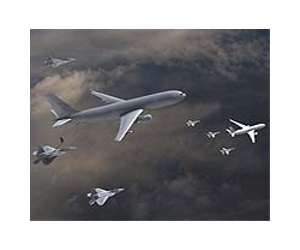
The day after the Pentagon opened bidding for a 35-billion-dollar aerial refueling tanker contract, speculation swirled that the Northrop Grumman-EADS team would not join the fray, leaving Boeing an open field.
Loren Thompson, an analyst at the Lexington Institute think tank, said that "even before the Defense Department unveiled its final strategy for acquiring a new aerial refueling tanker yesterday, Northrop Grumman was deep into preparations for announcing that it would not bid."
Richard Aboulafia, an aeronautics specialist at the Teal Group, agreed.
"There's a very good chance that Northrop won't bid," he told AFP.
The United States and European companies themselves were tight-lipped after the US Air Force published its request for proposals (RFP), the document specifying the requirements sought for the tankers that will replace a 1950s-era Boeing fleet.
Northrop Grumman, the leading US defense contractor, simply acknowledged receiving the RFP for the 179 aircraft that refuel warplanes in mid-air.
The European Aeronautic Defence and Space Company (EADS), the parent of Boeing arch-rival Airbus, said it was working with Northrop Grumman to evaluate the request.
"We're ready now and prepared to support Northrop Grumman in delivering the world's most advanced tankers to the US Air Force," Guy Hicks, spokesman for EADS North America, said in a statement to AFP.
Boeing, for its part, said it was "disappointed" that the RFP failed to take into account that Airbus enjoyed what the US firm sees as an unfair advantage due to subsidies from European governments.
Boeing also had concerns about how costs associated with fuel and the construction of hangars and runways would be factored into the evaluation of the competing bids.
But it was the tone of the supporters of each camp in Congress that was the most revealing of the forces in play.
Senator Richard Shelby of Alabama, where EADS plans to assemble the planes if it wins the deal, blasted the terms for the contest as unfair: "The final RFP discredits the integrity of the entire process."
A winning bid by the US-European team was expected to create 1,500 jobs in his southern state.
In contrast, lawmakers in Washington state and Kansas, where Boeing would build the tankers, welcomed the proposal.
"I am pleased the Department of Defense has honored its commitment to run a fair competition for the tanker contract," said Republican Senator Pat Roberts.
For several months Northrop Grumman has threatened to not enter the competition, alleging the Pentagon criteria would favor Boeing.
"It is not hard to see why Northrop is unhappy," Lexington Institute's Thomspson said.
On the performance side, the Pentagon has listed 372 mandatory requirements that the two competing sides can satisfy.
"Because there is no credit for exceeding the requirements, once their performance features are proven the competition is all about price," he said.
The US-European team's tanker, based on Airbus's A330 plane, "is so much bigger than Boeing's 767 and Airbus is currently in so much financial trouble due to cost overruns on the A380 airliner and A400M military transport that its pricing power has been diminished."
A dropout by Northrop Grumman-EADS, two years after the team was chosen to supply the tankers, would be another twist in the tortuous saga that began almost a decade ago.
It would force the Pentagon to go ahead with Boeing, which had already won a prior contact in 2003 that was canceled the following year over irregularities.
For Boeing, whose headquarters are in Chicago, the hometown of President Barack Obama, the risk of a political uproar is real.
Share This Article With Planet Earth