
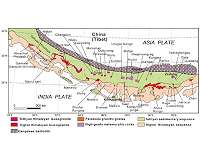
Two sub-parallel belts, Cenozoic aged Himalayan leucogranite on the Tibetan Plateau, extend east to west over more than 1000 km, regarded as the largest granitic belts in the world. The diverse rare-metal mineralization was identified commonly related to these leucogranites.
The Himalayan leucogranite is unique with petrolgoical characteristics similar to the well -known rare-metal granites worldwide. However, relatively few studies on the rare-metal mineralization in this region have been published.
The research groups in Nanjing University and Institute of Geology and Geophysics, Chinese and Academy of Science organized a field expedition in south Tibet in the summer of 2016 to constrain the distribution of mineralization in the region, which was published in the Science China Earth Sciences.
The first exciting discovery identified in the field is the widespread Be-mineralization containing in most of leucogranitic plutons (Fig. 2a).
The authors states in the article: "Aquamarine, a variety of beryl, major precious mineral resource in Nepal, has been widely explored and exploited and traded for a long time, and they may also be Be-mineralization potential on the Chinese side of the Himalayas."
Detailed microscope observation and microprobe analysis were conducted at the laboratories and twelve leucogranite plutons were found to contain rare-metal bearing minerals such as beryl (the representative of Be mineralization), columbite-group minerals (Fig. 2b), tapiolite, pyrochlore-microlite, fergusonite, Nb-Ta rutile (the representative of Nb-Ta mineralization), and cassiterite (the representative of Sn mineralization).
Based on the analytical results, the researchers revealed the distribution of the mineralization as: "Rare-metal mineralization was observed in both the Tethyan and Higher Himalayan belts.
No clear differences between the two belts were identified. However differences are clear when comparing the eastern and western parts of the belts. The eastern plutons are characterized by Nb, Ta, Sn, and Be mineralization and Sn mineralization is notably absent in western plutons.
"These results suggest that rare-metal mineralization in the Himalayan leucogranites is regionally variable, but does not appear to be controlled by tectonic characteristics of granite emplacement and the pluton size."
Petrogenesis was also prepared for the Himalayan rare-metal leucogranite. The model of "magmatic fractionation" and the abundance of fluxing components in the melt (e.g., H2O, Li, F, B, and P) are very important for the formation of the granite and enrichment of rare metal in the melt and/or fluids.
Rare metal has the widespread application value in the strategic development of new industries.
"China ranks high in resources and production of rare-metal mineral, especially in two granitic belts in the Nanling range and the Altai district (Xinjiang) with several world- class deposits", the authors in the article pointed out the immense value of the investigation in the Himalaya: "Our preliminary study on the Himalayan region shows additional enormous potential for the rare-metal mineralization in what may become the country's economically important metallogenic belt."
Scientists tie flexible crystals into knots
Researchers in Australia have grown bendable crystals strong enough to be tied in knots. Scientists are now considering how the flexible single crystals can be incorporated in new technologies and commercial applications.
"Crystals are something we work with a lot – they're typically grown in small blocks, are hard and brittle, and when struck or bent they crack or shatter," John McMur … read more
