
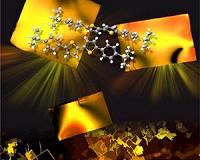
Researchers in Australia have grown bendable crystals strong enough to be tied in knots. Scientists are now considering how the flexible single crystals can be incorporated in new technologies and commercial applications.
"Crystals are something we work with a lot — they're typically grown in small blocks, are hard and brittle, and when struck or bent they crack or shatter," John McMurtrie, a professor of science and engineering at the Queensland University of Technology, said in a news release. "While it has previously been observed that some crystals could bend, this is the first study to examine the process in detail. We found that the crystals exhibit traditional characteristics of not only hard matter, but soft matter like nylon."
McMurtrie and his colleagues grew crystals from a copper acetylacetonate, a common metal compound. The crystals formed a thread-like shape measuring some 20 micrometers across.
Researchers used X-ray imaging to observe atomic behavior as the crystals were bent and unbent. Their analysis suggests the crystal's atoms are able to reorganize after being bent without suffering structural damage.
"Under strain the molecules in the crystal reversibly rotate and reorganize to allow the compression and expansion required for elasticity and still maintain the integrity of the crystal structure," said Jack Clegg, a professor of chemistry at the University of Queensland.
Researchers detailed the crystals and their potential in a paper published this week in the journal Nature Chemistry.
"Flexible crystals like these could lead to new hybrid materials for numerous applications, from components of planes and spacecraft to parts of motion or pressure sensors and electronic devices," Clegg said.
Breakthrough made in ultra-high strength steel
A team of mechanical engineers has developed a super steel called D & P Steel to improve the strength-ductility trade-off.
Aerospace, automotive and defense applications need metallic materials with ultra-high strength, and in some high-loading structural applications metallic materials also need to have large ductility and high toughness to allow for the precise forming of structural c … read more
