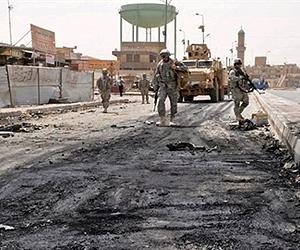
Nine Iraqi soldiers were killed on Wednesday by a roadside bomb on the outskirts of the main northern city of Mosul, police said.
The off-duty troops were in a minibus on a road heading northwest from Mosul when the vehicle struck the bomb at around 11:00 am (0800 GMT), a police official said, speaking on condition of anonymity.
Six other soldiers, all members of the Iraqi army's Third Division, were wounded in the attack, the official said.
Mosul, 350 kilometres (220 miles) north of Baghdad, and surrounding Nineveh province remain one of the most violent areas of Iraq, even as attacks in the rest of the country have dropped off after peaking in 2006 and 2007 during a brutal sectarian war.
Violence appears to have risen again in recent months, with July and August recording two of the highest monthly death tolls since 2008, according to Iraqi figures.
earlier related report
Kurdish reporter killed by Islamic militants: investigators
Arbil, Iraq (AFP) Sept 15, 2010 –
A journalist killed in May after writing a scathing article about the alleged corruption of Kurdish leaders was murdered by militants, authorities in Iraq's autonomous Kurdish region said Wednesday.
Sardasht Osman, 22, was kidnapped outside his university in the regional capital of Arbil on May 4, and his corpse was found a day later in the restive northern city of Mosul with a single bullet to the head.
He was killed after writing articles critical of the rule of Kurdish president Massud Barzani, and international press watchdog Reporters Without Borders (RSF) said at the time that his family and friends were "convinced" his murder was linked to his work as a journalist.
But a committee formed by Barzani to investigate Osman's death alleged on Wednesday that Osman was "tied" to Ansar al-Islam, a Sunni-Kurdish extremist group that has claimed attacks against American and Iraqi forces.
"Sardasht Osman was killed by terrorists because he had promised to work with them and then decided not to," the committee said, without giving details on what work he had allegedly pledged to carry out.
It said it had arrested the man who kidnapped Osman, 28-year-old Hisham Mahmud Ismail, saying he was a member of Ansar al-Islam. The committee said Ismail snatched Osman and then handed him over to other members of the armed group, who eventually killed him.
Osman, a final-year English student at Salaheddin University in Arbil, worked as a journalist for the magazine Ashtiname ("Letter for Peace" in Kurdish) and as an English-Kurdish translator.
RSF said he also wrote articles for a variety of other Kurdish publications.
In one of Osman's most critical articles, titled "I love the daughter of Massud Barzani" and published in the Kurdistan Post, he used an imaginary dream to condemn the alleged corruption of Kurdish leaders.
"When I become the son-in-law of Barzani, the wedding night will be in Paris and we will visit the palace of our uncle for several days in the United States," he wrote.
"We will leave our poor neighbourhood in Arbil to go to live in beautiful quarters and I will be protected at night by American sniffer dogs and Israeli guards," he continued, drawing a provocative contrast between Barzani's opulent lifestyle and that of ordinary Kurds.
RSF said last week that the Iraq conflict has been the deadliest for the media since World War II, and in October ranked Iraq a lowly 145th place for media freedom out of 175 countries.
And according to the "Impunity Index" released in April by the Committee to Protect Journalists, Iraq has the worst record of any country for solving the murder of reporters.
Share This Article With Planet Earth