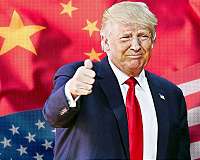
US and Chinese officials returned to the bargaining table late Thursday amid a sudden flare-up in hostilities, while President Donald Trump held out hopes of salvaging a trade deal.
The Chinese delegation, including Vice Premier Liu He, was greeted by US Trade Representative Robert Lighthizer and Treasury Secretary Steven Mnuchin.
With punishing US tariffs on hundreds of billions in Chinese merchandise due to jump after midnight, Trump told reporters he had received a letter from his Chinese counterpart Xi Jinping, and would likely speak to him by telephone later.
"It's possible to do it," Trump said of the trade deal at the White House. "I did get last night a very beautiful letter from President Xi."
But Trump warned he was also more than happy to use tariffs in resolving his differences with China.
"I am different than a lot of people. I happen to think that tariffs, for our country, are very powerful."
Months of increasing comity and optimism in trade talks appeared to go up in smoke this week as American officials accused China of a wholesale retreat from previously agreed commitments — a claim Beijing strongly rejected.
"They took many, many parts of that deal and they renegotiated. You can't do that," Trump said Thursday.
Since early this year, the trade talks have worked to resolve Washington's grievances of industrial theft, massive state intervention in markets and a yawning trade deficit.
China's Commerce Ministry warned Beijing would not "capitulate to any pressure" and threatened retaliation if US tariffs go up to 25 percent as scheduled on Friday — punctuating the drastic deterioration after months of seemingly collegial talks.
"The Chinese side has kept its promises and this has never changed," he added, without specifying what measures Beijing would take but warning that it "has already prepared for all possible situations."
Since last year, the two sides have exchanged tariffs on more than $360 billion in two-way trade, gutting US agricultural exports to China and weighing on both countries' manufacturing sectors.
The International Monetary Fund repeated its warning on Thursday that the trade battle between the world's top economies was a "threat" to global growth, and called for a rapid resolution.
– 'Fundamental misunderstanding' –
Meanwhile, the US Commerce Department reported that the trade deficit with China hit a three-year low in March, with US exports to China rising while imports, such as mobile telephones, fell.
The renewed tensions roiled global stock markets this week and unnerved exporters caught off guard.
But word of Xi's letter appeared to soothe Wall Street's nerves somewhat on Thursday, with the benchmark Dow Jones Industrial Average recovering some of the day's sell-off but still closing down 0.5 percent.
Markets in Europe and Asia also sank again.
Derek Scissors, a China expert at the American Enterprise Institute, told AFP the two sides had clashed over how much of the final trade agreement should be enshrined in publicly available document, something Beijing has long resisted.
"There was a fundamental misunderstanding," he told AFP by email.
"President Trump faces a political battle selling a China deal as being worthwhile. To do so, he needs a public document with clear gains for the US," Scissors said.
"But what China is willing to acknowledge in public is less than it is willing to acknowledge in private."
He noted that "the two sides failed to realize that they have very different tolerance for transparency."
But Scott Kennedy a trade expert at the Center for Strategic and International Studies said China had misjudged the Americans' eagerness to cut a deal at all costs.
"They didn't realize when they pulled their concessions off the table that the administration would have the reaction that it did," he told AFP.
Kennedy warned that the "possibilities for miscalculation on both sides is pretty high."
Chinese producers said the abrupt tariff hike announcement wreaked havoc on operations and would bring high costs, layoffs and further shifts of production to Southeast Asia.
"If the tariffs go up to 25 percent, costs will go up. Customers so far have suspended orders. I don't know what will happen," said Emily Wang of Hainan Zhongyi Frozen Food, which exports tilapia.
Washington has demanded far-reaching changes to the Chinese economy, such as subjecting state enterprises to market principles, reducing massive subsidies and ending the alleged theft of US technology.
Analysts say China will be reluctant to make many of these changes, which could undermine the Communist Party's political power.
While US companies complain of lost export markets, disrupted supply chains and higher costs, the US continues to see steady growth and falling unemployment.
But each side believes it is better positioned than the other to survive the dispute, Kennedy said.
The Chinese "don't see themselves as fragile and they see the US as having grown very quickly as a result of a tax cut that the US can't afford," he said.
USTR Lighthizer: Trump's tough trade negotiator
Washington (AFP) May 9, 2019 –
He stays out of the limelight but shares President Donald Trump's mistrust of China and the threat it poses to US economic power.
In his office across the street from the White House complex, US Trade Representative Robert Lighthizer will lead a key round of talks with Chinese negotiators on Thursday and Friday to try to salvage a deal to resolve a year-long dispute between the economic superpowers.
In the talks with China, the objectives are clear: to force the Asian giant to put an end to trade policies the US deems "unfair," especially the theft or forced transfer of American technology, and state subsidies for industry.
Trump last year tapped the 71-year-old Lighthizer to lead the charge to force Beijing to change its trade policies with perhaps more at stake for the global economy than the effort to revamp the North American Free Trade Agreement.
Trump previously entrusted that mission to Commerce Secretary Wilbur Ross and Treasury Secretary Steven Mnuchin. Like those officials, Lighthizer is a full member of the president's "cabinet" of ministers, and represents Washington in the World Organization Trade (WTO).
Lighthizer is a veteran trade negotiator, having served as deputy USTR under Republican President Ronald Reagan in the 1980s, and dealt with Japan, the trade power at the time.
Like Trump, Lighthizer believes free trade cannot be unfettered and must be reciprocal.
The new round of talks are critical, since Trump has decided to ratchet up punitive tariffs on $200 billion Chinese goods imported into the United States, more than doubling them to 25 percent as of May 10.
"Technology is the most important advantage that Americans have economically," Lighthizer said in a rare television interview in December.
"We will protect that technology and get additional market access from China. If that can be done the president wants us to do it. If not we'll have tariffs."
– Promises and action –
Lighthizer will not be satisfied with promises. He wants actions.
Unlike Trump who revels the spotlight, Lighthizer keeps a low profile.
During negotiations with Canada and Mexico his appearances were rare, his speeches parsimonious, his media statements distilled.
In testimony before Congress, his responses are measured and he makes it a point of honor not to expose in public what is happening behind the scenes.
But he was on the receiving end of a withering public attack from Trump in the Oval office in February — in the presence of China's Vice Premier Liu He and a bevy of reporters — when the president sharply corrected him on the terminology used to describe an agreement with Beijing.
But the USTR website describes Lighthizer as "a well-known advocate for the type of 'America First' trade policies supported by President Trump."
Lighthizer comes from an affluent family in Ashtabula, Ohio an important port on Lake Erie. It was used for coal and ore transport at the end of the 19th century, and the town's decline contributed to his skepticism about globalization and its drawbacks, according to relatives cited by The New York Times.
Prior to being named US Trade Representative in May 2017, Lighthizer, a father of two, was a partner in the powerhouse law firm Skadden Arps where he was a specialist in international trade law for more than 30 years.
He has an imposing stature, piercing gray-blue eyes and is described as equally "grumpy" in private as in public.
"He's very particular. Bombastic at times," said an official close to the US-Canada-Mexico talks. But he is "also charming, with a great sense of humor" and "tremendously respected for his strong intellect."
Like many of the Washington elite, Lighthizer attended Georgetown University both as an undergraduate and for law school.