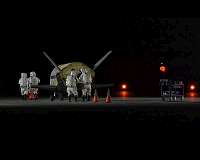
Soon after the fifth mission of the X-37B spaceplane ended, boffins started to pick apart the images released of the spacecraft. There it was, looking similar to the way it appeared after previous missions, which initially gave no cause to raise eyebrows.
But there was one strange element to this. The US Air Force released just two images, and they provided no rear views of the X-37B. To this analyst, that was odd. Was something being deliberately hidden from view?
That served as the fulcrum for an article this analyst wrote for SpaceDaily soon after touchdown. It was suggested that there could be a sensor target or an attachment for a sub-satellite located somewhere on the rear panel of the spacecraft, beside its main thruster.
The US Air Force had confirmed in a media statement that small satellites had been launched into orbit with the X-37B, but provided no specific details on where they were carried or how they were deployed. Sticking a small satellite in this area would be a logical way to handle the deployment of one or more sub-satellites from the spacecraft.
Now it's not so clear. The USAF has now released a partial view of the X-37B's backside. But even so, it's still not the full rear view we would like to see. The back panel is partially obscured by two people in hazardous environment suits, clearly tending to the vehicle.
They prevent us from seeing part of the area where a mounting bracket or target could be located. But all things considered, we can tell that most of the back panel looks pretty much the same as it always has.
Is this a question of modesty? Does the USAF wish that nosy boffins would stop ogling the backside of its semi-secret spaceplane? Possibly. In releasing this image, the USAF could be hoping to defuse some curiosity about the mission. But suspicions about a mystery payload at the rear have not been entirely dispelled.