The delay is no longer a poetic way of describing deep space. It is an operating condition.
Voyager 1 is so far from Earth that a radio command sent by mission controllers now takes more than 22 hours to reach the spacecraft. Then, if the probe receives the instruction, executes it and sends a response, that answer must spend more than 22 hours crossing the same emptiness in the other direction. In practice, one simple question can cost the Voyager team nearly two days before anyone on Earth knows whether the spacecraft answered.
That is not a theoretical limit. In a 2024 mission update, NASA described engineers sending a command to Voyager 1 while troubleshooting a computer fault. The spacecraft was then more than 15 billion miles, or 24 billion kilometres, away. NASA said the signal needed about 22.5 hours to reach Voyager 1 and another 22.5 hours for the reply to return. The arithmetic is brutal: 45 hours before the team could even begin to interpret the result.
Voyager is closing on a one-light-day distance
The number keeps growing because Voyager 1 is still moving outward. NASA’s current Voyager tracking page says the spacecraft will reach a full one-light-day distance from Earth on 18 November 2026 at 2:16:07 a.m. Pacific time, when it will be 16,094,799,096 miles, or 25,902,068,356 kilometres, from Earth. That milestone means light itself will need 24 hours to cover the gap.
The page also notes that the Voyager mission-status table is being fine-tuned as the spacecraft approaches that one-light-day point, because precision matters at this distance. Even without relying on a constantly changing dashboard number, the core fact is already clear from NASA’s own mission updates: Voyager 1 is beyond a 22-hour one-way light time and moving toward 24 hours.
That distinction matters. A popular shorthand says Voyager is “15 billion miles away”, but the exact Earth-spacecraft distance changes through the year as Earth moves around the Sun. The probe is still receding from the solar system, yet Earth is not standing still beneath it. Mission teams plan around calculated light time, not a rounded distance in a headline.
NASA describes Voyager 1 and Voyager 2 as the only spacecraft ever to operate outside the heliosphere, the protective bubble shaped by the solar wind and the Sun’s magnetic field. Voyager 1 crossed that boundary in 2012, while Voyager 2 followed in 2018. The mission began in 1977 as a tour of the outer planets and has become a long-duration test of how much useful work can be extracted from hardware built for another technological age.
A command is not a conversation
The delay changes the rhythm of engineering. Near Earth, controllers can often work through a problem in a loop: send a command, see the response, adjust, try again. With Voyager 1, that loop stretches across days. A single diagnostic step has to be planned as if there will be no immediate second chance.
This is why old spacecraft work can look slow from the outside. The team is not simply waiting for a radio signal. They are trying to understand what an instruction will do inside systems designed in the early 1970s, some of them operating with failed backups, dwindling power and aging components. Once the command leaves Earth, it cannot be pulled back.
During the 2023 and 2024 fault in Voyager 1’s flight data subsystem, the spacecraft was still receiving commands and transmitting a carrier, but the data stream was unreadable. NASA said engineers sent a “poke” command on 1 March 2024 to prompt the computer to try a different software sequence. Because of the light-time delay, the results did not reach Earth until 3 March. The information then had to be decoded and studied before the next move could be designed.
That lag is not only inconvenient. It raises the cost of being wrong. A mistaken instruction can consume days. A fix that works may still require many carefully spaced commands. A fix that fails may leave the team waiting almost two days to discover that the spacecraft is still in trouble.
The Deep Space Network hears a vanishingly weak signal
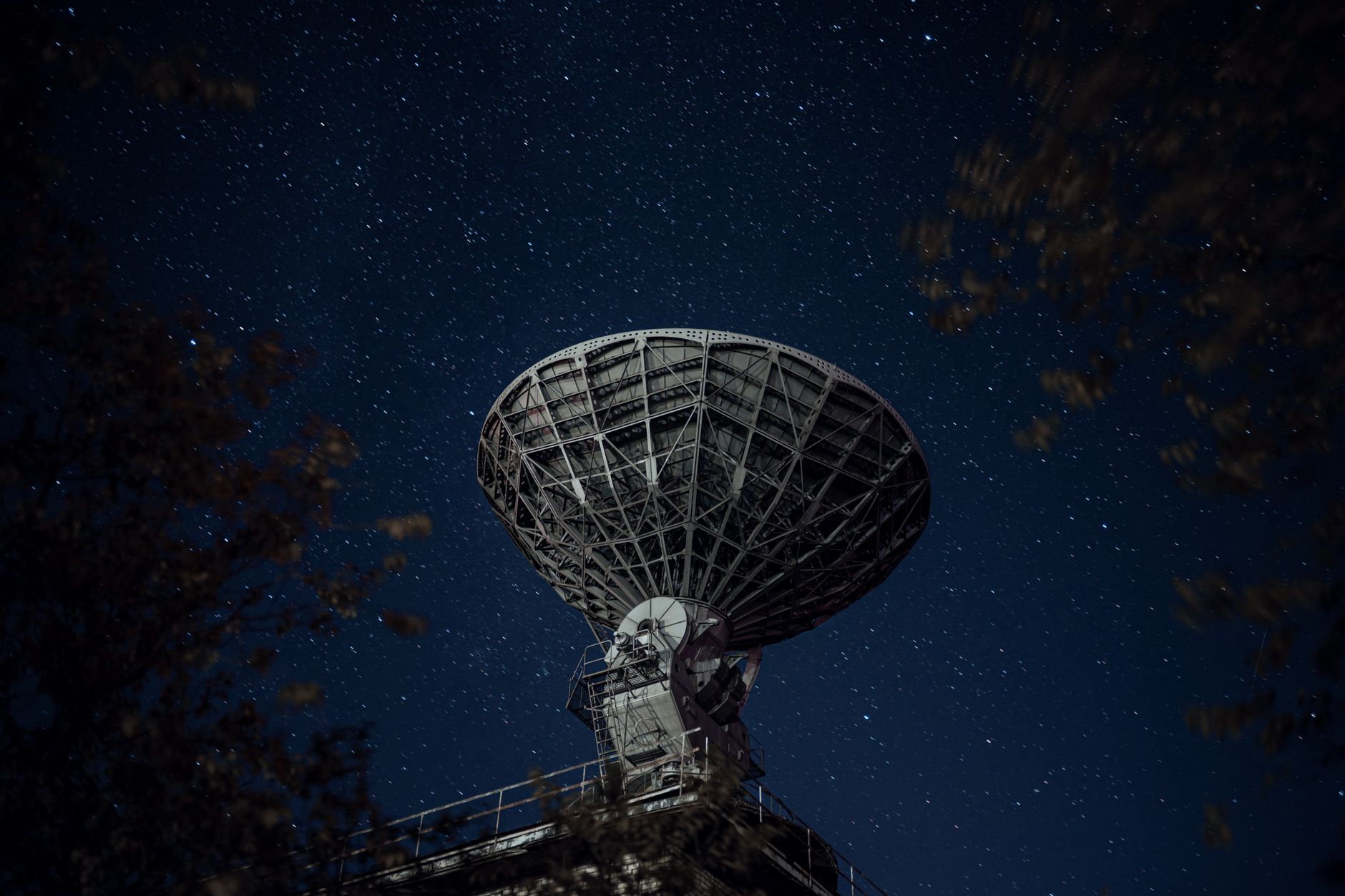
The other half of the story is the ground system that makes the delay survivable. Voyager 1 does not shout back at Earth. It transmits a faint radio signal across billions of kilometres, and NASA’s Deep Space Network has to catch it.
NASA describes the Deep Space Network as an international array of giant radio antennas operated by the Jet Propulsion Laboratory. The network is designed to command, track and monitor distant spacecraft. Its three complexes, in California, Spain and Australia, are spaced around Earth so the planet’s rotation does not break contact with deep-space missions for long. Each site has a 70-metre antenna, and NASA says those antennas are sensitive enough to track spacecraft travelling tens of billions of miles from Earth.
For Voyager, even that is becoming harder. In 2025, NASA’s Office of Inspector General wrote that it takes more than 22 hours and five giant radio antennas to detect Voyager 1’s faint signal, and that a sixth would soon be required as the probe continued outward. The report was about Deep Space Network capacity, not just Voyager nostalgia. The same antennas also support many other missions, from planetary spacecraft to lunar operations.
On the spacecraft side, NASA’s technical description says Voyager uses a 3.7-metre high-gain antenna pointed at Earth. Commands are uplinked at only 16 bits per second, while normal downlink telemetry can be as low as 160 bits per second. Those numbers are tiny by modern communication standards, but they are enough for the kind of work Voyager can still do: accept carefully prepared instructions, report engineering status and return limited scientific measurements.
Old hardware is still making decisions
Voyager 1’s age is part of the difficulty. The spacecraft launched on 5 September 1977, flew past Jupiter in 1979 and Saturn in 1980, then headed out of the plane of the planets after its Saturn and Titan encounter. JPL’s mission profile describes Voyager 1 as the most distant human-made object in existence and notes that it reached interstellar space in August 2012.
The spacecraft is not a passive relic. It still has to keep itself pointed well enough for the high-gain antenna to face Earth. Its command and attitude systems have to receive instructions, maintain orientation and preserve enough electrical margin to avoid demand exceeding supply. NASA’s spacecraft page says the command computer subsystem handles command decoding, fault detection and spacecraft sequencing, while the attitude system maintains the antenna pointing toward Earth.
But the power source is fading. Voyager uses radioisotope thermoelectric generators, which convert heat from decaying plutonium-238 into electricity. As output falls, NASA has to turn off loads to keep the spacecraft alive. That is why the mission has become a carefully managed retreat from its original capabilities.
In April 2026, NASA said engineers shut down Voyager 1’s low-energy charged-particle experiment to conserve power. The instrument had operated almost continuously since launch. The same update said Voyager 1 still had two science instruments operating: one listening to plasma waves and one measuring magnetic fields. The shutdown command itself was shaped by distance. NASA said the command sequence would take 23 or so hours to reach the spacecraft, followed by a shutdown process lasting about three hours and 15 minutes.
Nearly two days is the new heartbeat
The line in the title is therefore not an exaggeration, but it does need the right frame. Engineers do not always wait exactly two days for every activity. Sometimes they can infer that a command was received from a carrier signal or a scheduled change. Sometimes a process onboard the spacecraft takes additional hours after the command arrives. Sometimes the team needs days or weeks to analyse what came back.
The essential constraint remains the same. No spacecraft can send information faster than light, and Voyager 1 is now so distant that light itself has become a slow messenger by human standards. The probe may still be electrically alive. The Deep Space Network may still be able to hear it. The engineers may still know how to write commands for it. None of that makes the round trip quick.
This is the strange administrative reality of interstellar exploration. A command leaves Earth from a giant antenna. Almost a day later, a machine built before the first personal-computer boom receives it in the dark beyond the heliosphere. It may rotate a mechanism, change a memory address, switch off a load or report the health of a system older than most working engineers. Then Earth waits again.
That waiting is now part of the mission’s science and survival. Voyager 1 is no longer just measuring plasma waves and magnetic fields beyond the Sun’s protective bubble. It is also demonstrating what it means to operate a spacecraft when the distance has become so large that even a yes-or-no answer must cross nearly two days of space before it can matter.