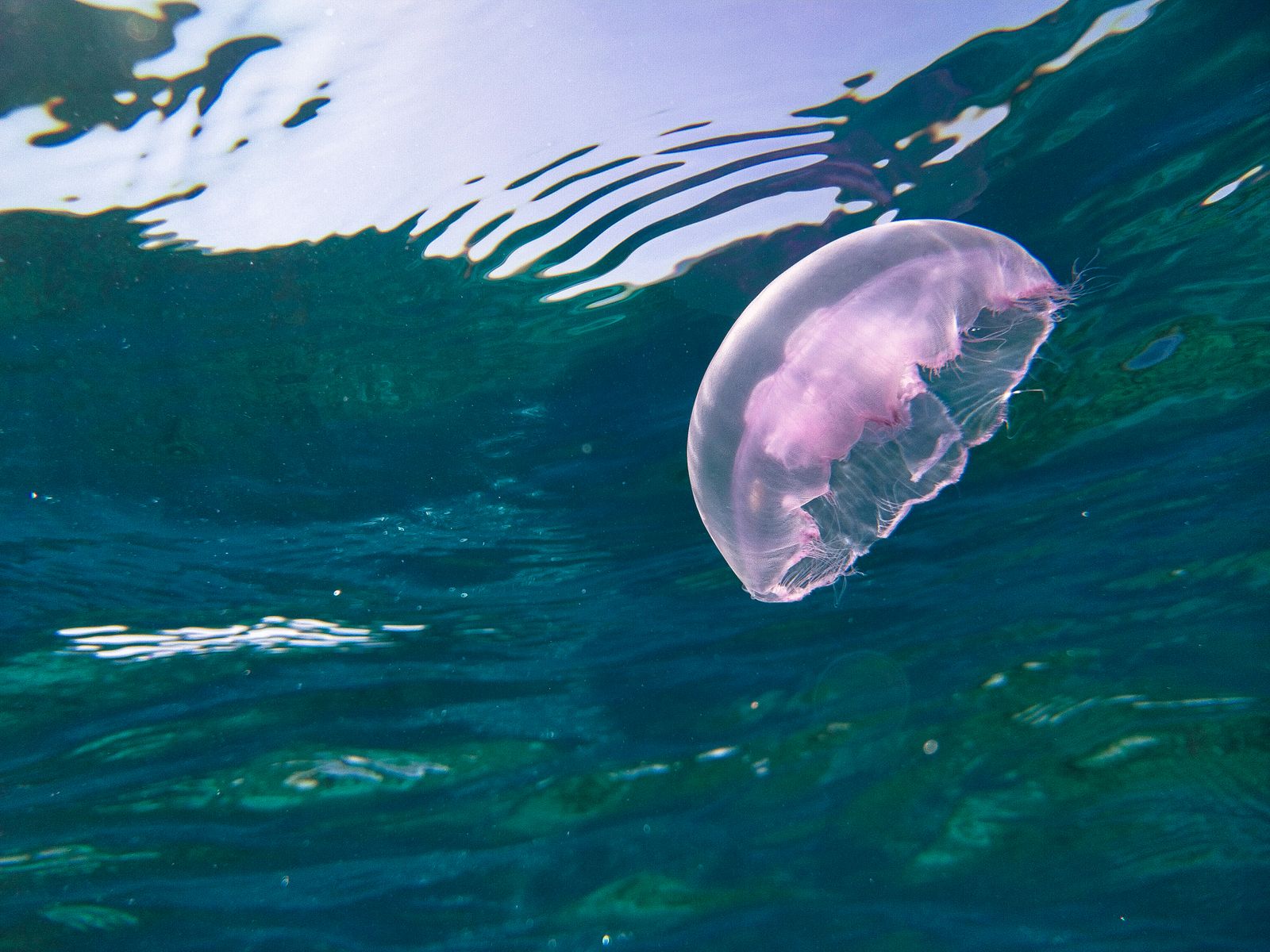
In the plankton drifting through the Mediterranean and now, thanks to ship ballast water, oceans on every continent, a jellyfish no bigger than a fingernail can do something no vertebrate has ever managed. When Turritopsis dohrnii is wounded, starved, or stressed, its adult body dissolves its own tissues, sinks to the seafloor, and reassembles itself as a juvenile polyp — the biological equivalent of a butterfly turning back into a caterpillar. The Natural History Museum in London lists it among the very few animals with no fixed lifespan.
The medusa itself is tiny. Roughly 4-5 millimetres across, translucent, with a bright red stomach visible through its bell and tentacles trailing behind it. You could balance one on the head of a pencil eraser.
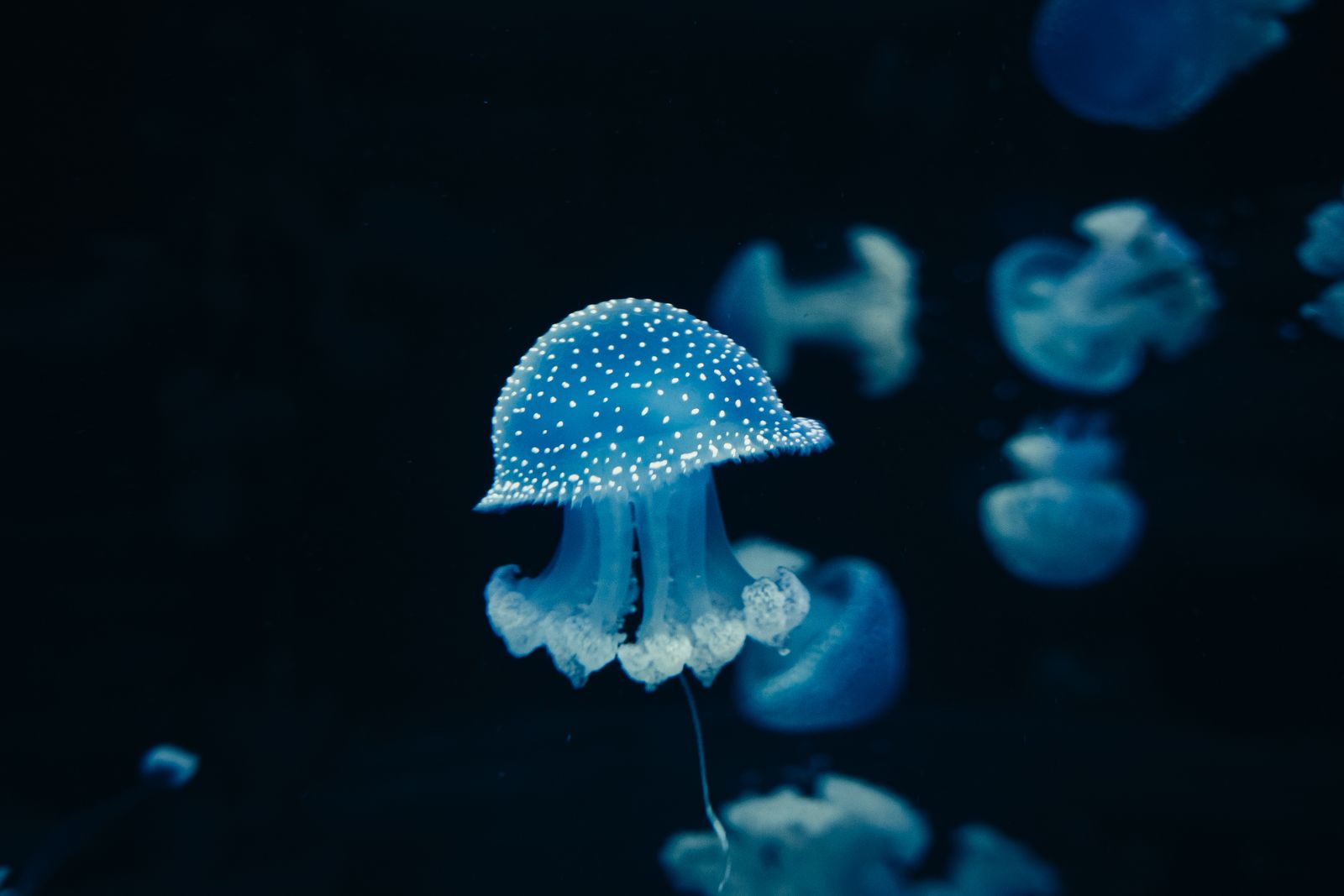
The trick has a name: transdifferentiation
Most cells, once they commit to being a muscle cell or a nerve cell, stay that way. That commitment is why humans age. Skin cells wear out, neurons die, and the body cannot simply reissue the blueprints. Turritopsis dohrnii ignores this rule.
When the adult medusa suffers damage — a torn bell, prolonged hunger, a sudden temperature spike — its cells undergo a process called transdifferentiation, in which specialised adult cells revert to an unspecialised state and then re-specialise as something else entirely. Muscle becomes nerve. Nerve becomes stinging cell. The whole medusa collapses into a small blob on the seabed within hours.
From that blob, a new polyp grows. The polyp is the sessile, plant-like stage of the jellyfish life cycle — a stalk anchored to a rock or shell, budding off tiny clones. In time, those buds detach and swim away as fresh medusae, genetically identical to the animal that dissolved days earlier.
A life cycle that runs in both directions
A normal jellyfish life cycle moves in one direction only: egg, larva, polyp, medusa, death. Turritopsis dohrnii can run that film backwards.
For a century after its first description, nobody noticed anything strange about it. The reversal was spotted only later, when researchers keeping the animals in tanks noticed that stressed medusae were not dying — they were shrinking, sinking, and turning into polyps. As The Boar has recounted, the discovery reframed assumptions about how animals age.
The trigger matters. The reversal is not automatic. In laboratory observation, it kicks in when the animal is physically damaged, environmentally stressed, or approaching starvation. A healthy, well-fed medusa will simply live out its normal adult life. A dying one gets a second draft.
Why it doesn’t just live forever in practice
Immortality on paper is not immortality in the ocean. The jellyfish is small and has no defences worth mentioning. Fish eat it. Sea turtles eat it. Larger jellyfish eat it. Disease kills it. A single unlucky current can slam it into rocks.
So the species is biologically capable of dodging senescence — the gradual decline that kills every mouse, elephant, and human — but it dies constantly from everything else. Biologist Scott Travers has described it as theoretically immortal, a careful phrase that does real work. The mechanism is real. The lifespan-of-the-average-individual is not.
No one knows how many times a single genetic lineage of Turritopsis dohrnii has cycled through medusa and polyp. There is no ring to count, no tooth to slice. A specimen in a jar looks the same whether it is on its first cycle or its five hundredth.
What the genome revealed
Genetic analysis has shown that the immortal species carries extra copies of genes involved in DNA repair, telomere maintenance, and the silencing of harmful mobile genetic elements. It also has variants in genes that control the packaging of DNA inside cells — the machinery that decides which genes are switched on and which are shut off. As biologists have explained in follow-up coverage, that packaging machinery is what allows a fully committed adult cell to unpack its identity and become something else.
In other words, the jellyfish has not invented a new trick. It has an unusually good version of a trick every animal cell can do a little bit of.
Is it really alone?
The claim that Turritopsis dohrnii is the only animal with no fixed lifespan gets thrown around a lot, and it needs qualifying. Several other creatures do strange things with aging.
Hydra, the freshwater relative of jellyfish, appears not to senesce at all in laboratory conditions — its stem cells keep replacing tissue indefinitely, though it does not reverse its life cycle. Some deep-sea sponges can live for thousands of years. The Greenland shark can reach 400 years or more. Lobsters keep growing and moulting until something else kills them.
But among animals that can actually reverse from adult to juvenile — running the film backwards, not just refusing to age — Turritopsis dohrnii is essentially alone. A handful of other hydrozoans show partial reversal under extreme stress, but the medusa-to-polyp trick, executed with the reliability the immortal jellyfish manages, has not been documented in any other free-swimming adult animal.
How it spread to every ocean
The species was originally Mediterranean. It is now found in the Caribbean, the Sea of Japan, the coasts of Panama, Florida, Spain, and Italy — genetically identical populations separated by thousands of kilometres of ocean.
The vector is shipping. Ballast water taken on in one port and dumped in another has carried polyps stuck to hulls and larvae suspended in tanks across the globe. Genetic studies show the populations are so similar that the spread must have happened within the last century or two. A creature that can survive being flushed through a ship’s plumbing, dumped into a strange sea, and rebuilt from scratch on a foreign rock is uniquely suited to hitchhiking.
Which is fitting. The animal already treats death as a logistical problem.
What researchers actually want from it
The obvious question is whether any of this is useful for humans. The honest answer is: not directly, and probably not soon.
Human cells cannot transdifferentiate on demand. Forcing them to do so — as scientists have managed in a limited way with induced pluripotent stem cells — tends to produce tumours as often as it produces useful tissue. Cancer is, in a sense, cells forgetting what they are supposed to be. The jellyfish forgets on purpose and rebuilds correctly. Humans forget by accident and rebuild wrong.
Still, the mechanism offers clues into biological aging that researchers cannot get from any other model organism. Understanding how the jellyfish’s cells shut off their adult identity without triggering runaway growth could inform tissue regeneration research — repairing a damaged heart after a heart attack, or regrowing spinal cord tissue after injury. It could also sharpen the understanding of cancer, which is in many ways the same trick going wrong.
The scale of what a 4-millimetre animal is doing
To appreciate the reversal, consider what would have to happen for a human to do it. Every organ would need to dedifferentiate — the heart’s muscle cells forgetting they were heart, the brain’s neurons unspooling their connections, the skeleton dissolving back into cartilage. The body would collapse into a pool of undifferentiated cells and reorganise itself as an embryo, keeping none of the memories, none of the acquired immunity, none of the injuries.
That is roughly what the medusa does, at a scale of a few thousand cells rather than 30 trillion. The full reversal takes, in laboratory observation, somewhere between 24 and 72 hours. A medusa that is torn or dying at sunset can be a healthy polyp by the same time two nights later.
The polyp, once established, then buds off new medusae the way a strawberry plant sends out runners. A single reverted individual can seed dozens of genetic copies of itself. When those copies mature and are themselves injured, they can revert again. The line, in principle, is unbroken.
An animal older than most nations
Somewhere in the plankton right now — in the Bay of Naples, the Panama Canal, the harbours of Osaka — there are almost certainly polyps whose genetic material has been cycling for longer than any human family tree can be traced. The individual animals are new. The lineage that keeps rebuilding them may be, in a real sense, the same animal.
It is 4-5 millimetres across. It has no brain. It has no heart. It has tentacles, a red stomach, and a bell so transparent you can read a newspaper through it. And when it is time to die, it simply does not.