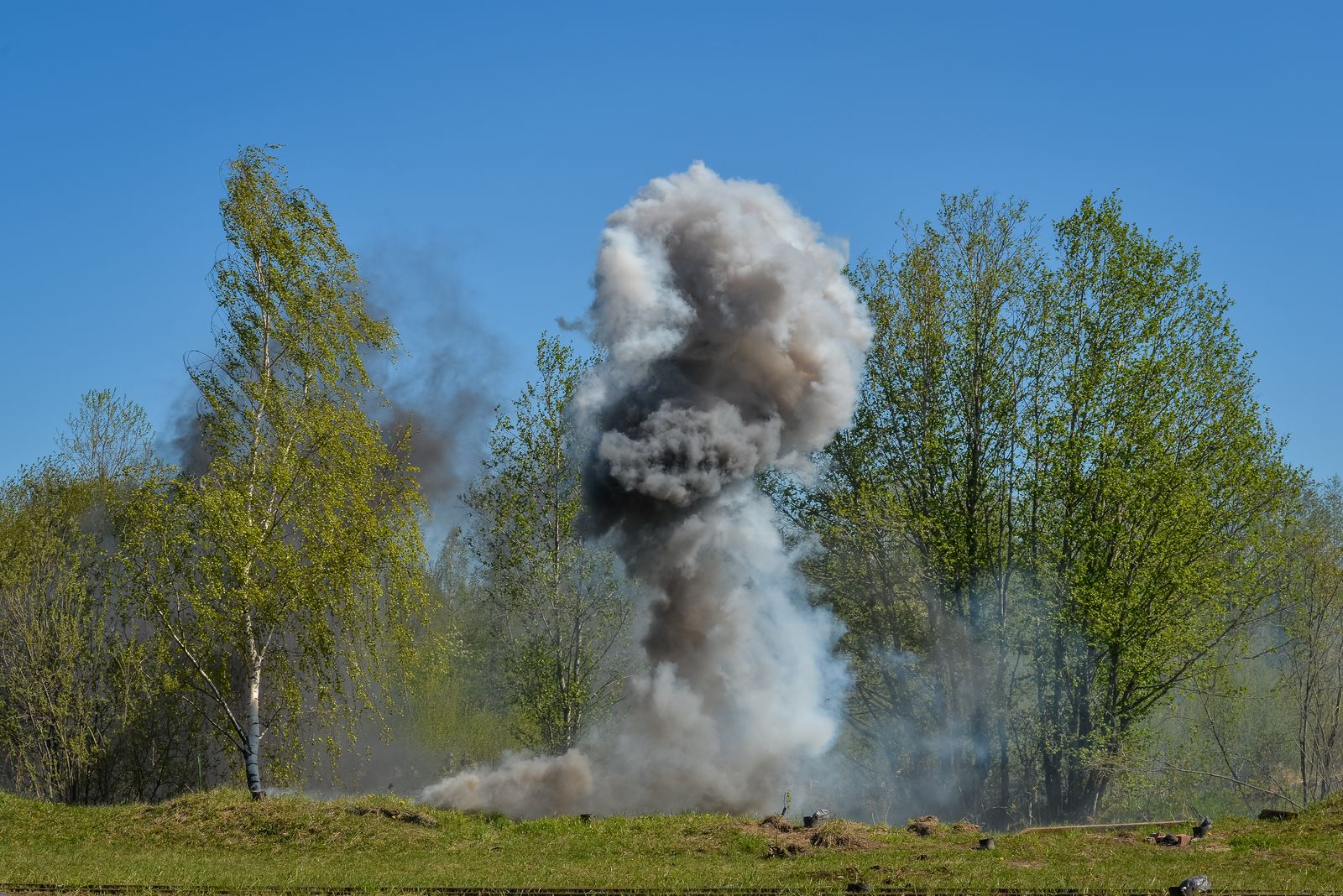
On the morning of 30 October 1961, a Tu-95V bomber lumbered north over the Barents Sea toward the frozen archipelago of Novaya Zemlya, carrying a single weapon so large it could not fit inside the aircraft’s bomb bay. The plane had been stripped of parts of its fuselage to accommodate it. When the bomb fell away on its enormous parachute and detonated four kilometres above the tundra, it released the energy of roughly 50 megatons of TNT — more than ten times the combined force of every conventional explosive used in the Second World War.
The flash was seen roughly 1,000 kilometres away. The mushroom cloud climbed to 64 kilometres, brushing the edge of the mesosphere. More than six decades later, the AN602 — better known as Tsar Bomba — is still the largest explosion humans have ever produced.
A weapon designed to be seen, not used
Tsar Bomba was a political object as much as a military one. Nikita Khrushchev wanted a demonstration. At the 1960 UN General Assembly he had promised to show the United States Kuz’kina Mat — a Russian idiom roughly meaning he would show them something unprecedented. A year later, Soviet physicists led by Andrei Sakharov delivered it.
The bomb weighed 27 tonnes. It was roughly eight metres long and two metres in diameter, about the height of a two-storey building lying on its side. According to Radio Free Europe’s account of the test, the Tu-95V carrying it had been painted with a special reflective white coating to deflect thermal radiation from its own weapon. Even so, the crew was given only a 50 percent chance of surviving.
The original design called for a yield of 100 megatons. Soviet engineers deliberately halved it. The uranium-238 tamper in the third stage — the component that would have doubled the yield through fast fission — was replaced with lead. The result was still catastrophic, but the fallout was reduced dramatically. It became, by ratio of yield to radioactive contamination, one of the cleanest thermonuclear devices ever built.
What 50 megatons actually looks like
Numbers on this scale stop meaning anything without comparison. The Hiroshima bomb was 15 kilotons. Tsar Bomba was roughly 3,300 times more powerful. The largest American test, Castle Bravo in 1954, yielded 15 megatons — itself a catastrophic accident that irradiated Marshall Islanders and a Japanese fishing crew. Tsar Bomba was more than three times that.
The fireball reached about 8 kilometres in diameter. It was so large it touched the ground beneath the detonation point and rebounded upward before the shockwave could arrive. Observers in a filming aircraft roughly 160 kilometres away reported that the flash lit the sky through heavy cloud cover. According to a BBC feature on the weapon, the thermal pulse could have caused third-degree burns at a distance of 100 kilometres. Wooden structures were destroyed hundreds of kilometres from the test site. Windows shattered in Finland and Norway.
The mushroom cloud, documented in War History Online’s technical breakdown, rose to 64 kilometres — roughly seven times the cruising altitude of a commercial airliner. Its cap spread to about 95 kilometres wide. The shockwave circled the Earth three times before dissipating.
The archipelago that absorbed it
Novaya Zemlya was chosen for a reason. The two long islands sit above the Arctic Circle, separated from the Russian mainland by the Kara Sea. Their indigenous Nenets population had been forcibly relocated in 1955 to make way for what became the Soviet Union’s primary nuclear test range. Between 1955 and 1990, 224 nuclear tests were conducted there, including most of the largest ones.
The detonation point sat over Sukhoy Nos, a peninsula on the northern island. Everything within a radius of about 55 kilometres of ground zero was flattened. A village 55 kilometres away — abandoned, but structurally intact before the test — was described afterwards as having been erased. Only foundations remained.
The seismic signature of the blast registered around 5.0 to 5.25 on the Richter scale. That is a moderate earthquake produced by a single bomb. According to a technical analysis published on NextBigFuture, a similar-yield device detonated at sea could have generated tsunami waves large enough to threaten distant coastlines.
The physics of a three-stage bomb
Tsar Bomba was a hydrogen bomb, meaning most of its energy came from fusion rather than fission. The distinction is not academic. Fission bombs, like those dropped on Hiroshima and Nagasaki, split heavy atoms — uranium or plutonium — to release energy. Their yield is limited by the amount of fissile material that can be assembled before the reaction blows itself apart. Fusion bombs use a fission device as a trigger to compress and heat a secondary stage of hydrogen isotopes, which then fuse into helium. That process has no practical yield ceiling. The difference between the two designs is the difference between kiloton and megaton weapons.
Tsar Bomba had three stages. A fission primary triggered a fusion secondary, which was intended to trigger a third fusion stage. In the full 100-megaton design, the outer casing and tamper would have been made of uranium-238, which does not sustain a chain reaction on its own but fissions readily when struck by the high-energy neutrons produced during fusion. Substituting lead for uranium in that tamper eliminated the fast-fission contribution and roughly halved the yield. It also cut the fallout by a factor of ten or more.
The weapon was, in that sense, deliberately gentled. It was still the loudest event on the planet since Krakatoa.
Too big to use
Tsar Bomba was never a practical weapon. The Tu-95V that dropped it had a combat radius reduced so severely by the bomb’s weight that it could barely reach targets in Western Europe and return. No Soviet missile could lift 27 tonnes. The device had no strategic role. Only one was ever built.
The BBC’s history of the weapon describes it as too big to use — a demonstration piece that revealed the outer limit of what thermonuclear physics could produce, and simultaneously showed how meaningless that limit was. A 50-megaton warhead detonated on a city would waste most of its energy pushing air into the upper atmosphere. Smaller warheads, delivered in numbers, do more damage. By the mid-1960s both superpowers were miniaturising weapons to fit multiple warheads on a single missile.
The replica of the bomb casing now sits in a Moscow museum. When the mock-up went on public display, visitors could stand next to a green-painted cylinder the size of a small bus and read the specifications on a placard. The real device had a filming aircraft that recorded roughly 40 minutes of footage from the drop through the mushroom cloud’s dispersal.
Sixty-five years and still the record
No larger explosion — nuclear or conventional — has been produced since. The United States never tested above 15 megatons. The Soviet Union tested a handful of devices in the 20 to 25 megaton range in the years after Tsar Bomba, then stopped. France’s largest atmospheric test was around 2.6 megatons. China’s peak was about 4 megatons. Every subsequent nuclear test, including the recent claimed thermonuclear tests by North Korea — a topic Spacewar has covered in a breakdown of Pyongyang’s claimed H-bomb yields — has been dramatically smaller. The largest North Korean test, in 2017, was estimated at around 250 kilotons, roughly one two-hundredth of Tsar Bomba’s yield.
The 2020 explosion of ammonium nitrate at the Port of Beirut, described by researchers as one of the largest non-nuclear explosions in history, released roughly the energy of a 1.1-kiloton bomb. Tsar Bomba was more than 45,000 times more powerful.
In 2020, Rosatom, Russia’s state atomic energy corporation, declassified a 40-minute documentary showing the full sequence: the bomb being wheeled out on a rail cart, hoisted into the Tu-95V’s modified bay, the drop, and the fireball. The Barents Observer reported that the footage had sat in Russian archives for nearly six decades before being released to mark the 75th anniversary of the Soviet nuclear programme.
What the flash actually showed
Watching the declassified footage now, the strange thing is how small the bomb looks before it falls. It rides on rails. Technicians in fur hats stand near it without ceremony. The Tu-95V taxis under a grey sky. The drop is unremarkable until it isn’t. Then a white sphere blooms, expands, and keeps expanding, and the camera struggles to hold exposure as the horizon glows.
The physicists on the observation aircraft, roughly 250 kilometres away, felt the shockwave arrive as a sustained low rumble. The pilots of the drop plane, having released the bomb from 10,500 metres, were 45 kilometres away when it detonated — the parachute delay was designed precisely to let them escape. The aircraft dropped nearly a kilometre in altitude when the pressure wave hit. It landed safely.
Sakharov, who would later become the Soviet Union’s most famous dissident and a Nobel Peace laureate, wrote afterwards that the test convinced him thermonuclear weapons had passed some invisible threshold. He spent the rest of his career arguing against them.
The cloud, still
Sixty-five years on, the cap of the mushroom cloud has long since dispersed into the stratospheric wind, its carbon-14 signature now diffused into every tree ring grown since 1961. The radioisotopes released by Tsar Bomba and the other atmospheric tests of the era are still detectable in polar ice cores, in the enamel of teeth grown in the 1960s, in the tissue of long-lived Arctic animals.
The village on Sukhoy Nos has not been rebuilt. The Nenets did not return. The northern island of Novaya Zemlya remains a closed military zone, and satellite imagery occasionally shows fresh activity at what was once the largest nuclear test range in history. In late 2023, Russia formally revoked its ratification of the Comprehensive Nuclear-Test-Ban Treaty, though it has not resumed testing.
The bomb itself is a museum piece now. The record it set is holding.