json
{“content”:”
Israel, a country where more than half the land is desert and freshwater rivers are essentially a single modest waterway called the Jordan, produces roughly 95 percent of its own food. The tool that made that arithmetic work is a black plastic tube perforated at intervals with tiny emitters, laid along the base of a plant row, releasing water one slow drop at a time directly onto the root zone. It is called drip irrigation, and it was refined into a commercial system in the Negev desert in the 1960s by an engineer named Simcha Blass working with Kibbutz Hatzerim, which became the company Netafim.
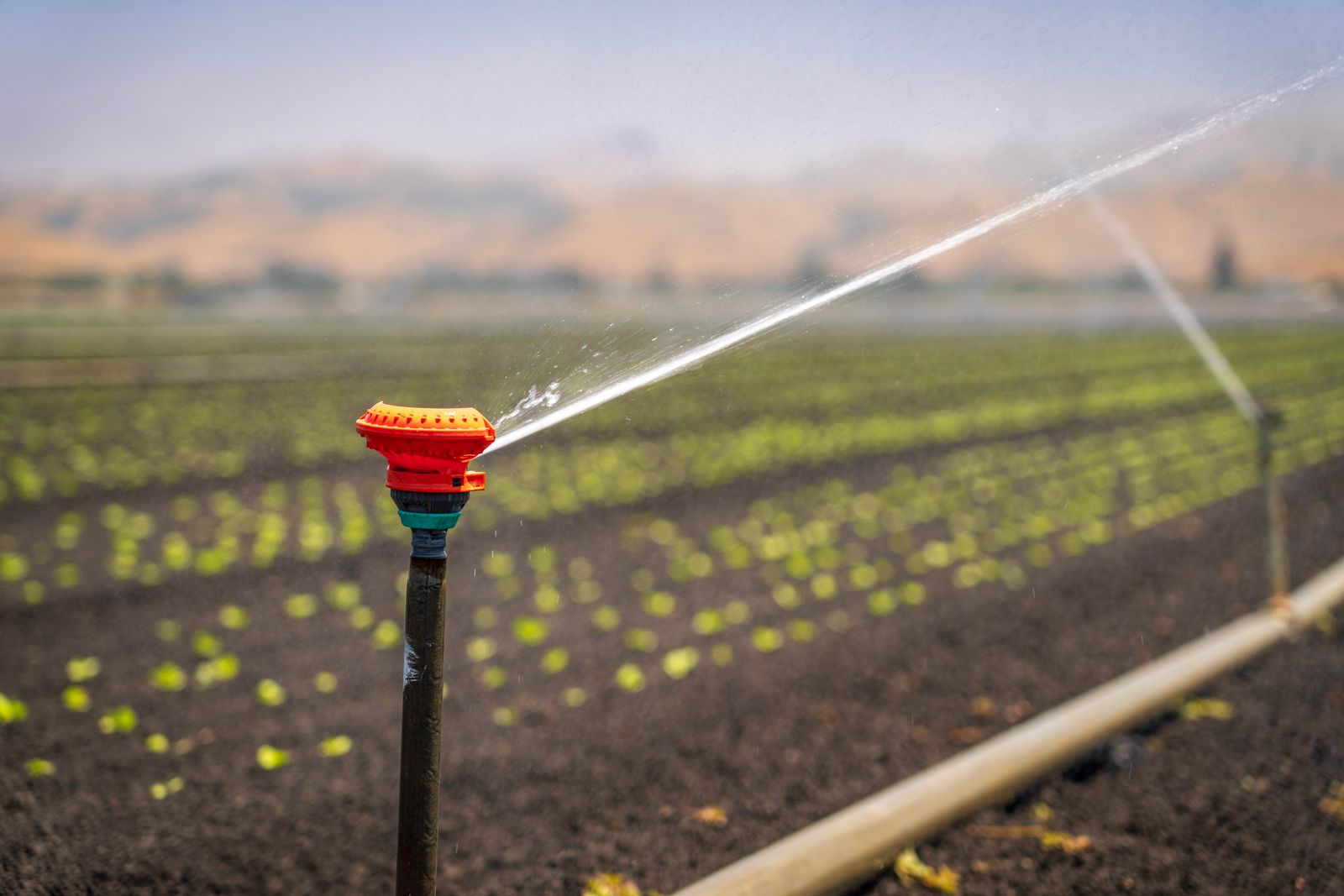
The mechanism is almost embarrassingly simple. A conventional flood or sprinkler system throws water into the air and onto the soil, where somewhere between 40 and 60 percent of it is lost to evaporation, wind drift, deep percolation past the roots, and runoff. A drip line delivers water at low pressure straight to the plant, so field trials and extension data consistently show water savings in the range of 20 to 50 percent or more compared with conventional methods, a figure the American Farm Bureau Federation cites when describing how western U.S. growers have adapted the same technology.
The black tube and the arithmetic of scarcity
Blass’s insight came from a leaky faucet. He noticed a tree next to a dripping pipe growing conspicuously larger than its neighbors, even though the surface soil looked dry. Water applied slowly and continuously, he realized, spreads sideways underground into a bulb-shaped wet zone that matches the root system with unusual precision. A crop grown that way never sits in a puddle and never quite dries out.
The economic consequence for a desert nation is enormous. Israeli agricultural output, measured by volume of crops produced, grew roughly sixteen-fold between the founding of the state in 1948 and the early 2000s, according to figures published by Israel’s Central Bureau of Statistics and cited in agricultural histories. Water consumption per unit of crop, over the same period, fell sharply. The country now recycles about 90 percent of its wastewater, most of which is routed back to farms — a rate that is roughly five times higher than the second-place country, Spain.
Why evaporation is the enemy
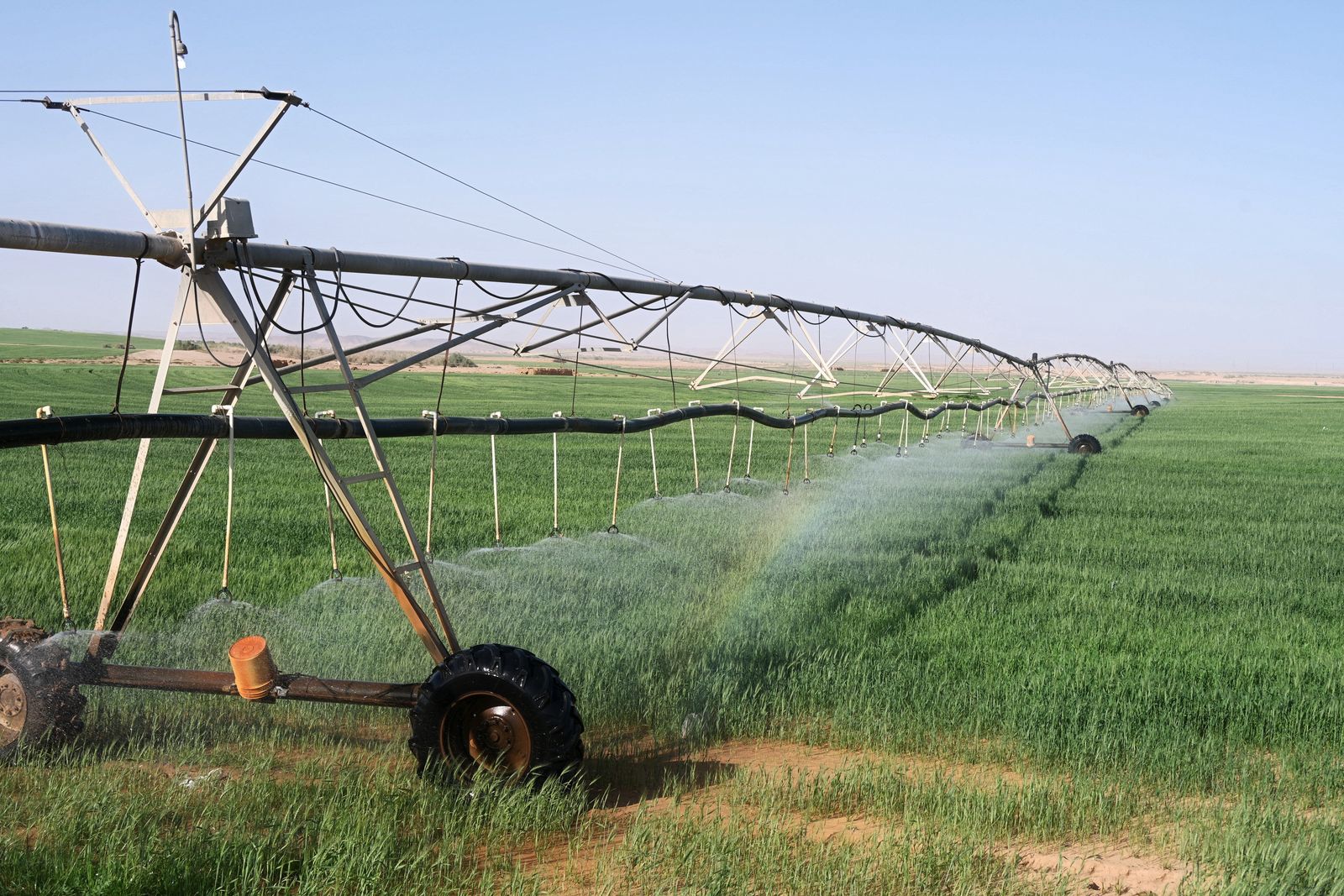
In hot, dry climates, the physics of open-air irrigation are brutal. A center-pivot sprinkler on a summer afternoon in the Negev, the Sonoran, or the North China Plain can lose a quarter of its water to the atmosphere before the droplets ever hit a leaf. Flood irrigation loses even more to seepage into unlined ditches and to percolation beneath the root zone, where it becomes unavailable to the plant.
Drip irrigation cuts nearly all of those losses at once. Because water is emitted directly onto the soil surface or, in subsurface systems, several centimeters underground, there is no aerial phase during which the sun and wind can steal it. Coupled with lined concrete canals that curb seepage and evaporation on the way from reservoir to field, the delivery system starts to approach the theoretical minimum: a farm that uses only the water the plants actually transpire.
Field research on sorghum forage grown under deficit irrigation, published in Nature, has shown that carefully calibrated under-watering combined with precise delivery can maintain yields while cutting applied water substantially — the same principle Israeli and Arizonan growers now apply across dozens of crops.
Sensors, fertigation, and the smart field
The tube alone would have been a large improvement. What turned it into a step change was pairing it with sensors and dissolved fertilizer. Soil-moisture probes buried at root depth report back to a controller every few minutes. Weather stations track evapotranspiration in real time. When a field starts to dry, the valve opens; when it hits target moisture, the valve closes. Farmers monitor the whole system from a phone.
Fertilizer travels down the same tube in a technique called fertigation. Rather than broadcasting nutrients across a field where most of them wash away, growers dissolve nitrogen, phosphorus and potassium into the irrigation water and deliver them straight to the roots in the exact quantities the plant is using that week. A 2023 study in Frontiers in Agronomy on water–fertilizer coupling technology found that combining precise irrigation with matched nutrient delivery raised both soil health and crop yields while cutting input waste.
Greenhouses that recycle their own air
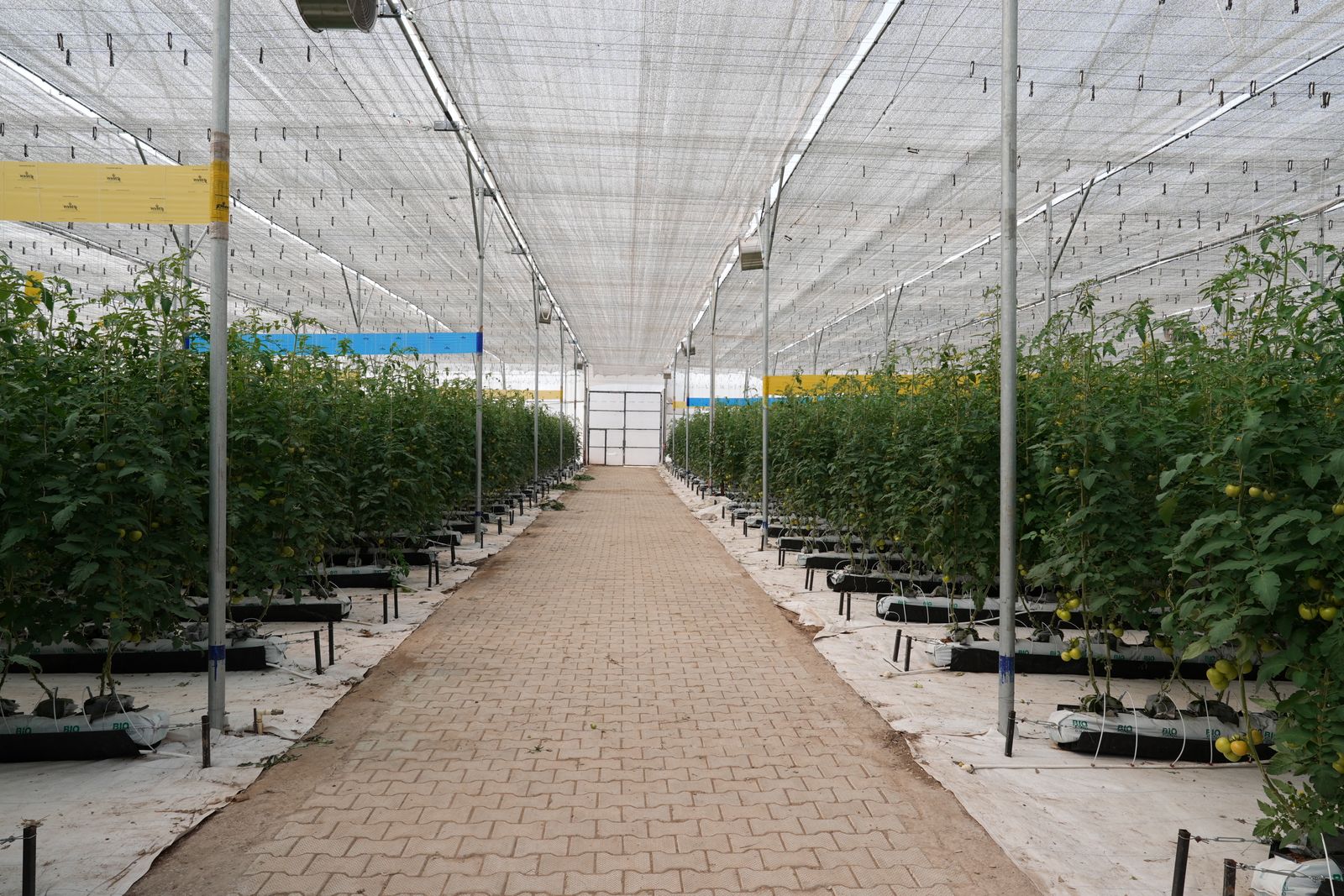
The second Israeli move was to put high-value crops — tomatoes, peppers, cucumbers, herbs — inside sealed greenhouses. Once the roof is on, water that would have evaporated into the sky instead condenses on the ceiling and drips back down to be captured. Humidity, CO₂, and temperature become variables the grower controls rather than accepts.
A Nature analysis of next-generation water-saving strategies for greenhouses describes a nexus of technologies — closed hydroponic loops, condensate recovery, LED supplemental lighting — that together allow a modern greenhouse to produce a kilogram of tomatoes on a small fraction of the water a field crop requires. Israeli greenhouse tomatoes routinely yield more than 300 tonnes per hectare per year, roughly ten times the open-field average, on a per-kilo water budget that is a small fraction of the field-grown crop.
The recycled sewage nobody wants to talk about
The third leg is wastewater. Israel’s Shafdan plant, south of Tel Aviv, treats the sewage of the Dan metropolitan region and pipes the treated effluent to the Negev, where it irrigates cotton, alfalfa, and orchards. Treated wastewater now supplies roughly half of Israel’s agricultural water. It is not used on crops eaten raw, but for forage and fiber crops it closes the loop entirely: water flushed down a Tel Aviv toilet on Monday grows an alfalfa bale in the Negev on Friday.
That matters because the alternative — pumping fresh groundwater or desalinated seawater onto forage crops — is enormously expensive. Alfalfa is famously thirsty. In the American West, the crop has become the flashpoint of the Colorado River crisis; E&E News has reported that alfalfa consumes a disproportionate share of the river’s water even as reservoirs shrink. Israel grows alfalfa too, but on recycled effluent, which changes the calculus.
Desalination fills the gap
When the recycled water and the drip lines still aren’t enough, Israel turns to the Mediterranean. Five large seawater desalination plants along the coast — Sorek, Hadera, Ashkelon, Palmachim and Ashdod — together supply the majority of the country’s drinking water. Sorek alone produces about 624,000 cubic meters of fresh water a day using reverse osmosis, at an energy cost that has fallen by roughly half over the past two decades as membrane technology improved.
Desalinated water is more expensive than pumped groundwater but cheaper than crop failure. By routing desal water to cities and recycled wastewater to farms, Israel effectively decoupled its agricultural sector from rainfall.
The technology travels
Netafim, the company that grew out of Kibbutz Hatzerim, now sells drip systems in more than 110 countries. Indian sugarcane growers in Maharashtra, Californian almond orchards, Kenyan flower farms and Chinese cotton fields all run the same basic hardware. The Arizona Farm Bureau notes that western U.S. farms have driven agriculture’s share of state water use down from 90 percent to about 72 percent, largely through the same suite of tools: drip lines, lined canals, surge irrigation, soil-moisture sensors and deficit-irrigation strategies.
Nevada, the driest U.S. state, is running a parallel experiment. The University of Nevada, Reno’s Desert Farming Initiative coordinates a Nevada Farmers Forum where small growers trade notes on lean production and water-efficient practices — the same farmer-to-farmer knowledge transfer that spread drip irrigation through the Israeli kibbutz movement half a century ago.
The climate dividend
Water savings are only half the story. Precision irrigation also cuts the carbon footprint of a crop, because pumping water is one of the most energy-intensive parts of farming. A Nature Index review of carbon footprint reduction in crop production highlights that fertilizer manufacture and diesel consumption dominate agricultural emissions, and that precision nutrient management — the exact thing fertigation enables — is one of the most effective levers for cutting them.
Less water pumped means less electricity used means fewer emissions per tomato. The same review notes that intercropping and reduced-tillage practices, layered on top of efficient irrigation, can turn some cereal systems from net carbon emitters into modest sinks.
What the black tube couldn’t fix
Efficiency has limits, and Israel has hit some of them. Aquifers under the coastal plain have been overdrawn for decades and now suffer saltwater intrusion. The Sea of Galilee, the country’s largest freshwater lake, has repeatedly dropped below its red line. Efficient irrigation lets a country grow more food per drop, but it does not create new water — and where subsidies keep the price of agricultural water low, farmers sometimes use their gains in efficiency to expand acreage rather than to save.
The pattern shows up wherever drip has spread. In parts of India and the American Southwest, adoption of the technology has correlated with stable or even rising aggregate water use, because thirstier crops replaced hardier ones once the water budget seemed to allow it. The tube is a tool, not a policy.
A leak, a tree, a country
Sixty years after Simcha Blass noticed one tree drinking better than the rest, the black plastic tube he refined runs under vineyards in Napa, cotton fields in Xinjiang and greenhouse tomatoes in the Netherlands. Israel exports the hardware, the software, the desalination plants and the wastewater engineering as a package.
Coverage of long-duration engineering feats has been a recurring beat here — the terracing of the Loess Plateau is one recent example, and the durability of Voyager 1’s four-decade signal is another. Drip irrigation belongs in the same category: a small mechanical idea, iterated stubbornly across generations, that quietly rearranged what a landscape could produce.
The next time you cut into an out-of-season tomato in January, look at where it was grown. If the label reads Almería, or the Negev, or Sonora, there is a black plastic tube behind it, releasing water one drop at a time onto a root that never sees the sky.
“,”excerpt”:”How Israel turned the Negev into a farm export power using drip irrigation, recycled sewage, and desalinated seawater — and why the black plastic tube invented on a kibbutz in the 1960s now runs under fields in 110 countries.”}