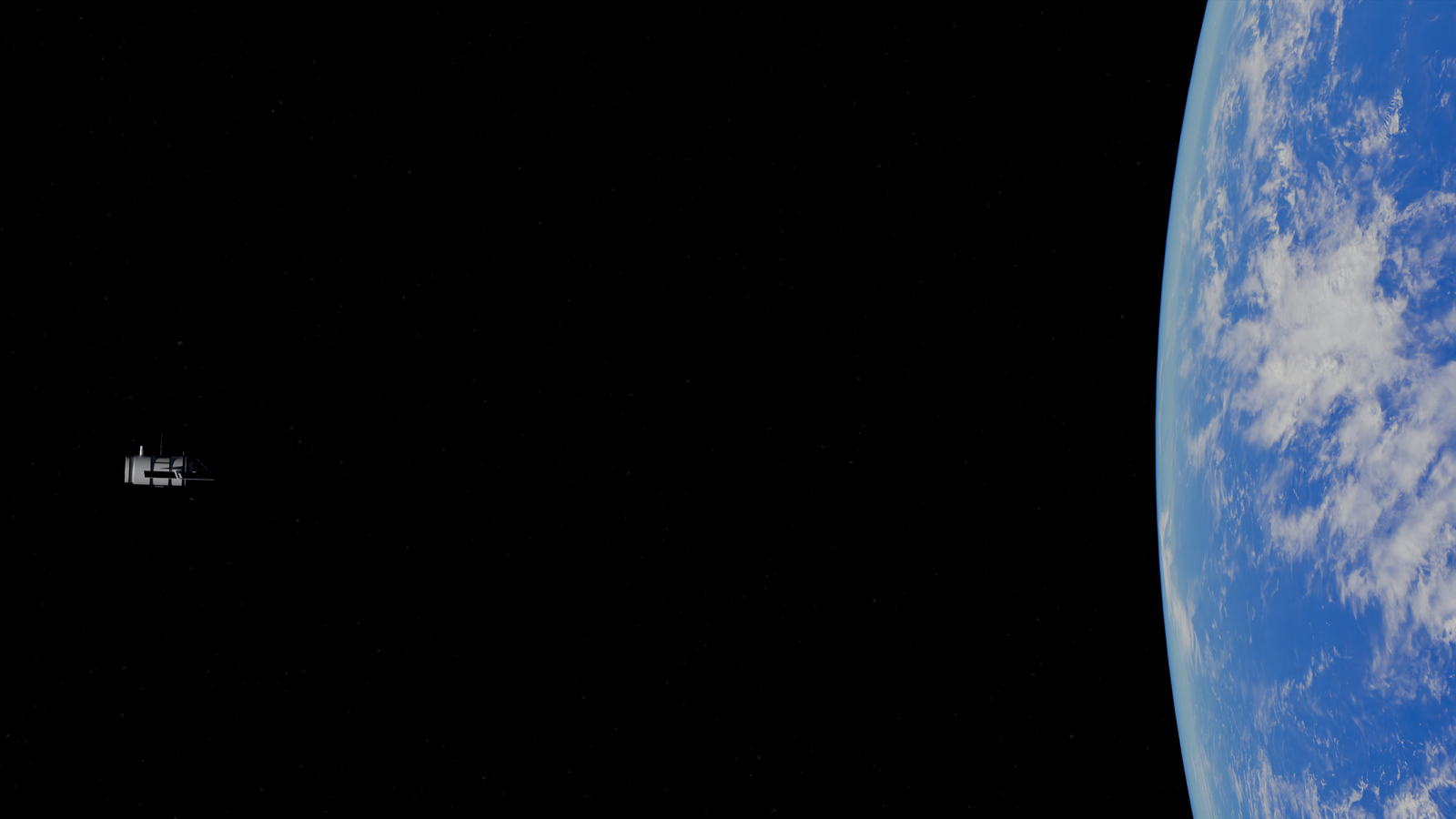
Every time a phone finds itself on a map, it is quietly trusting Albert Einstein. The atomic clocks aboard GPS satellites orbiting above Earth’s surface tick faster than identical clocks on the ground — by approximately 38 microseconds every day — and if that discrepancy were not engineered out before launch, the entire system would drift significantly within 24 hours. The physics that keeps GPS working demonstrates that without relativity, satellite navigation would render itself useless in a matter of hours.
The number breaks down into two competing effects. Special relativity slows the satellite clock because the satellite is moving at high speed relative to the ground. General relativity speeds it up because Earth’s gravitational field is weaker at GPS orbital altitude than it is at sea level. The net result is a gain of approximately 38 microseconds per day — time itself, running faster in orbit.
Why the altitude matters
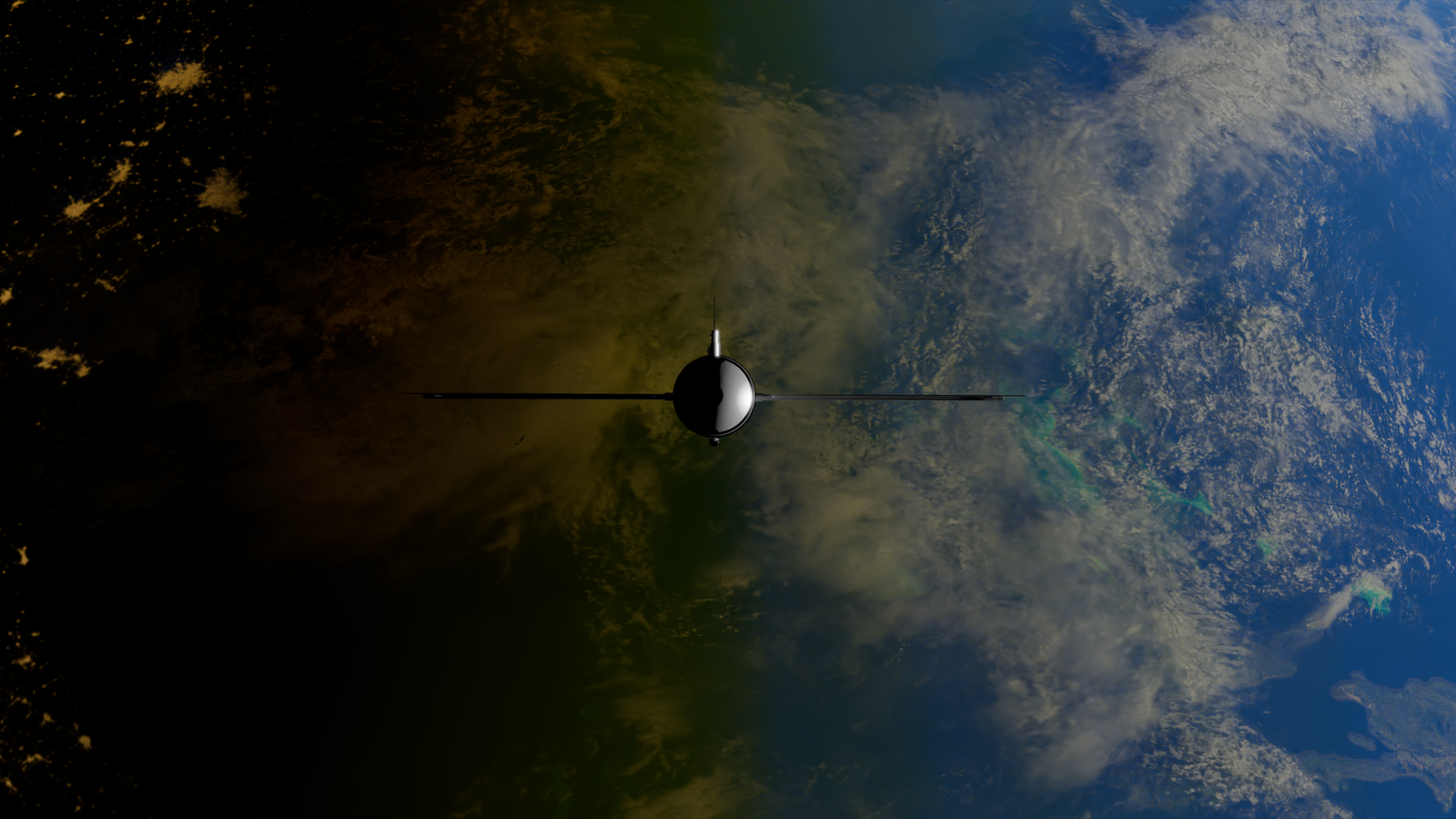
GPS satellites sit in medium Earth orbit, well above the International Space Station and well below geostationary orbit. Low Earth orbit satellites like CHAMP and GRACE have flown at lower altitudes, deep inside Earth’s atmospheric drag envelope. GPS operates much higher, where the air is essentially absent and the gravitational potential is measurably weaker.
That weaker gravity is what does the work. Under general relativity, a clock deeper in a gravitational well ticks more slowly than one further out. Move a wristwatch from your ankle to your forehead and, in principle, it runs faster — the effect is real, though far too small to notice without an atomic clock. At GPS altitude, the potential difference between the satellite and the ground is enough to produce a gain of approximately 45 microseconds every day. Multiplied across a constellation, across years, that becomes the difference between finding a restaurant and finding the wrong city.
Engineering the correction before launch
The fix is elegant. Before a GPS satellite ever reaches orbit, its onboard atomic clock is deliberately tuned to run slow. Once the satellite is on station, the combined effects of special and general relativity pull the clock’s apparent rate back up to the correct frequency as seen from Earth.
Engineers, in other words, pre-compensate for Einstein. The satellite launches knowing time will speed up for it, and it carries a clock deliberately mistuned to arrive at the correct rate only once it is in the weaker gravitational field. As The Indian Express explained in a technical walkthrough of the system, without this correction the errors would compound minute by minute until the receiver in a car’s dashboard could no longer tell one intersection from the next.
How small a microsecond really is
A microsecond is one millionth of a second. Light travels approximately 300 metres in that time. So a 38-microsecond daily error, uncorrected, would translate into significant positioning errors — GPS without relativity is not slightly worse, it is unusable.
The satellites themselves carry rubidium and caesium atomic clocks with extraordinary precision. Even nanosecond-level timing errors translate to positioning errors. The whole architecture is built on the premise that you can measure the flight time of a radio signal so precisely that even Einstein’s tiny gravitational tick counts.

The fourth satellite trick
Consumer devices do not carry atomic clocks. A smartphone runs on a cheap quartz crystal oscillator with errors in the microsecond range — the same order of magnitude as the relativistic effect itself. So the receiver uses a fourth satellite not to add a location dimension, but to solve for its own clock error. Three satellites give a position in three-dimensional space. A fourth lets the receiver correct its own drift, forcing the four calculated distances to converge on a single point.
Modern smartphones typically listen to multiple satellites at once, pulling signals not only from the American GPS constellation but also from Russia’s GLONASS, Europe’s Galileo, and China’s BeiDou. The redundancy is what pushes accuracy from tens of metres down to a few metres. And every satellite in every one of those constellations carries the same relativistic pre-correction baked into its clock.
Testing Einstein above the atmosphere
The relativistic correction is not a theoretical adjustment that engineers accept on faith. It has been measured, cross-checked, and now refined by newer missions. SpaceX has launched atomic clocks connected by lasers explicitly designed to test Einstein’s predictions against ever finer thresholds. The experiment aims to measure gravitational time dilation with enough precision to probe the boundaries between general relativity and quantum mechanics — the region where physics still lacks a unified theory.
The GPS constellation itself is one of the largest continuously running experiments in general relativity ever conducted. Every day, in every satellite, the correction holds to within the tolerance of the atomic clocks themselves. If Einstein had been wrong by even a small fraction, satellite navigation would have failed decades ago and the discrepancy would have exposed the error.
Gravity bends time — and space
The intuition most people carry about gravity is Newtonian: mass pulls on mass. Einstein’s insight was that mass warps the geometry of spacetime itself, and that clocks and rulers behave differently depending on where they sit in that warped geometry. As a recent explainer on gravitational time dilation notes, moving a clock closer to the ground makes it tick measurably slower than an identical clock held higher up — an effect that has been confirmed in laboratories using atomic clocks.
At GPS altitudes the effect is significant. At the event horizon of a black hole, time effectively stops for an outside observer. Between those extremes lies every clock ever built, each ticking at a rate dictated by its position in Earth’s gravitational field. This is the same physics that makes time dilation a genuine, if impractical, pathway to time travel — astronauts on long-duration missions return to Earth having aged fractionally less than the people they left behind.
The human body knows the difference too
Orbit changes more than clocks. Astronauts aboard the International Space Station experience physiological shifts that would be impossible on Earth. Free of Earth’s gravitational load, astronauts can grow taller within weeks as their spinal discs rehydrate and expand. The same weakening of gravitational pull that stretches an astronaut’s spine is what speeds up the atomic clock in a GPS satellite. Both are consequences of moving away from the mass of Earth.
The astronaut effect is temporary — spines compress again on return. The clock effect is permanent for as long as the satellite stays in orbit, which is why the pre-launch tuning is so critical. There is no way to reset a GPS clock from the ground without disrupting the entire constellation’s synchronisation.
What the correction enables
The 38-microsecond figure is the reason a delivery driver in Jakarta can be routed within metres of a doorway, the reason a container ship can enter a fog-bound harbour without a pilot boat, the reason a farmer’s combine harvester can drive itself through a field of wheat to within a hand’s breadth of the previous pass. It is also the reason that precision-guided munitions can hit a target from hundreds of kilometres away, and the reason that a downed pilot’s beacon can be located to within a city block.
Newer NASA missions continue to depend on this same relativistic bookkeeping. The NISAR Earth observation satellite, a joint NASA-ISRO mission, carries GPS receivers that provide precision orbit determination and onboard timing references down to the pulse per second. Its synthetic aperture radar can detect ground deformation as small as 4 millimetres per year — a measurement that would be meaningless if the underlying timing were even microseconds off.
An experiment that never stops
Every microsecond of every day, in every one of the GPS satellites currently on orbit, an atomic clock ticks a little faster than it would on Earth. Ground stations at Schriever Space Force Base in Colorado monitor the drift, upload corrections, and keep the constellation aligned to within a few nanoseconds of Coordinated Universal Time.
The whole system is a running physical confirmation of a theory Einstein published in 1915, translated into the mundane act of finding a coffee shop. The satellites do not care about the elegance of the equations. They simply tick, faster than they should, exactly as predicted, and the maps on a billion phones keep working because engineers decided a century after Einstein that his numbers were worth trusting to the eighth decimal place.
Somewhere above, right now, an atomic clock is running faster than the identical clock it left behind at the factory. Give it a day, and it will be 38 microseconds ahead. Give it a year, and 14 milliseconds. The satellites will keep gaining time for as long as they orbit — a small, permanent lead over the ground, engineered in advance, measured continuously, and quietly holding the world’s navigation together.