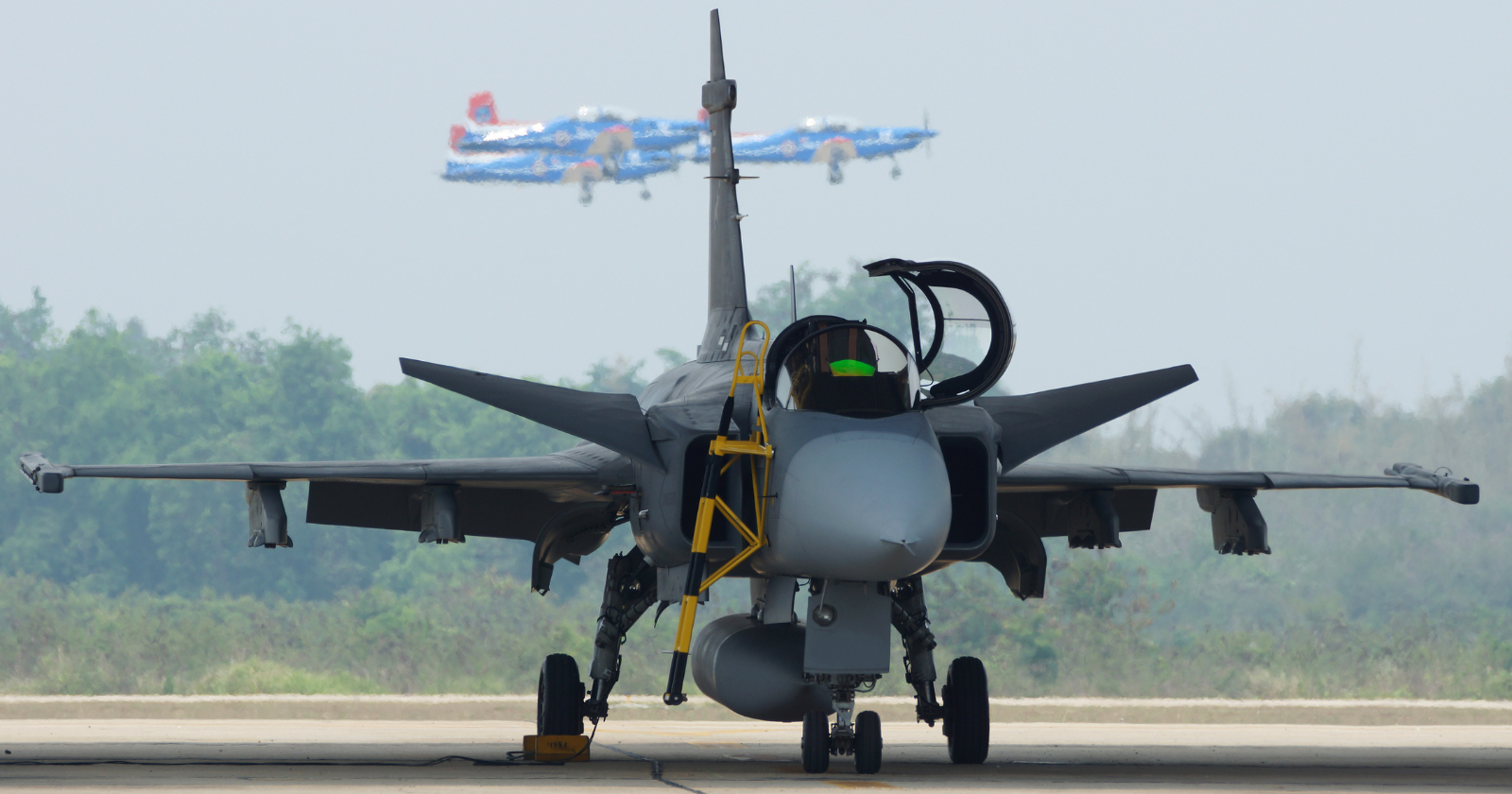
Sweden did it by designing the fighter, the road and the ground crew as one weapon system. Its Cold War Bas 90 network scattered aircraft across 800-metre road strips and wooded servicing sites, while the Saab Gripen was engineered for short landings and a usual ten-minute refuel-and-rearm turnaround. The aim was brutally simple: an enemy’s first strike should not destroy the Swedish Air Force before it could take off.
Bas 90 was less an air base than an inhabited piece of landscape. A main runway, several short strips, taxi roads, fuel trucks, ammunition trailers, command posts and small teams were distributed across kilometres of forest. A pilot could land on what looked like a country road, disappear between the trees and emerge ready for another sortie.
The cleverness was not any single feature. Short-field aerodynamics would have meant little without mobile fuel, and hidden parking bays would have meant little if a fighter needed a hangar full of specialists. Sweden made every part answer the same question: how do you keep flying after the obvious runway has been bombed?
The day an air force died on the ground
The warning arrived from far outside Scandinavia. On 5 June 1967, Israeli aircraft struck Egyptian airfields and destroyed much of Egypt’s combat aviation on the ground during the opening hours of the Six-Day War. A Swedish historical account of Bas 90 records the conclusion drawn by the air staff: concentrating aircraft and equipment inside a small area made them dangerously easy to kill.
For officially neutral Sweden, that vulnerability was existential. It sat between NATO and the Soviet Union, defended a long coastline and expected to fight without the guarantee of allied reinforcements. As a recent Air University study of Swedish dispersed basing explains, armed neutrality drove the country to build a large air force, a domestic aircraft industry and a system intended to survive on the ground.
Sweden already had Bas 60, an earlier dispersal scheme created in the 1950s for the age of nuclear attack. By the mid-1970s, the armed forces controlled about 50 airfields, including roughly 20 active or former wings and a larger set of reserve bases. A 1991 RAND assessment of the Swedish Air Force captured a force still shaped by that deep national infrastructure.
The threat then became more precise. Conventional warheads and cluster munitions could cut runways, scatter unexploded bombs and damage aircraft parked close together without requiring a nuclear strike. Bas 90, developed from the late 1970s and fielded in the 1980s, answered by dispersing not only between bases but within each base.
An air base spread across the forest
A typical Bas 90 complex began with a conventional main runway about 2,200 metres long. The documented layout could add as many as five auxiliary strips, each with roughly 800 metres of usable pavement, spread across a zone 10 to 15 kilometres wide. Losing the main runway therefore did not mean losing the base.
The aircraft were scattered too. Historical plans allowed for 20 to 40 parking and servicing positions, while a modern Swedish description of Hagshult says the concealed stands were preferably at least 500 metres apart. Trees screened the aircraft from casual observation, and distance reduced the chance that one attack would destroy several at once.
Asphalt taxiways and adapted public roads connected the pieces, allowing fighters to move under their own power. Trials began at Hagshult in 1981 and 1982 because the site already had a useful road network, and exercises soon tested whether communications, traffic control and servicing could function across the enlarged footprint. The base was a web rather than a dot.
The short strips were austere by design, but they were not magical. Many had no runway lights or permanent landing aids and were intended mainly for good weather; the main runway remained preferable when it was available. Bas 90 traded the convenience of one fully equipped airfield for the survivability of many imperfect options.
Behind the aircraft moved a second network of trucks and people. Mobile units carried fuel, weapons, electrical support and tools to whichever site was active, while protected command posts and redundant communications passed orders across the base. The Air University study describes earlier Bas 90 supply teams of two technical officers and 21 conscripts, but the Gripen would shrink that footprint dramatically.
The fighter built around the road
The Saab 37 Viggen embodied the road-base idea in its airframe. Its canard foreplanes helped at low speed, and a thrust reverser shortened the landing roll, let the aircraft back up under its own power and reduced its dependence on towing vehicles. The aircraft and basing study also describes a tactical landing system that helped pilots acquire and align with short, partly concealed runways.
The JAS 39 Gripen inherited the requirement but met it with a smaller, lighter airframe. Its canards increase lift during the approach and then help press the aircraft onto the pavement after touchdown, making wheel braking more effective. Nose-wheel brakes replaced the Viggen’s heavy thrust-reversing arrangement, and Saab gives the specified road footprint as about 800 by 16 metres.
That still asks a great deal of the pilot. During an April 2026 exercise at Hagshult, the Swedish Armed Forces described a Gripen crossing the threshold at just under 300 kilometres per hour, with trees close on either side and heavy braking beginning immediately. An 800-metre road is long to a driver and startlingly short to a fighter pilot.
Once stopped, the aircraft was designed to need as little outside help as possible. Built-in test equipment tells maintainers where faults lie, major components can be replaced as units, an onboard auxiliary power unit reduces reliance on ground machinery, and quick-opening panels shorten access time. Saab says even an engine change can be completed in less than an hour.
The ten-minute figure needs one important boundary. Saab describes it as the Gripen’s usual turnaround, including refuelling and rearming, while a later manufacturer account gives up to 15 minutes for a full rearm and refuel for any mission. Weapons load, inspection needs and local conditions change the clock, but both figures describe the same design priority: minutes on the road, not hours in a hangar.
Ten minutes beneath the pines
The sequence begins when the Gripen turns off the strip and taxis into a small lay-by under the trees. An Air University account of a 2024 Swedish exercise describes a support team of one full-time technician and three conscripts waiting there, with specialist vehicles positioned nearby. The scene looks closer to roadside repair than to a modern fighter base.
Each person has a narrow set of rehearsed jobs. Fuel flows, the aircraft is inspected, weapons are made ready and fitted, and the pilot receives what is needed for the next mission. Simple hand-operated equipment can replace heavy machinery, keeping the team small enough to move before the site becomes a fixed target.
Speed depends as much on authority as on tools. Dispersed crews may lose contact with higher headquarters, so commanders must state their intent in advance and trust local teams to act. The hardest part is often not landing the jet but getting the right fuel, ammunition, people and orders to the same hidden strip at the right moment.
That is the real meaning of the ten-minute turn. The stopwatch measures the visible work beside the aircraft, but the system has been preparing for hours or days: trucks dispersed, routes selected, loads assigned and alternate strips kept clear. Sweden hid the fighter inside a moving schedule as much as beneath a canopy.
Can the forest still hide a fighter?
After the Cold War, Sweden abandoned the full Bas 90 organization and closed many sites as its armed forces contracted. The strategic weather changed again after Russia’s attacks on Ukraine, and Sweden became a full NATO member on 7 March 2024, a shift recorded by the Swedish government. The road-base skill now sits inside a wider alliance posture, alongside Gripen deployments for NATO air policing.
Hagshult shows that the old logic is active rather than nostalgic. During the 2026 Aurora exercise, pilots used two 800-metre short strips that could keep aircraft moving if the main runway were damaged. The jets still taxied from the road into small servicing areas beneath the forest cover, following a pattern laid down more than four decades earlier.
Yet the forest is no longer as dark as it was in 1985. Satellites revisit more often, drones watch roads, infrared sensors notice heat and long-range precision weapons can strike coordinates deep inside a country. The US Air Force’s doctrine for Agile Combat Employment reaches the same conclusion as Bas 90: dispersal complicates targeting, but only if communications, logistics, camouflage, air defence and local decision-making survive with it.
A road can be cratered, a fuel truck followed and a radio link jammed. Spreading aircraft creates more targets for an enemy to find, but it also creates more routes and supply problems for the defender to manage. The same contest now extends into orbit, reflected in SpaceWar’s coverage of Sweden’s satellite-imagery contract: modern air warfare is a race between hiding, finding and moving again.
So the answer is not that Sweden found a road narrow enough to become a runway, or trees thick enough to make a fighter vanish. It built an air force that could briefly turn a road into a runway, a patch of forest into a service bay and ten minutes of uncertainty into another launch. Then the trucks moved, the pines swallowed the lay-by, and the enemy was left aiming at where the aircraft had been.