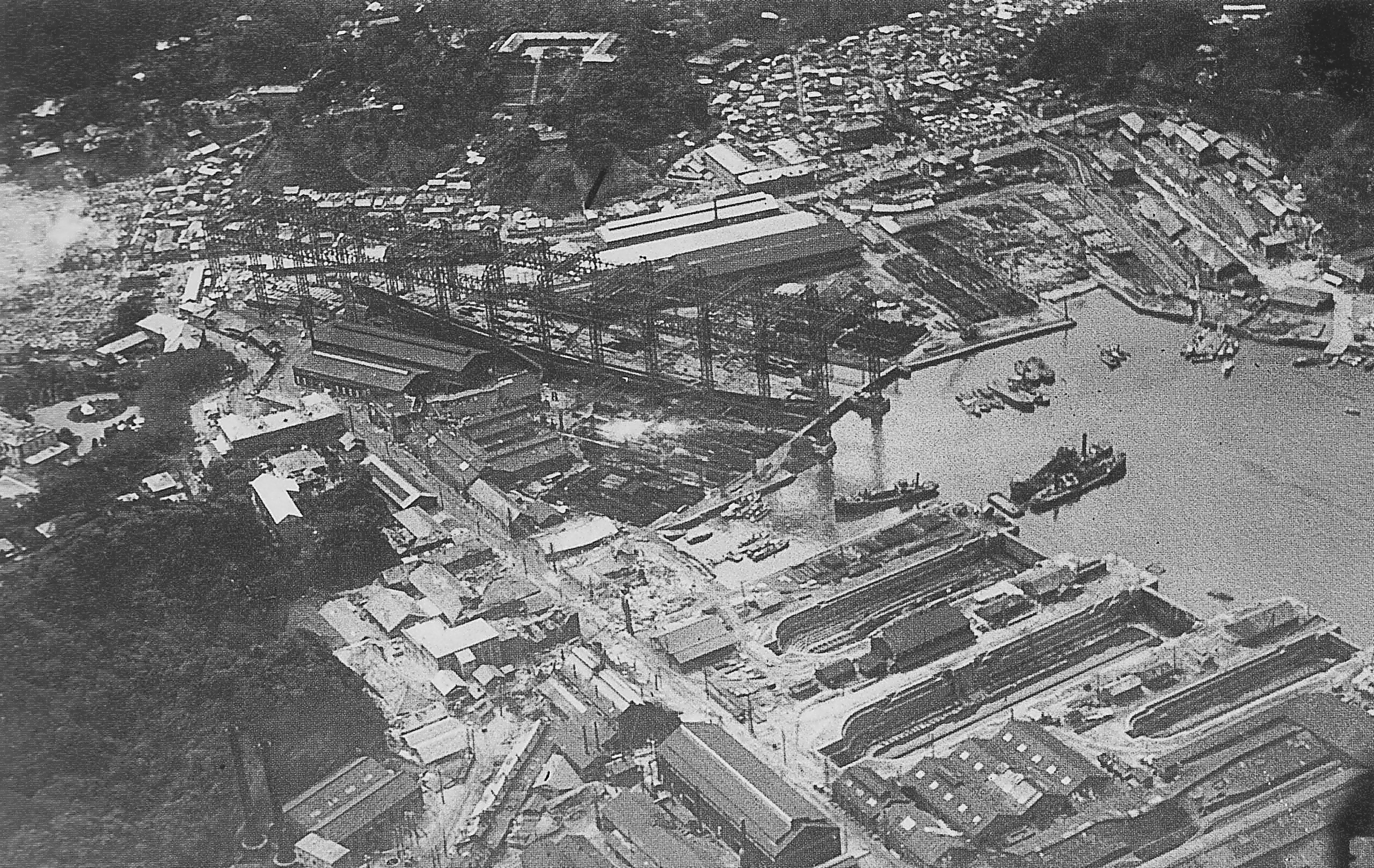
Two or three days after the ground moved beneath Sagami Bay on 1 September 1923, a camera looking down on Yokosuka Naval Arsenal recorded the yard as a field of collapsed sheds, buckled cranes, burned frontage and interrupted work, and in the middle of it, still held upright by the timbers and gantry of her building berth, the incomplete hull of the battlecruiser Amagi. The image preserved on Wikimedia Commons, attributed there to photographer Toshio Matsumura (松村壽雄), is dated in caption chains to the 3rd or 4th of September; the same aerial appears in the WW2DB caption record describing the arsenal after the quake with Amagi mid-conversion on the ways. It is one of the rare photographs in which the wreck of a naval industrial base and the end of a specific capital ship occupy the same frame.
The ship that was ordered twice
Amagi was laid down at Yokosuka Navy Yard on 16 December 1920 as the lead unit of a class of four fast, heavily armed battlecruisers, according to Pacific Wrecks, which renders her name as “Heaven Castle.” Her sister Akagi had been started earlier at Kure. They belonged to a building program that assumed the 1920s would be decided by ships that could outrun what they could not outfight, and outgun what they could catch.
That program did not survive the conference table. The Washington Naval Treaty of 1922 imposed capital ship limits that canceled the battlecruisers outright, but it left a door open: two incomplete capital ship hulls could be converted into aircraft carriers rather than broken up. Japan chose Amagi and Akagi. Pacific Wrecks puts each hull at roughly forty percent complete when the decision was made, a figure worth treating as an approximation rather than a survey.
So the ship in the 1923 photograph was already in her second identity. She was no longer being built as a battlecruiser and was not yet a carrier; she was a heavy, partially plated hull sitting where she had been laid down, with the flight deck, hangars and uptakes of the conversion still ahead of her. Contemporary captions place her on the building berth under the gantry rather than afloat or docked, which matters for what happened next: a hull on the ways rests on blocks and shores, distributing its weight into a slipway structure that was itself part of the arsenal’s fabric.
What the aerial shows
The 3 to 4 September frames show the arsenal as a wrecked industrial site. Yokosuka was not merely shaken; the British parliamentary record of 20 February 1924 summarized the naval dockyard there as severely damaged by earthquake and fire, with output expected to be limited for roughly twelve months. Those Hansard figures are a foreign summary of Japanese losses, and the monetary and oil-tonnage numbers quoted in that debate should be read as parliamentary estimate rather than dockyard ledger. What is not in dispute is the character of the damage visible from the air: shop roofs down, crane structures compromised, the working landscape of a first-rank naval yard rendered temporarily unusable.
Amagi herself was badly damaged in the quake while still under construction. The assessments that followed treated the hull as beyond economical repair for the carrier conversion, and the conversion was abandoned. Pacific Wrecks records that scrapping commenced in her building berth on 14 April 1924, a little over seven months after the photograph was taken.
There is a specific cruelty of engineering in that outcome. A hull on the ways is at its most vulnerable precisely because it is unfinished: framing not fully closed, decks not yet tying the structure together, weight sitting on a keel blocking arrangement designed for a controlled launch and not for seismic movement. The photograph does not let a reader measure that damage, and no responsible reading of it should try. It shows position, context and scale: a large hull in a broken yard, on a berth she would not leave under her own name.
Kaga instead, Akagi onward
Japan still held a treaty entitlement to two converted carriers, and the loss of Amagi meant finding another qualifying hull. The choice fell on the incomplete Tosa-class battleship Kaga, which was reordered for conversion in Amagi’s place, a substitution noted in the same February 1924 British parliamentary summary of Japanese naval earthquake damage and repeated across naval histories of the period, including standard reference accounts of the Amagi class. Akagi’s conversion continued, and she went on to serve as one of the Imperial Japanese Navy’s principal carriers.
That is the quiet arithmetic behind the picture. Two ships were meant to carry aircraft into the next war; one was replaced before her first launch by a hull originally designed as a battleship, and the pairing that shaped a decade of Japanese carrier doctrine was set not by a naval board’s preference but by where the ground happened to fail on a September morning.
Amagi never floated. She was laid down, redesignated, damaged and dismantled without ever having been launched, and the aerial taken on the 3rd or 4th of September 1923 is the clearest surviving view of her as an object rather than a plan: a battlecruiser hull that had been reassigned to become a carrier, sitting on its berth inside a wrecked arsenal, photographed from above in the days when the decision to abandon her had not yet been written down. Seven months later the scrappers began work in the same berth, and the ship in the frame became the only Amagi there would ever be.