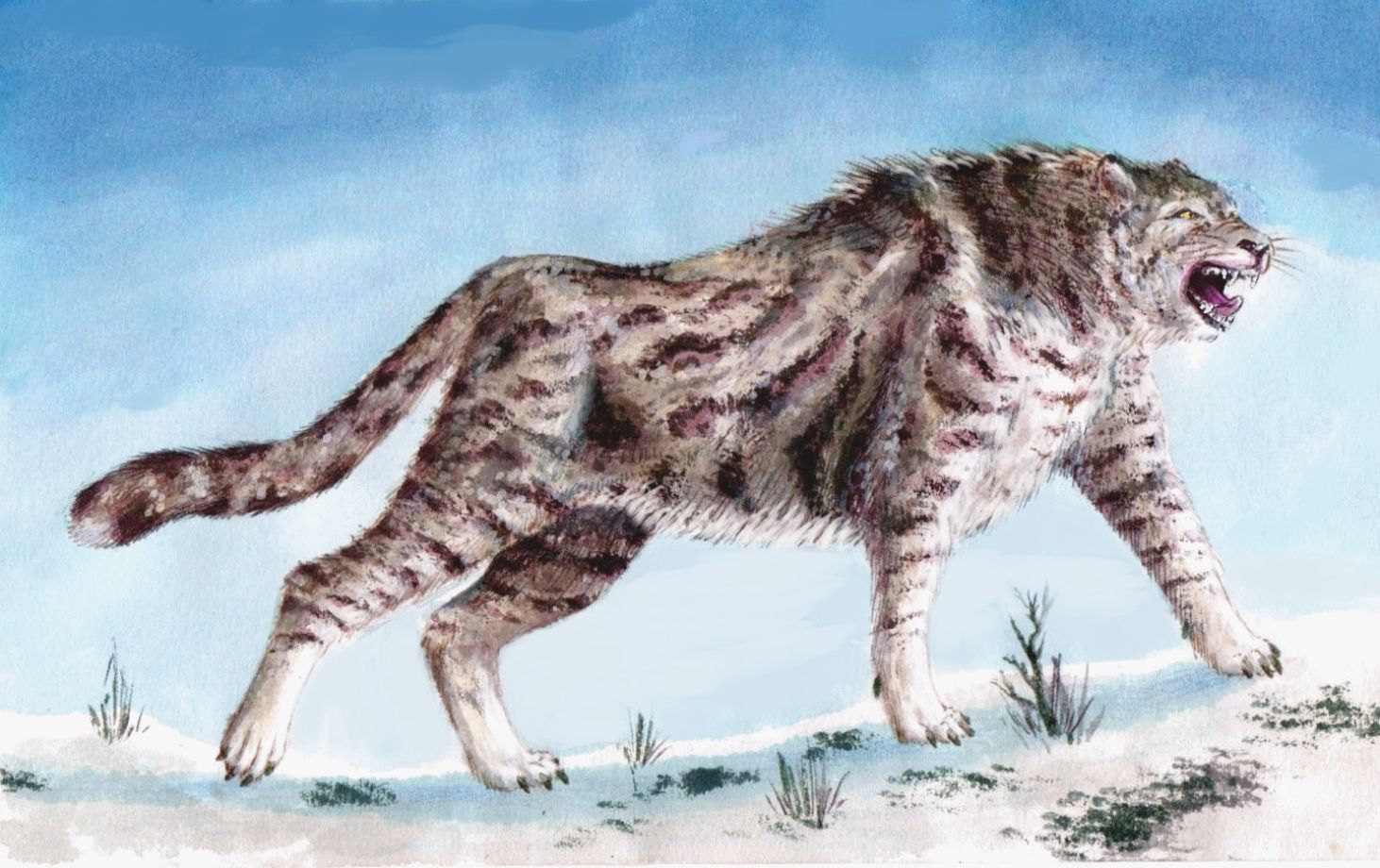
Three cat bones pulled from frozen Yukon ground — long shelved, two of them filed as pumas — carry the genome of Miracinonyx trumani, the extinct felid nicknamed the American cheetah, and radiocarbon dates of roughly 31,000 to 34,000 years, placing the animal deep inside the Arctic during a warm interval before the last glacial peak, with nitrogen isotope signals that the study’s authors read as a diet dominated by fish rather than the sprinting pronghorn hunts the nickname implies. The work, reported by phys.org and published by Molly Cassatt-Johnstone and colleagues in Current Biology, pairs four paleogenomes with stable isotope chemistry and pushes the cat’s known range more than 20 degrees of latitude north of where paleontologists had placed it — on the order of 1,400 miles beyond the temperate grasslands that anchored the old story.
The cheetah that never was
The nickname came from anatomy, and the anatomy is real. Miracinonyx had a light frame, elongated forelimbs, a shortened face, and enlarged nasal openings — the trademark package of an animal built to move oxygen fast while running fast. Its bones turned up in western North American deposits alongside pronghorn, the fastest surviving land mammal on the continent and one whose speed has long looked over-engineered for any predator alive today. From those pieces grew a tidy evolutionary parable: a New World cheetah analog that drove pronghorn to their present velocity, then vanished and left the antelope running from a ghost.
Nuclear DNA rearranges the family tree behind that parable. The sequenced genomes place M. trumani as the closest known relative of the living puma, Puma concolor, with the two lineages separating around 2.6 million years ago; the deeper node shared with true cheetahs, genus Acinonyx, sits back near 4.7 million years, per the phys.org account of the team’s analysis. That ordering matters. It means the cheetah-like build was assembled independently — convergence toward a common solution for open-country pursuit — rather than inherited from cheetah ancestors that wandered into the Americas. Miracinonyx is a puma cousin wearing a cheetah’s silhouette, and silhouettes, as this study underlines, are poor witnesses to behavior.
Two cats, two worlds
The four sequenced individuals split cleanly by geography. One comes from Natural Trap Cave in Wyoming, dated to roughly 23,000 years ago, in the range and habitat the species was expected to occupy. The other three come from Yukon Territory, from fossils recovered within the Traditional Territories of the Tr’ondëk Hwëch’in and Vuntut Gwitchin, and their dates of about 31,000 to 34,000 years place them in the interstadial conditions preceding the Last Glacial Maximum — a mammoth-steppe Arctic of grasses, sedges, long winter darkness, and a predator guild that, per the paper’s abstract, included cave lions, scimitar cats, wolves, brown bears, and short-faced bears.
Two of those Yukon specimens had been assigned to other cats, pumas among them, precisely because Miracinonyx was not supposed to be there. Mitochondrial and nuclear sequencing corrected the identification, which is the quiet methodological point inside the headline: range maps built from morphology alone can encode the assumption that produced them.
The chemistry is where the animal’s life diverges most sharply from the nickname. Stable isotope work led by the team, with Matthew Wooller of the University of Alaska Fairbanks among the collaborators, found that the Wyoming individual carried the markers of a generalist terrestrial carnivore taking herbivores — a profile comparable to lions from similar deposits. The Yukon individuals did not. Their nitrogen values run high, and the authors report those values as consistent with heavy reliance on anadromous fish such as salmon, with phys.org describing profiles that resemble those of fish-specialist killer whales and coastal sea wolves. The reading is isotopic, not observational: the tissue chemistry constrains trophic level and prey source, and the paper interprets it as fish specialization rather than as a record of any single hunt. Salmon runs would have concentrated dense, seasonal, predictable protein along northern rivers — the kind of resource that rewards a cat willing to abandon the open-country chase.
An adaptable cat, not a one-trick sprinter
The genomes add a further hint about life at high latitude. The team reports loss-of-function changes in two genes involved in circadian regulation — a suggestive result for animals living where daylight collapses to a few hours in winter and barely retreats in summer, and one the authors treat as a possible signal of altered activity timing or nocturnality rather than a demonstrated adaptation. Loss-of-function variants can indicate relaxed constraint as easily as directional selection, and the paper does not push further than the data allow.
What the combined evidence describes is a felid with far more ecological range than a pursuit specialist should have: temperate grasslands in the mid-continent, Arctic steppe-tundra above the Arctic Circle, terrestrial herbivores in one setting and, by the isotopic reading, fish in the other. Beth Shapiro of UC Santa Cruz and Cassatt-Johnstone, the paper’s first author, frame the animal in those terms — a lineage whose flexibility, not its speed, is the durable finding. The genomes also carry signals of low diversity and long-term population decline, context the authors offer cautiously and without assigning a single cause to the species’ disappearance near the end of the Pleistocene.
The pronghorn-chaser story is not disproven so much as demoted from biography to hypothesis about one population in one landscape. What the ancient DNA and isotopes establish, as reported in Current Biology (DOI 10.1016/j.cub.2026.07.072), is that Miracinonyx trumani lived far into the Arctic 31,000 to 34,000 years ago, that it was a close relative of the puma rather than a true cheetah, and that its northern individuals carried the chemical signature of a diet built on fish.