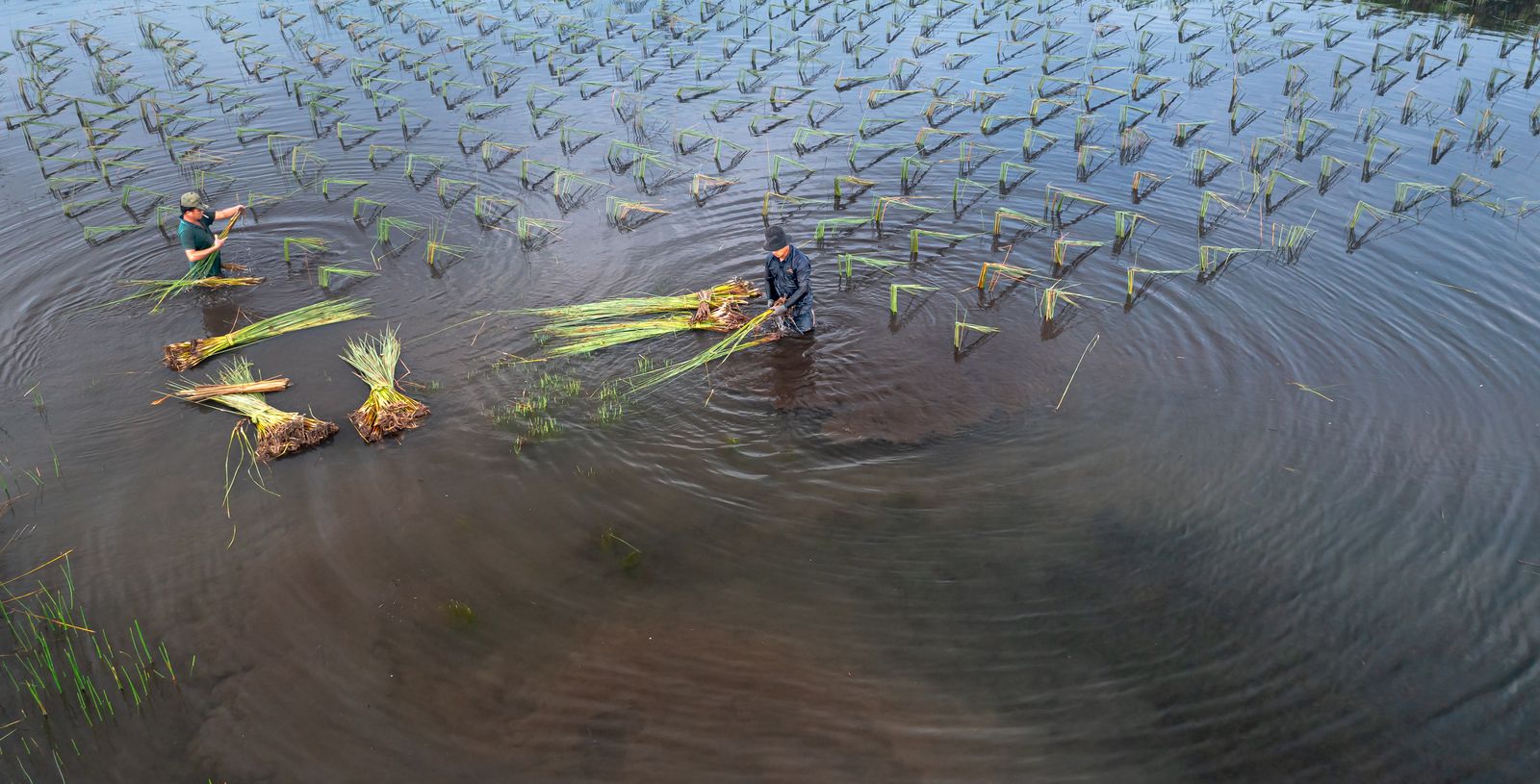
When a bulldozer or a controlled winter flood punches a gap in an earthen levee along the Sacramento River, something that used to happen every winter starts happening again. Water spreads sideways across flat land that grew rice all summer. Sunlight hits warm, shallow pools studded with rotting rice straw. Zooplankton explode. And juvenile Chinook salmon, dropped into those flooded fields by hatchery trucks, put on weight two to five times faster than salmon of the same age stuck in the leveed main channel a few hundred metres away.
The mechanism is not mysterious. Winter-flooded rice fields support far more zooplankton — the tiny crustaceans a fry-sized salmon eats — than the adjacent Sacramento River. That is the whole story compressed into one ratio. Break the levee, sunlight reaches shallow water, decomposing rice straw feeds the base of the food web, and a fish that would otherwise starve in a fast, cold, sterile canal grows into a smolt strong enough to survive the Delta and reach the Pacific.
The floodplain California erased
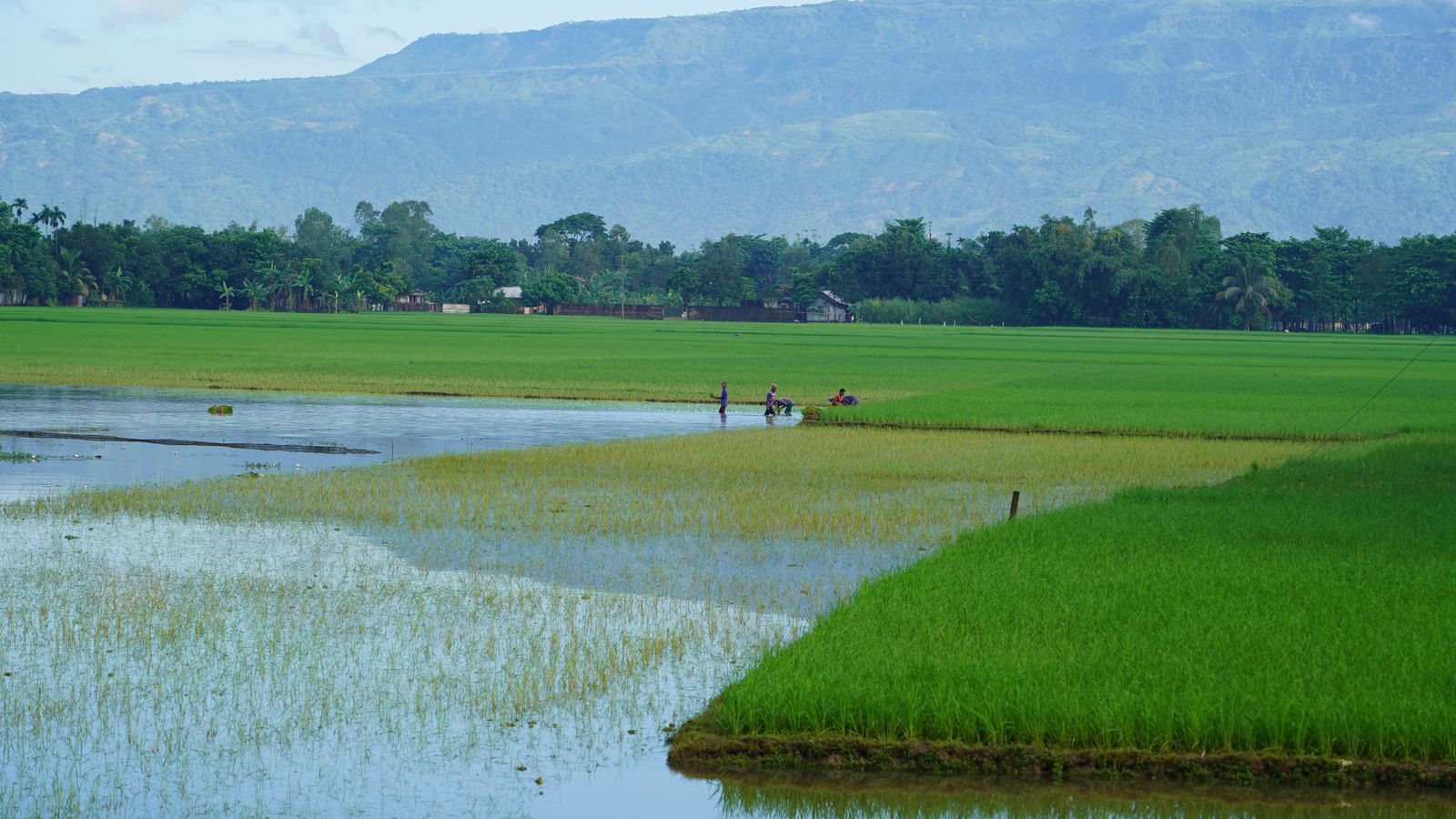
Before the levees, the Sacramento Valley in winter was one of the largest freshwater floodplains on the Pacific coast of North America. Snowmelt and winter storms pushed the Sacramento and its tributaries out of their banks and across hundreds of thousands of acres of tule marsh and seasonal wetland. Juvenile Chinook drifting downstream spent weeks or months in that warm, food-rich sheet of water, fattening before they hit salt.
Then came the levees. Starting in the late 19th century, farmers and the U.S. Army Corps of Engineers walled off the river to protect towns and to reclaim the bottomlands for agriculture. The main channel got faster, deeper and colder. The floodplain got drier and, eventually, planted mostly in rice. Jacob Katz, senior scientist at California Trout, puts the loss in one line: The food used to be on the landscape, he told Comstock’s magazine. Restricted to narrow channels, young salmon are starved of the calories they need for the run to the sea.
The population crashed. California’s ocean commercial salmon fishery was closed for three consecutive years — 2023, 2024 and 2025, the longest run of closures the fishery has seen — with recreational anglers limited to only a handful of restricted days in 2025 and no commercial catch permitted at all that year. The closures gutted the fleet from Monterey Bay to the Oregon border; commercial fishing did not resume, under new trip limits and harvest guidelines, until 2026.
What a breach actually does
An earthen levee along a Central Valley river is a berm of packed dirt, usually five to twenty feet high, running parallel to the channel. Breach one — deliberately, through a gated notch, or opportunistically during a high-water event — and the physics reverses. Water that had been racing downstream at a metre or two per second spreads laterally across a nearly flat surface. Depth drops to inches. Velocity drops to almost zero. Sunlight, which barely penetrates a turbid, deep channel, hits the bottom.
Warm, shallow, sunlit, still water with a carbon source — in this case, the leftover rice straw from the fall harvest — is a zooplankton factory. Copepods, cladocerans and midge larvae hatch and multiply in days. A three-inch salmon fry dropped into that soup is doing what its ancestors did every winter for ten thousand years: eating almost continuously in water warm enough to accelerate its metabolism.
The growth-rate finding comes from a multi-year experiment on Knaggs Ranch, a working rice farm on the Yolo Bypass. Scientists released marked fall-run Chinook fry into winter-flooded fields and compared their growth and survival to fry in the adjacent Sacramento River. They tested variables: leftover rice straw versus stubble disced under, deeper refuge pools, fast versus slow drainage.
Most of the tinkering did not matter much. Food did. Fields carried far more zooplankton by volume than the river, and salmon in those fields grew two to five times faster than the river-reared controls. Survival stabilised after an initial period. The experiment ran during one of the worst droughts in California history, and the fields still worked.
From experiment to two million fish a year
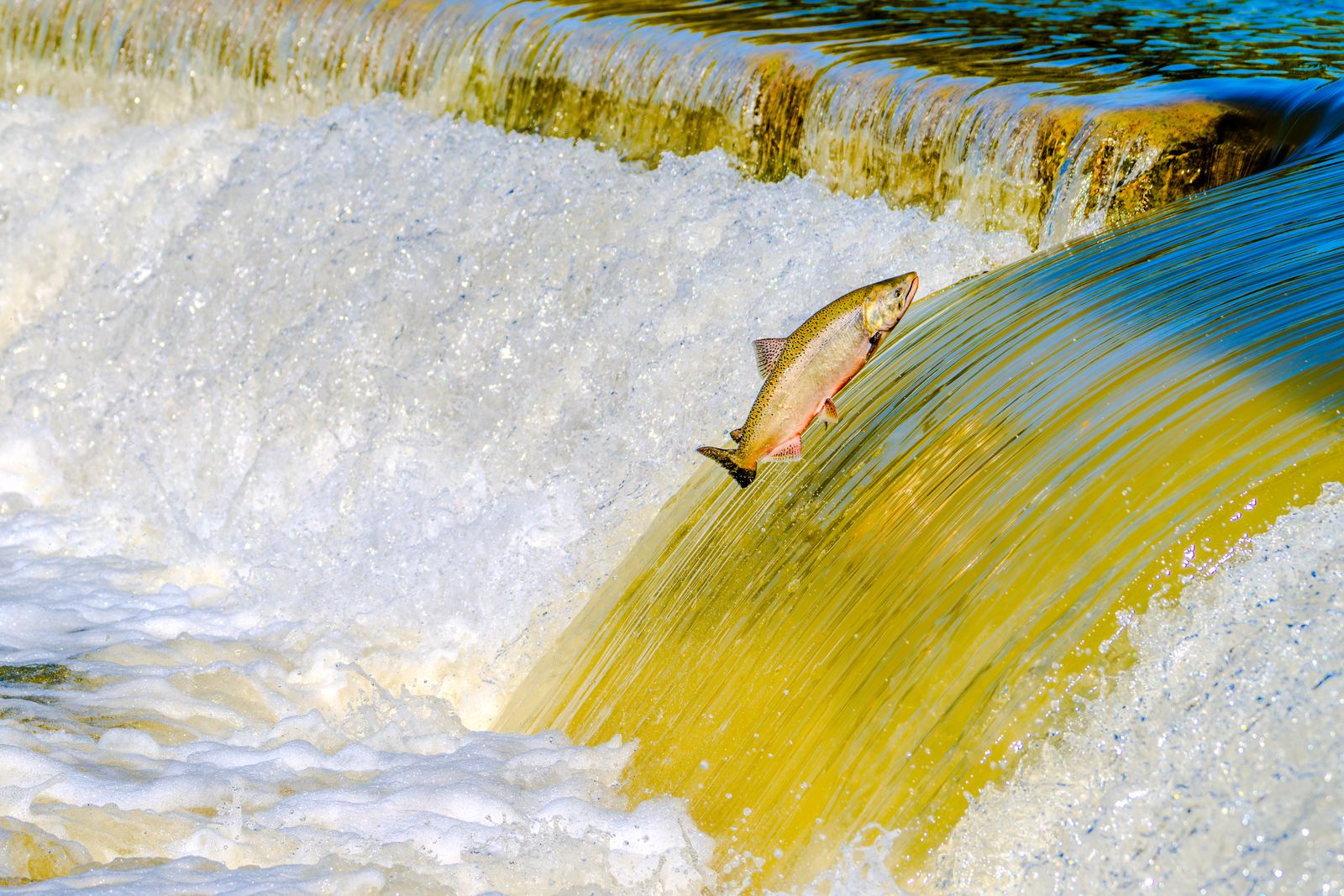
What began as a single-farm science project has scaled. In January 2026, a coalition called The Bridge Group — rice farmers, commercial fishermen, water agencies and conservationists, working with the U.S. Fish and Wildlife Service’s Coleman National Fish Hatchery — released 1.8 million fall-run Chinook fry into winter-flooded fields at Conaway Ranch and Knaggs Ranch in Yolo County. Under a ten-year plan drafted with U.S. Fish and Wildlife, roughly two million hatchery fry a year will be placed in floodplain rice fields and tracked with parentage-based genetic monitoring back to the ocean and, ideally, back up the river as returning adults.
The Bridge Group is an unusual alliance. It includes the Pacific Coast Federation of Fishermen’s Associations, the Golden Gate Fishermen’s Association, the NorCal Guides and Sportsmen’s Association, the Northern California Water Association, the Sacramento River Settlement Contractors and the California Rice Commission — groups that have spent decades on opposite sides of California water litigation. The strategy involves diversifying hatchery release methods so different cohorts can respond to different hydrological years, and tracking juvenile survival, harvest contribution, and adult river return rates over the next three to four years will help determine which release methods perform best.
The rice straw is doing quiet, important work. After the fall harvest, growers in the Sacramento Valley used to burn the residue. Under state law that phased out most burning, farmers now flood fields to decompose the straw over winter. Those flooded fields were originally a waterbird boon — the Central Valley sits under the Pacific Flyway, and rice acreage now substitutes for the tule marshes that migratory ducks and geese lost a century ago.
Salmon are the newer beneficiary. The same decomposing straw that feeds midges and copepods for waterbirds also feeds them for fish. All the rice-field project does is add a gated notch or a pumped connection so the bug-rich water — and, in the direct release programs, the fish themselves — can move between field and river. Some projects use custom fish gates to let juvenile salmon swim off the floodplain as waters recede.
Why the main channel is a starvation corridor
To understand why a broken levee helps, look at what the intact levee does. A leveed Sacramento River is engineered for one job: move water and boats downstream fast. The channel is deep, the banks are hard, the flow is cold snowmelt released from Shasta Dam upstream. Sunlight barely reaches the bottom. Aquatic insects and zooplankton, which need warm shallow edges to reproduce, have almost nowhere to live. A juvenile salmon migrating down that pipe burns calories fighting current and finds almost none to replace them.
The Delta at the downstream end compounds the problem. Water diversions to Central Valley farms and Southern California cities pull fish toward pumps. Rising temperatures stress cold-water species. Non-native predators — striped bass, largemouth bass — eat undersized smolts. A four-inch smolt has a poor chance of making it through. A six-inch smolt, fattened on rice-field zooplankton, has a much better one. Size at ocean entry is a strong predictor of adult return in Chinook, which is why the two-to-five-times growth differential matters more than the raw number sounds.
The politics of a hole in a wall
Deliberately breaching or notching a levee is a political act in California. Levees protect towns, roads and farmland. The state has spent more than a century, and billions of dollars, building them higher. Reversing that logic — paying farmers to flood their own fields, cutting notches so water can escape sideways — asks a delta society to unlearn something it thought it knew.
The Netherlands went through a version of this reckoning, as Spacewar has covered, deliberately breaching dykes under its Room for the River program after four centuries of building them higher. California’s version is smaller, more piecemeal, and driven as much by an endangered fish as by flood safety. The Floodplain Forward Coalition — Audubon, California Trout, Ducks Unlimited, the California Rice Commission, water suppliers — has spent a decade building the political scaffolding to make winter flooding of farmland a legitimate tool. Governor Gavin Newsom’s Healthy Rivers and Landscapes Program, folded into the State Water Resources Control Board’s draft Sacramento River watershed plan in July 2025, leans heavily on that work.
Not everyone is convinced. Some environmental groups argue the plan does not release enough cold water down the main channel and leans too hard on floodplain habitat as a substitute for flow. The debate is real. But the growth-rate data from Knaggs Ranch is not in dispute, and neither is the food ratio.
The next several years will settle the harder question: does a fatter smolt become a returning adult? The Bridge Group’s parentage-based genetic monitoring assigns every hatchery fry a genetic fingerprint from its parents, so when adults are caught in the ocean fishery or counted back at Coleman Hatchery in three or four years, biologists can tell which release method produced them. It is the closest thing salmon management has to a controlled trial at industrial scale.
The wider context is that floodplain reconnection is quietly working in a lot of places. Spacewar has reported on a 25-acre Lake Erie wetland where sonar logged about 3.44 million fish detections in roughly 2,022 monitoring hours after reconnection, and on a New England river where Atlantic salmon returned to spawning grounds they had not reached in about 200 years after a dam came out. Fish respond, and quickly, when the geometry of the river returns to something closer to what they evolved in.
What a rice field looks like in February
Stand on a Yolo Bypass levee in late January and the view is not dramatic. A grey sheet of water, six inches deep, spreads across a thousand acres of stubble. Rice straw pokes up in yellow tufts. Sandhill cranes and tundra swans work the edges. Somewhere in the middle, if a hatchery truck has come through that morning, a hundred thousand fingerling Chinook are dispersing into the shallows, finding zooplankton that were not there in December, and starting to grow at a rate their siblings in the concrete-hard main channel a mile east will not match.
Six weeks later the field is drained, the salmon pour through a gate into the Sacramento, and the rice farmer starts prepping the same ground for a spring planting. The levee, most of the year, holds. In winter, briefly, it does not — and that is the point.