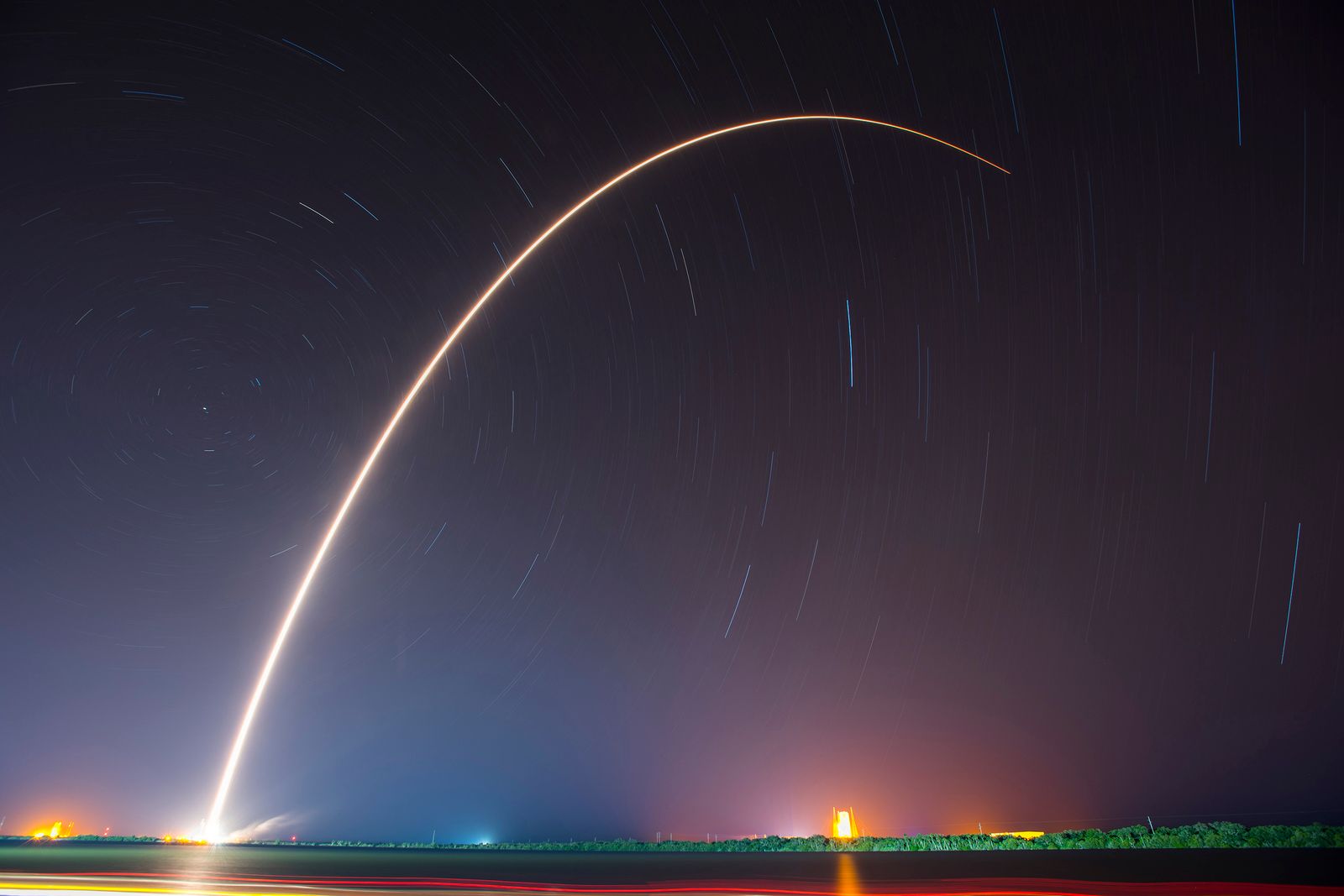
The observatory that lifted off from Kennedy Space Center on the morning of August 30, 2026 carries the name of a woman who joined NASA in 1959 and became the agency’s first chief of astronomy and its first female executive. Nancy Grace Roman spent the next two decades building NASA’s space-astronomy program, championing the large space telescope that became Hubble and laying institutional groundwork that NASA now connects to the broader Great Observatories program. Roman launched aboard a SpaceX Falcon Heavy from Launch Complex 39A.
Roman herself died in 2018 at 93. Her namesake observatory is a wide-field infrared survey telescope with a 2.4-meter primary mirror, the same diameter as Hubble’s, but a field of view dramatically larger. NASA’s established mission plan puts Roman’s total lifecycle cost at about $4.3 billion.
The astronomer who wasn’t supposed to be an astronomer
Roman was born in Nashville in 1925. At eleven, while living in Reno, Nevada, she organized an astronomy club with classmates. As she moved through school, she repeatedly encountered the assumption that advanced mathematics and astronomy were unusual choices for a girl, an attitude she refused to let determine her direction.
She earned her PhD in astronomy from the University of Chicago in 1949 and remained at the university for another six years, working primarily at Yerkes Observatory. Her stellar research helped connect differences in stars’ chemical composition with differences in their motion through the Milky Way, providing evidence that ordinary stars did not all belong to the same-age population. NASA’s biography records both that work and the barriers she encountered as a woman seeking an academic career.
Roman moved to the Naval Research Laboratory in 1955 and worked in radio astronomy before joining NASA in early 1959, only months after the agency was formed. She later described the chance to create a space-astronomy program from scratch as too important to resist.
What a chief of astronomy actually does
The title was not ceremonial. Roman’s responsibilities included planning programs of satellites and rockets, administering grants and translating the astronomical community’s ambitions into projects that NASA could fund, engineer and defend before the federal government.
Her work touched missions including the Orbiting Solar Observatories, Orbiting Astronomical Observatories and International Ultraviolet Explorer, as well as planning that fed into later major observatories. That institutional work helped make space-based astronomy a sustained NASA program rather than a collection of isolated experiments.
The most consequential campaign, however, centered on the telescope that became Hubble.
Mother of Hubble
Physicist Lyman Spitzer had argued for a large telescope above Earth’s atmosphere as early as 1946. Turning that scientific idea into a funded NASA mission required years of technical definition, political support and agreement among astronomers about what the observatory needed to do.
Roman led science and planning committees, brought scientists and engineers together, briefed executive-branch officials and pushed for NASA approval of what was then called the Large Space Telescope. She also worked to secure congressional support and funding, becoming a bridge between the scientific community and Washington.
Roman retired from NASA in 1979, more than a decade before Hubble launched in April 1990. Her successor Edward Weiler later helped popularize the nickname “Mother of Hubble,” recognizing the years of organizational and political work that came before the spacecraft itself reached orbit.
The Great Observatories, one by one
The Great Observatories program brought together four major space telescopes designed to examine the universe across different parts of the electromagnetic spectrum. Hubble launched in 1990, the Compton Gamma Ray Observatory in 1991, Chandra in 1999 and Spitzer in 2003.
Roman was retired by the time any of those four observatories launched, so her role should not be confused with personally managing each spacecraft through construction and flight. But NASA describes her as the driving force behind its entire Great Observatories program, crediting the scientific and institutional framework she built during her years at the agency.
That distinction matters. Roman’s legacy was not that she personally assembled four telescopes. It was that she helped establish the kind of NASA space-astronomy program in which projects of that scale could be proposed, defended, funded and eventually flown.
Why the new telescope carries her name
The observatory was originally known as WFIRST, the Wide Field Infrared Survey Telescope. NASA renamed it the Nancy Grace Roman Space Telescope in May 2020, explicitly tying the mission to Roman’s role in making space-based astronomy a central part of the agency’s science program.
The hardware makes the connection particularly visible. Roman’s primary mirror is 2.4 meters across, the same diameter as Hubble’s, but its Wide Field Instrument is built to see vastly more sky in each exposure. NASA describes the WFI as a roughly 300-megapixel camera built around an array of 18 detectors, giving the telescope Hubble-class sharpness across a much wider field.
Roman also carries a Coronagraph Instrument technology demonstration. Using masks, deformable mirrors and active control of scattered starlight, the instrument is designed to detect planets about 100 million times fainter than their stars. Existing telescopes, including Hubble and Webb, have already used coronagraphs and other techniques for direct imaging; Roman’s advance is the much greater contrast it is intended to demonstrate for future missions seeking smaller and fainter worlds.
What Roman will actually see
Roman is now traveling roughly a million miles from Earth toward an orbit around the second Sun-Earth Lagrange point, or L2, the same general region used by the James Webb Space Telescope. Its wide-field surveys will repeatedly map enormous areas of sky rather than concentrating only on individual targets.
The mission’s science spans dark energy, dark matter, galaxies, stars and exoplanets. NASA projects that Roman’s surveys could uncover roughly 100,000 new exoplanets while building an enormous public archive and mapping billions of galaxies.
For cosmology, Roman will track how galaxies and exploding stars are distributed across cosmic time, testing models of how the universe has expanded and how large-scale structure has grown. For planets, repeated observations toward crowded regions of the Milky Way will use gravitational microlensing, transits and other techniques to find worlds that conventional planet searches can miss.
Roman is not expected simply to prove that today’s standard cosmological model is wrong. NASA describes the situation more cautiously: new observations may show that the model needs an update, or they may show that it remains sound. Roman’s value is its ability to collect enough precise data to distinguish between those possibilities.
The hardware and the price tag
Roman will extend more than 42 feet when fully deployed, with a mirror the same diameter as Hubble’s and a vastly larger focal plane. The Falcon Heavy that launched it used 27 Merlin engines; NASA reported more than 5 million pounds of thrust during ascent.
The 2.4-meter primary mirror also has an unusual history. Key optics, including the primary mirror, were made available to NASA by the National Reconnaissance Office. L3Harris Technologies in Rochester, New York, reshaped the inherited mirror and integrated it into Roman’s Optical Telescope Assembly so that it could meet the mission’s infrared-survey requirements.
That history gives Roman a physical connection between two very different kinds of space hardware: optics inherited from a reconnaissance program, adapted into a telescope intended to map galaxies, dark matter and planets across the universe.
The survey machine and the discoveries nobody scheduled
Roman’s operating model differs in important ways from the traditional image of an astronomer winning time for one carefully chosen target. Much of the mission is organized around large community-defined surveys that will repeatedly sweep broad regions of sky, creating datasets capable of serving many investigations at once.
The access model is equally important. NASA says Roman’s data will have no proprietary period, allowing researchers to work with the observations without waiting for an original observing team to finish using them.
That makes unexpected discoveries part of the mission’s design rather than an accident at its edges. A wide survey built to measure dark energy can also reveal unusual stars, distant galaxies, moving objects and transient events that nobody knew to request in advance.
What she left behind
Nancy Grace Roman remained engaged with astronomy and science outreach long after leaving NASA. She lived to see Hubble transform astronomy, Compton map the gamma-ray sky, Chandra open a sharper view of the X-ray universe and Spitzer explore the infrared cosmos.
She did not live to see Webb launch. Roman died on December 25, 2018, exactly three years before the James Webb Space Telescope lifted off on December 25, 2021. Nor did she live to see the observatory that would eventually carry her own name leave Earth.
That observatory is now in its commissioning journey toward L2. NASA expects Roman’s first images in early 2027, after the spacecraft completes deployments, calibrations and instrument tests. When those first wide infrared mosaics arrive from nearly a million miles away, they will come from a survey machine bearing the name of an astronomer who began by studying stellar populations one spectrum at a time.